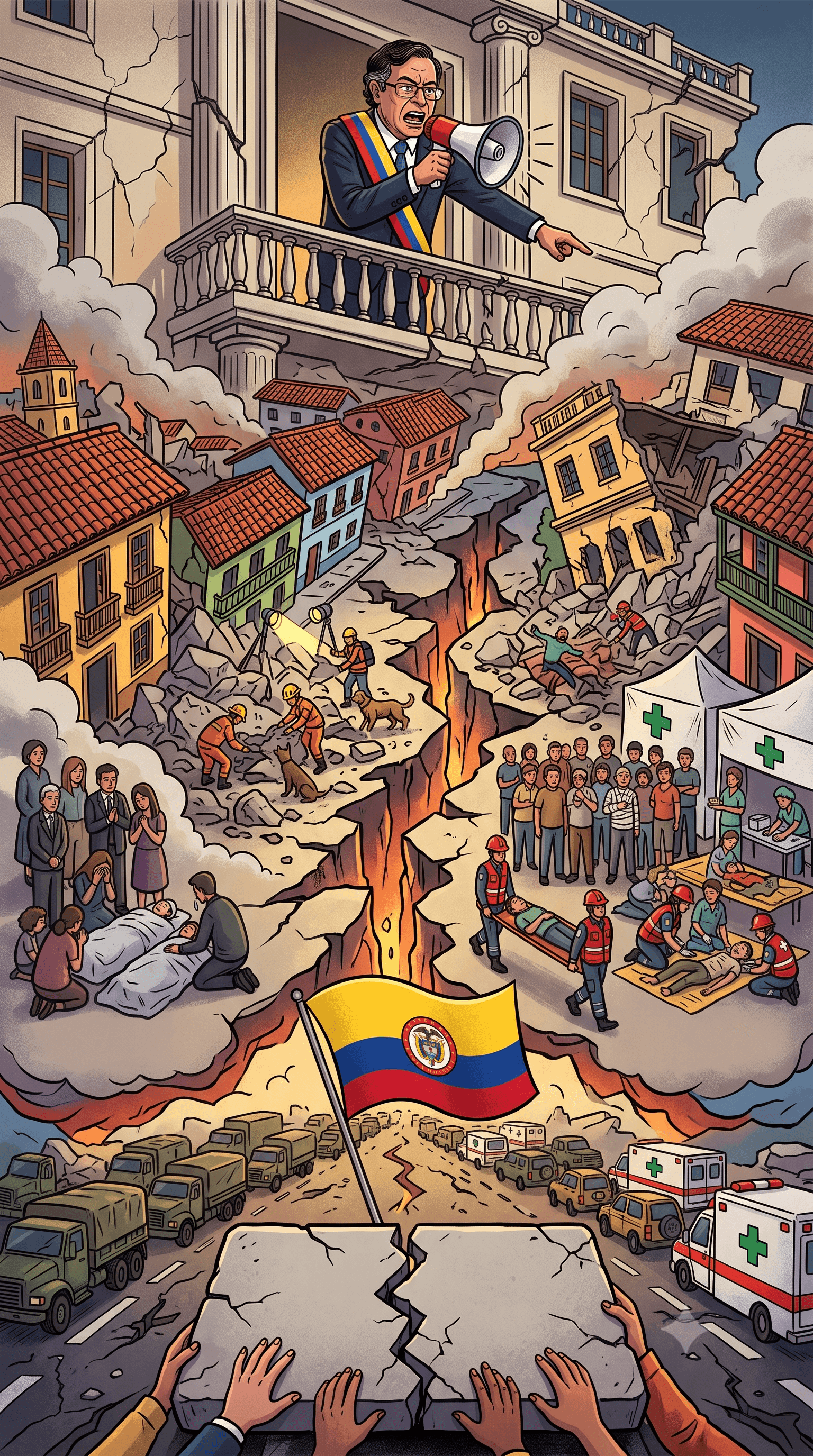
(BOGOTA, Colombia) — A powerful 7.4-magnitude earthquake struck western Colombia early Monday morning, leaving at least 111 people dead and 87 injured in its devastating wake. The massive tremor brought down dozens of buildings, damaged crucial infrastructure, and prompted the newly inaugurated government to declare a national state of emergency as search and rescue operations scramble to find survivors trapped beneath the rubble.
Epicenter in Chocó and Immediate Impact
The United States Geological Survey (USGS) reported that the earthquake struck at approximately 7:34 a.m. local time (12:34 UTC) on August 10, 2026. The epicenter was located about 5 kilometers east of San Jose del Palmar, a rural community in Colombia’s heavily forested Chocó department, at a depth of roughly 107 kilometers.
While the epicenter was rooted in the Pacific coastal region—a historically impoverished and largely rural area—the violent tremors were felt across major metropolitan areas nationwide, including the capital city of Bogota, over 250 miles away. Residents in neighboring countries, including Ecuador, Panama, and Venezuela, also reported feeling the earth shake, though local authorities outside Colombia confirmed no significant damage.
The US Tsunami Warning System quickly confirmed that there was no tsunami threat to the Pacific coast following the seismic event. However, the sheer force of the tremor has severely crippled local infrastructure, marking it as the strongest earthquake to hit Colombia in the past decade, according to the Colombian Geological Service.
Widespread Devastation Across Key Cities
The human and structural toll has been catastrophic, with casualties heavily concentrated in Colombia's western-central provinces. President Abelardo de la Espriella reported that over 1,500 residential buildings sustained damage, with at least 61 structures completely collapsing. Furthermore, the earthquake damaged 52 schools, 18 health centers, and multiple community hubs.
The department of Risaralda emerged as one of the hardest-hit zones. Local officials, including Risaralda Governor Juan Diego Patino, confirmed at least 40 fatalities in the region. The provincial capital, Pereira, experienced severe destruction, including a partial roof collapse at the Matecaña International Airport, which claimed three lives.
In the Valle del Cauca department, at least 27 people were killed. Cali, Colombia's third-largest city, saw intense destruction. Cali Mayor Alejandro Eder stated that at least 30 buildings collapsed across the municipality, trapping an unknown number of residents. Emergency responders, aided by civilians forming human chains, are working frantically to clear debris.
In Manizales, located in the Caldas department, Mayor Jorge Eduardo Rojas confirmed three deaths and extensive structural damage, including the tragic collapse of a tower at the city's iconic neo-Gothic Metropolitan Cathedral Basilica. Meanwhile, Chocó Governor Nubia Carolina Córdoba-Curi reported at least nine deaths in the regional capital of Quibdó, warning that the final toll could rise as rescue teams access isolated areas.
A Baptism by Fire for the New Administration
The catastrophe presents a monumental challenge for President Abelardo de la Espriella, who was sworn into office just days prior. Facing his administration's first major crisis, the right-wing leader swiftly declared a national state of emergency, directing immediate federal funding and resources toward search, rescue, and recovery operations.
"The national government has all of its capabilities deployed to protect lives, assist affected communities and deliver aid wherever it is needed," De la Espriella announced in a midday national address. "The first priority is rescuing the people trapped under the rubble. We aren't going to leave people alone."
The president has convened an emergency committee and established a unified command post to coordinate disaster relief. Furthermore, the national civil aviation authority has suspended operations at six regional airports—including Pereira, Manizales, Quibdó, Armenia, Cartago, and Buenaventura—to assess runway damages and prioritize emergency military and medical flights.
International Solidarity and Aid Pledges
The global community has rapidly mobilized to offer support to the South American nation. Given President De la Espriella's strong diplomatic ties with the United States, Washington was quick to respond. US Secretary of State Marco Rubio stated that the US administration is closely monitoring the situation and "stands ready to support the people of Colombia."
The European Union has also pledged significant logistical assistance. EU Commission President Ursula von der Leyen announced that Europe has activated its Copernicus satellite service to provide real-time mapping data to aid Colombian rescue operations. Additional offers of specialized disaster relief and financial aid have poured in from Israel, Mexico, France, and the United Nations.
Lingering Trauma and the Ring of Fire
Colombia's western coast sits directly on the "Ring of Fire," a horseshoe-shaped belt of intense seismic and volcanic activity that spans the Pacific Ocean. Monday's earthquake has revived painful memories for a region uniquely vulnerable to geological disasters.
For many Colombians, the devastation echoes the tragic 1999 Armenia earthquake, a 6.1-magnitude tremor that killed an estimated 1,200 people in the country's Coffee Cultural Landscape. The 1999 disaster fundamentally reshaped Colombia's approach to structural engineering, leading to strict seismic building codes. However, as Monday's collapses demonstrate, older infrastructure and rural buildings remain highly susceptible.
Furthermore, Latin America is already reeling from a recent massive seismic tragedy. In June 2026, a devastating pair of earthquakes struck neighboring Venezuela, leaving over 6,000 people dead. The psychological and economic toll of back-to-back continental disasters is expected to weigh heavily on regional recovery efforts.
Outlook and Next Steps
As the crucial 72-hour search and rescue window closes, Colombia faces a grim and arduous path to recovery. The immediate priority remains extracting survivors and treating the 87 individuals currently hospitalized with injuries. However, the economic implications of the 7.4-magnitude earthquake will be long-lasting.
Rebuilding the deeply affected Chocó, Risaralda, and Valle del Cauca departments will require a massive influx of state and international funds. For President De la Espriella, effectively managing the logistics of temporary housing, infrastructure repair, and long-term economic relief will heavily define the early legacy of his presidency. As aftershocks continue to rattle the Andes, the resilience of the Colombian people will once again be tested in the face of profound natural adversity.
In times of emergency, every donation can make a difference. If you’re able to contribute, please consider supporting emergency relief efforts and helping families and communities affected.
🙏 Every contribution counts. Please donate here paypal.me/utkarshjaiswal
#Colombia #ColombiaNeedsUs #Donate #EmergencyRelief #HelpColombia #HumanitarianAid #Solidarity