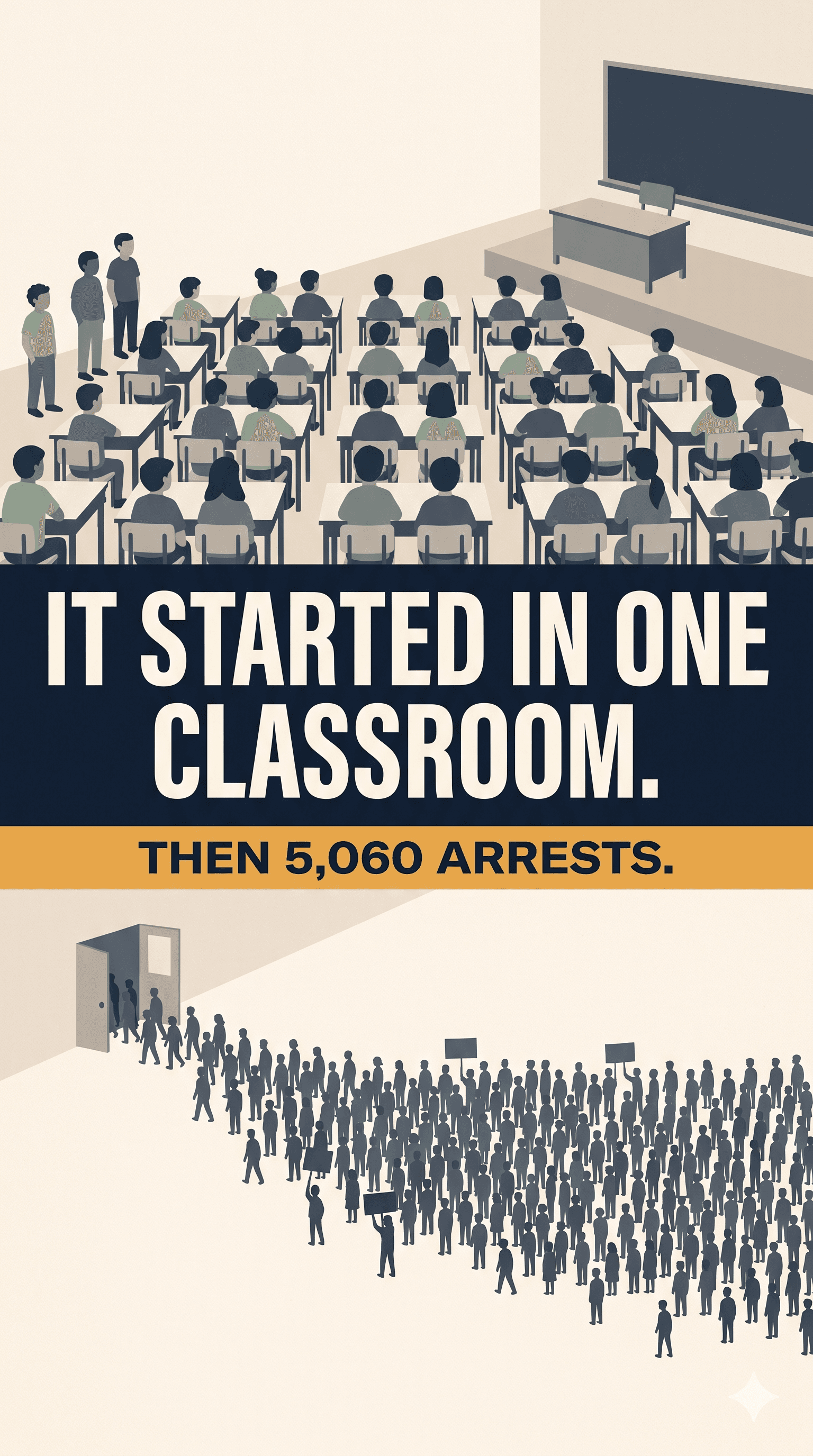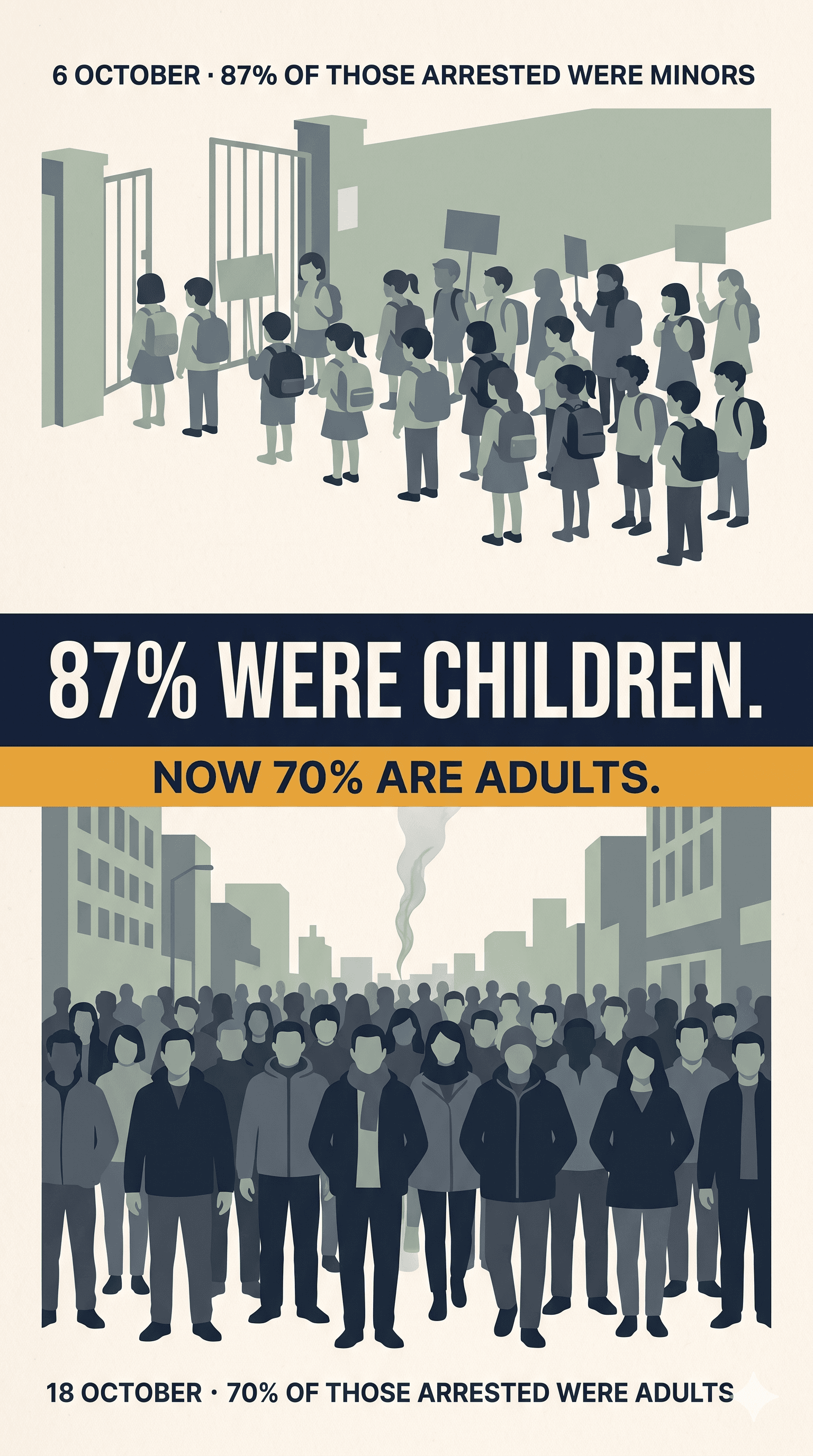
On 6 October, France's Justice Ministry reported 5,060 arrests in the school protests, and said 87% of them were minors.
On 19 October, after the worst weekend of unrest in years, Justice Minister Gérald Darmanin said more than 2,330 people had been taken into custody over the weekend — and that 70% of them were adults.
That is the story. Not the fires, not the arrest totals. The arrest demographics inverted in thirteen days.
The movement that began on 18 September with schoolchildren in Créteil complaining about class sizes of 32 to 36 and a French teacher who never arrived is, by the state's own count, no longer mostly made of schoolchildren. Something else is now using the same streets.
WHAT HAPPENED THIS WEEKEND
Saturday 17 October. Hundreds of thousands marched in more than 140 cities. The CGT claimed over 500,000 nationwide — its own figure. About 60,000 police and gendarmes were deployed.
The damage. Looting and arson in several cities, with town halls and police stations attacked. Lyon's tourist office was burned. Hundreds of businesses were vandalised across Île-de-France.
The cost. More than 2,300 arrested. Almost 1,000 police and gendarmes injured. At least one demonstrator lost a hand to a police crowd-control grenade. On Monday, protesters blocked access to the Louvre and forced it to close.
The admission. Interior Minister Laurent Nuñez said police had "lost control" on Saturday and cited a "lack of anticipation" in how security forces were deployed. On the shops: "you couldn't look shopkeepers in the eye after hundreds of shops had been looted."
He offered to resign. Macron refused. The Élysée said the President wanted him to stay so the police chain of command stayed intact, and asked him to "take all necessary steps to ensure transparency over the failures in planning and intelligence."
The response. Prime Minister Sébastien Lecornu called for partial, localised curfews rather than a national one — "It is out of the question to put all of Paris under curfew." Curfews were set from 8pm to 6am in Lille and three nearby communes, and from 11pm to 6am around Place de la République and Les Halles in Paris. A state of emergency remains possible; Lecornu said partial curfews seemed "more appropriate" for now.
WHY THE DEMOGRAPHIC FLIP MATTERS
Three readings, and we are not picking one.
One: the movement broadened, as French movements do. Unions, nurses, firefighters, parents and the remnants of the gilets jaunes joined. More adults in the street means more adults arrested. On this reading the flip is just arithmetic, and the original grievance is still the engine.
Two: the movement was captured. A legible, sympathetic complaint about schools became a vehicle for a cost-of-living fight that was already there, waiting. The government says the far left organised it. La France Insoumise says it was spontaneous. A Figaro poll earlier this month found 62% thought the protests justified and 78% thought LFI was exploiting them — the French public apparently believes both.
Three: policing changed, not the crowd. Arrest statistics measure who gets arrested, not who turns up. A riot squad on a Saturday night in central Paris encounters a different population than officers clearing a blockaded lycée on a Tuesday morning. The flip may partly describe a change in police posture rather than in the protest.
All three can be true at once. What none of them supports is the simplest headline — that children are rioting. By the state's own numbers, this weekend, mostly they weren't.