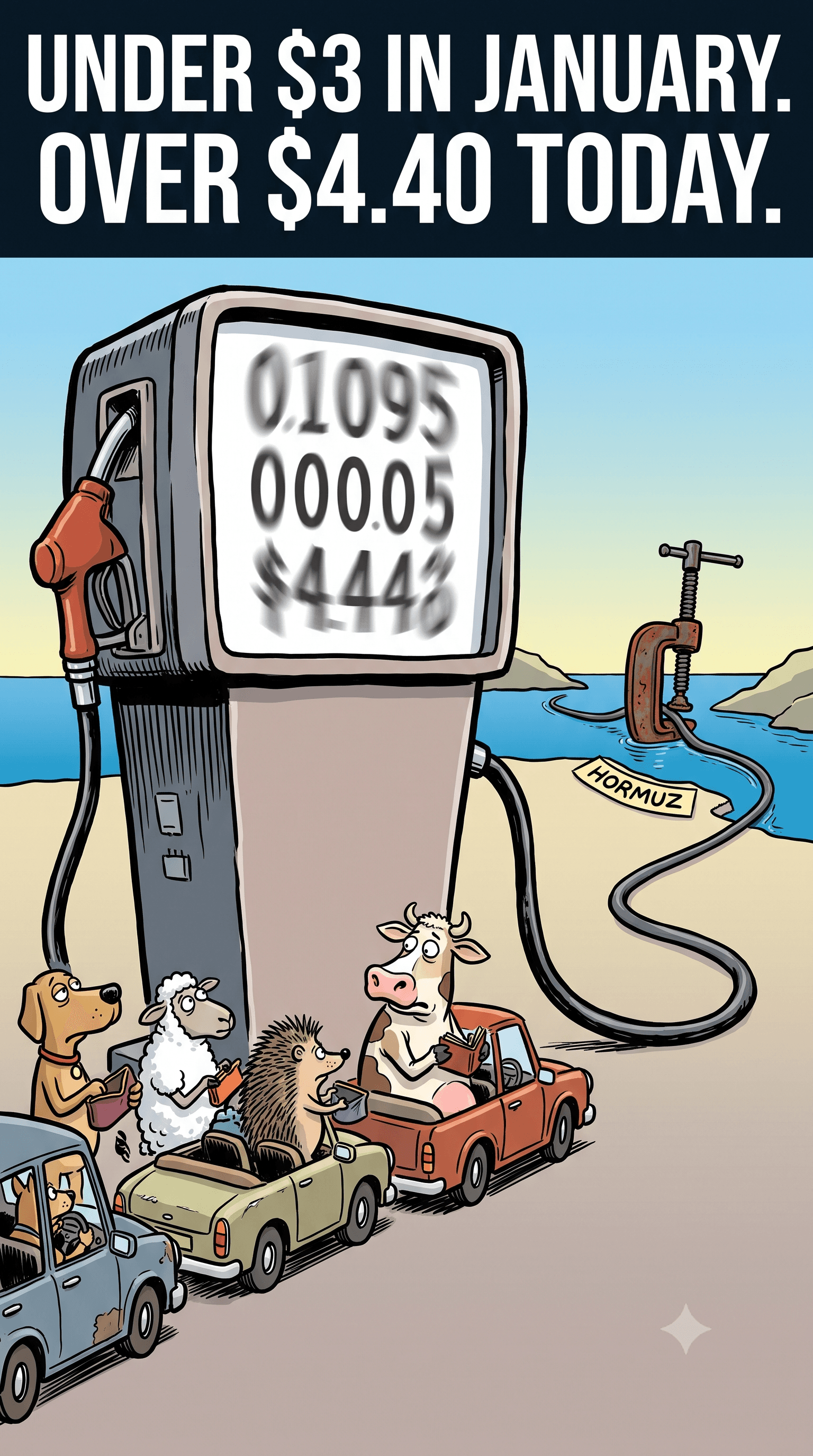
On 15 September 2026, the US national average price of diesel reached $6.285 a gallon — up 32 cents in a single week, and up $2.50 on the year. That is a 68% rise in twelve months. On the West Coast it is $7.25.
Petrol has followed: a national average of $4.319 on the same date, and above $4.40 by 22 September. Before February, it was under $3.
Crude has been trading above $100 a barrel.
None of this is a fuel story. It is a geography story, and the geography is a channel between Iran and Oman that most people who are paying for it could not point to on a map.
What actually happened
In February 2026 the United States joined Israel's war on Iran. Iran's response included closing the Strait of Hormuz.
More than a fifth of the world's oil trade normally moves through that channel, along with a very large share of seaborne LNG. There is no meaningful way around it. Pipelines bypassing Hormuz exist but carry a fraction of the volume.
The International Energy Agency called the result "the largest supply disruption in the history of the global oil market." Its executive director, Fatih Birol, went further: "the largest energy security crisis the world has ever faced."
The price record since then reads like a seismograph. Brent rose 10–13% to $80–82 in the first days of March, peaked at $118.35 on 31 March, fell back to $71.57 by 1 July, then climbed again to $96.78 by 24 July. Asian LNG spot prices rose more than 140% after an Iranian strike on Qatar's Ras Laffan facility on 18 March.
And even after a ceasefire was announced on 8 April, shipping traffic through the strait stayed far below pre-war levels. This is the part that surprises people: the closure is not the only mechanism. Insurers price war risk, and shipowners price the possibility of a closure resuming. A strait that might close is nearly as expensive as one that is closed.
Why it reaches everybody
Oil is a global market with a single price. There is no domestic pool insulated from it. A country that produces no oil, has no involvement in the war and holds no view on it pays the same increment as a country that started it.
What that looks like in practice, country by country, is the most striking part of this story:
Slovenia introduced fuel rationing on 23 March — 50 litres a day for private motorists.
The Philippines declared a national energy emergency on 24 March, the first country to do so. President Ferdinand Marcos Jr signed it.
Bangladesh closed universities early and restricted shop opening hours to conserve power. It is projected to lose up to 3% of GDP.
Egypt ordered retail closures at 9pm and dimmed street lighting.
India cut excise duty by ₹10 a litre on 27 March and raised export duties to hold domestic supply.
China ordered refiners to suspend fuel export contracts on 5 March.
Australia halved fuel excise and announced a National Fuel Security Plan on 30 March.
Germany announced two months of fuel tax cuts on 13 April.
Bangladesh, Vietnam, Pakistan, the Philippines, Kenya and Ethiopia are among the worst affected. Not one of them had a vote on the decision that caused it.
The IMF revised 2026 global growth down to 3% in July. Yearly inflation reached 3.53% by June.
The part that is genuinely counterintuitive
You would expect a fuel shock to hurt the countries that import the most oil. It does — but not in proportion to their wealth.
Rich importers absorb a price rise by spending a slightly larger share of income on fuel. Poor importers absorb it by not doing other things: the electricity that runs a cold chain, the diesel that runs an irrigation pump, the bus fare that gets someone to work. Bangladesh closing universities early is not a fuel policy. It is a power policy, forced by a fuel price, caused by a war on the other side of a continent.
This is also why diesel has moved so much further than petrol — 68% against 36%. Petrol is mostly cars. Diesel is freight, farming, construction, generators and shipping. A diesel shock is an everything shock, and it arrives in the price of food several months later.
What would actually bring prices down
Three things, in descending order of likelihood.
Traffic normalising. The single largest component of the current price is not physical shortage but risk premium. If shipowners and insurers become confident the strait will stay open, a substantial part of this unwinds without a single extra barrel being produced.
Spare capacity coming online. Producers outside the Gulf can add volume, but slowly, and much of the world's spare capacity is itself inside the Gulf — which is the problem.
A settlement that looks durable. Not a ceasefire announcement; those have come and gone, and 8 April demonstrated that an announcement alone does not move ships.
What will not do it is any government's domestic tax policy. Every excise cut listed above lowers the price at the pump and does nothing to the price of the barrel. They are cushions, not cures, and they are expensive ones — India's ₹10 a litre is revenue forgone, permanently, in exchange for a temporary effect.
What to watch
Shipping volumes through Hormuz, not the oil price. Traffic is the leading indicator; price is the lagging one. If transits recover toward pre-war levels, the price follows within weeks.
Whether the US midterms on 3 November change the policy. Polling has shown the war unpopular and cost of living dominant. That is the most direct mechanism by which any of this could shift.
Food prices in about six months. Diesel moves freight and runs farm equipment. A fuel shock becomes a food shock on a lag, and the countries in the list above are the ones that will feel it.
Sourcing note: Diesel and petrol prices and their weekly and annual changes are US Energy Information Administration data as of 15 September 2026, with the 22 September petrol figure separately reported. Crude price movements, the 140% Asian LNG spot rise, and the national emergency measures in Slovenia, the Philippines, Bangladesh, Egypt, India, China, Australia and Germany are from compiled reporting on the 2026 fuel crisis; each is a government announcement. The IEA characterisations are attributed to the agency and to its executive director Fatih Birol. The IMF growth revision is a July 2026 forecast, and the Bangladesh GDP figure is a projection rather than a measured outcome. The distinction between physical shortage and risk premium is analysis, not a sourced claim, and is offered as such.