The geopolitical crisis in West Asia has reached a critical inflection point as United States President Donald Trump issued a stark warning to Tehran, demanding an immediate end to the blockade of the Strait of Hormuz. In an explosive social media post on Saturday, April 4, 2026, Trump declared a 48-hour ultimatum, warning that "all hell will rain down" on Iran if it fails to either reopen the vital shipping route or secure a ceasefire agreement.
With the deadline set to expire on Monday, April 6, global markets are bracing for potential shockwaves, and military analysts are warning of an unprecedented escalation involving international shipping lanes and sensitive nuclear infrastructure.
The 48-Hour Ultimatum: Trump's Warning to Tehran
President Trump’s latest declaration was broadcast via his Truth Social platform early Saturday morning, reflecting his administration's mounting impatience with the diplomatic standstill between the US, Israel, and Iran.
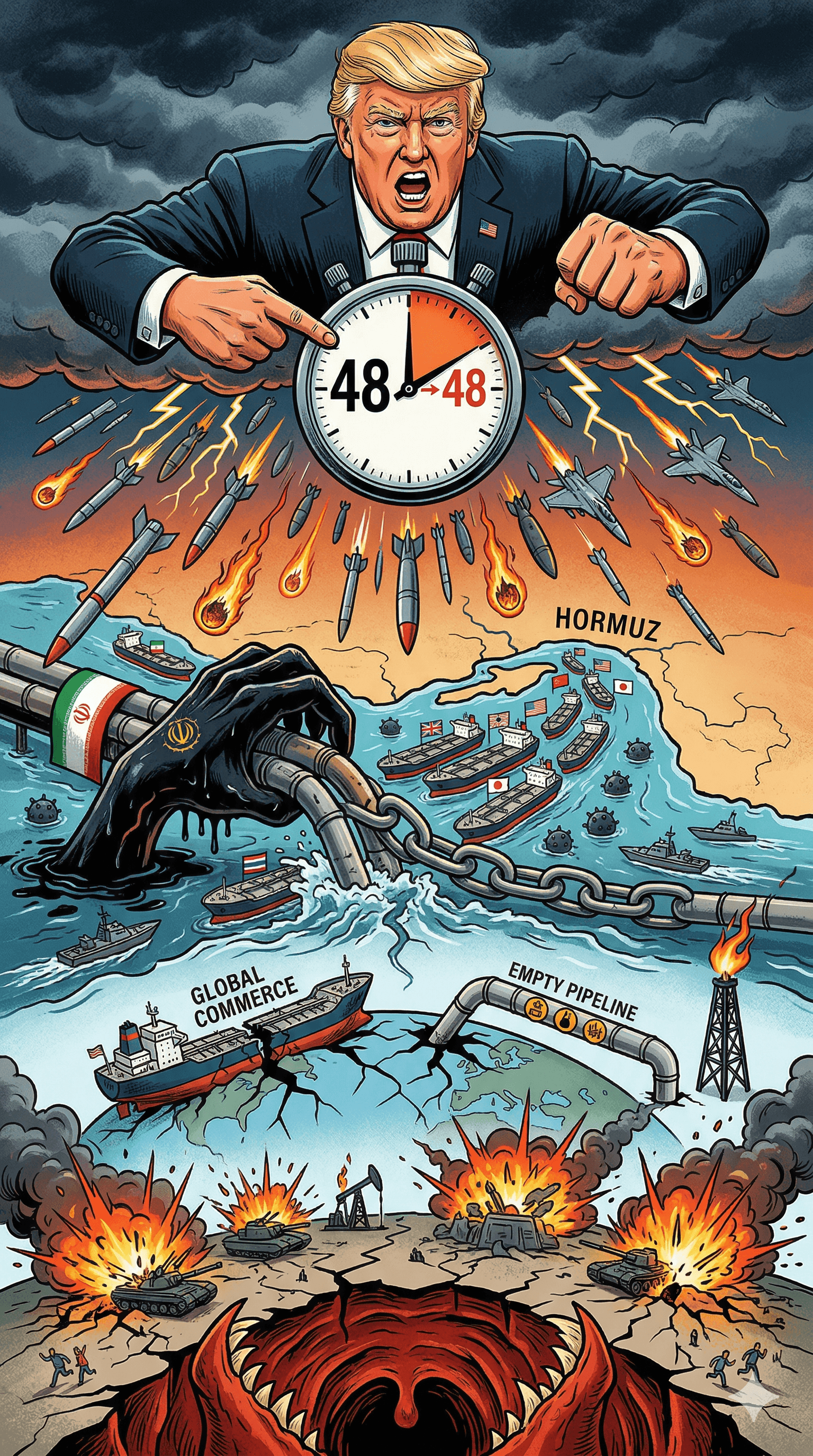
"Remember when I gave Iran ten days to MAKE A DEAL or OPEN UP THE HORMUZ STRAIT. Time is running out—48 hours before all Hell will rain down on them. Glory be to GOD!" Trump wrote in the capitalized, forceful tone that has characterized his administration's wartime messaging.
This recent ultimatum serves as the final countdown to a previous 10-day extension Trump had issued in late March. At that time, the US had paused a planned military campaign aimed at devastating Iran's energy grid, citing "ongoing talks" requested by the Iranian government. However, as diplomatic efforts have reportedly stalled and violence across the region has intensified, Washington is now threatening catastrophic military consequences if Tehran does not immediately change its posture.
The Strait of Hormuz Blockade and Global Economic Stakes
At the center of this standoff is the Strait of Hormuz, a narrow maritime chokepoint between the Persian Gulf and the Gulf of Oman. Roughly 20 percent of the world's global oil and liquefied natural gas (LNG) shipments pass through this corridor, making it the most critical energy artery on the planet.
In recent weeks, Iran’s Islamic Revolutionary Guard Corps (IRGC) has enforced a de facto blockade, asserting that it is restricting access solely to vessels flagged by or affiliated with "aggressor" nations, specifically the US and Israel. While Iran maintains that the waterway remains open to friendly and neutral countries—such as China and India—the West has outright condemned the maneuver. A coalition of 22 nations, including the United Kingdom, Germany, and the United Arab Emirates, recently issued a joint statement denouncing the blockade as illegal and deeply destabilizing.
The threat to global commerce is not merely theoretical. Tensions spilled directly into the maritime corridor this weekend when the IRGC Navy claimed responsibility for a drone strike on a commercial vessel, the MSC Ishika. Iranian state media identified the ship as being affiliated with Israel, reporting that the drone impact triggered a massive onboard fire. While Israel has not officially commented on the MSC Ishika incident, the attack has severely rattled global energy markets, sending crude oil prices surging as shipping insurers scramble to assess the ballooning risk.
Nuclear Sites and Escalating Regional Strikes
The maritime crisis is unfolding against a backdrop of escalating, near-daily airstrikes across Iranian territory and neighboring states. Of chief concern to the international community is the encroaching proximity of these strikes to Iran's nuclear infrastructure.
Recently, an apparent US-Israeli strike hit near Iran’s Bushehr Nuclear Power Plant, fatally wounding a security staffer and damaging peripheral infrastructure. This marked the fourth such incident in recent weeks, following similar near-misses around the highly sensitive Natanz nuclear facility.
The International Atomic Energy Agency (IAEA) confirmed that a projectile landed dangerously close to the Bushehr plant. IAEA Director General Rafael Mariano Grossi expressed "deep concern" over the strikes, reiterating that nuclear facilities "must never be attacked." Nuclear experts have cautioned that even indirect strikes or near-misses risk triggering cascading mechanical failures—such as disrupted cooling systems or power supplies—which could result in a devastating environmental and human catastrophe.
In retaliation for these incursions, Tehran has warned that it will launch broad, sweeping attacks on US energy infrastructure, desalination plants, and information technology networks throughout the Gulf and Israel if its territory is invaded or heavily bombed.
Geopolitical Implications and the Diplomatic Standstill
Despite the looming threat of total war, peace negotiations remain heavily gridlocked. The US and Israel have demanded that Iran lift the Strait of Hormuz blockade and agree to a ceasefire on Washington's terms. Conversely, Tehran insists on a complete and total end to the war, rejecting any temporary pause or uneven truce.
Iran’s foreign ministry has also called out what it views as Western hypocrisy, accusing the US of backing blockades in Gaza while condemning Tehran for defending its territorial interests in the Strait of Hormuz. Top Iranian diplomats have consistently maintained that they will not back down under the pressure of Trump's deadlines.
Outlook: What Happens When the Clock Runs Out?
As the 48-hour countdown nears its Monday expiration, the world is watching to see if Trump will authorize devastating strikes against Iranian power plants and oil facilities, as previously threatened. An attack on Iranian energy infrastructure would likely trigger immediate Iranian retaliation against Gulf energy sites, severely disrupting the global energy supply chain.
If diplomatic backchannels fail to produce a breakthrough, the region risks plunging into a broader, uncontrollable conflict that could permanently alter the geopolitical map of West Asia and plunge the global economy into a severe energy-driven crisis.