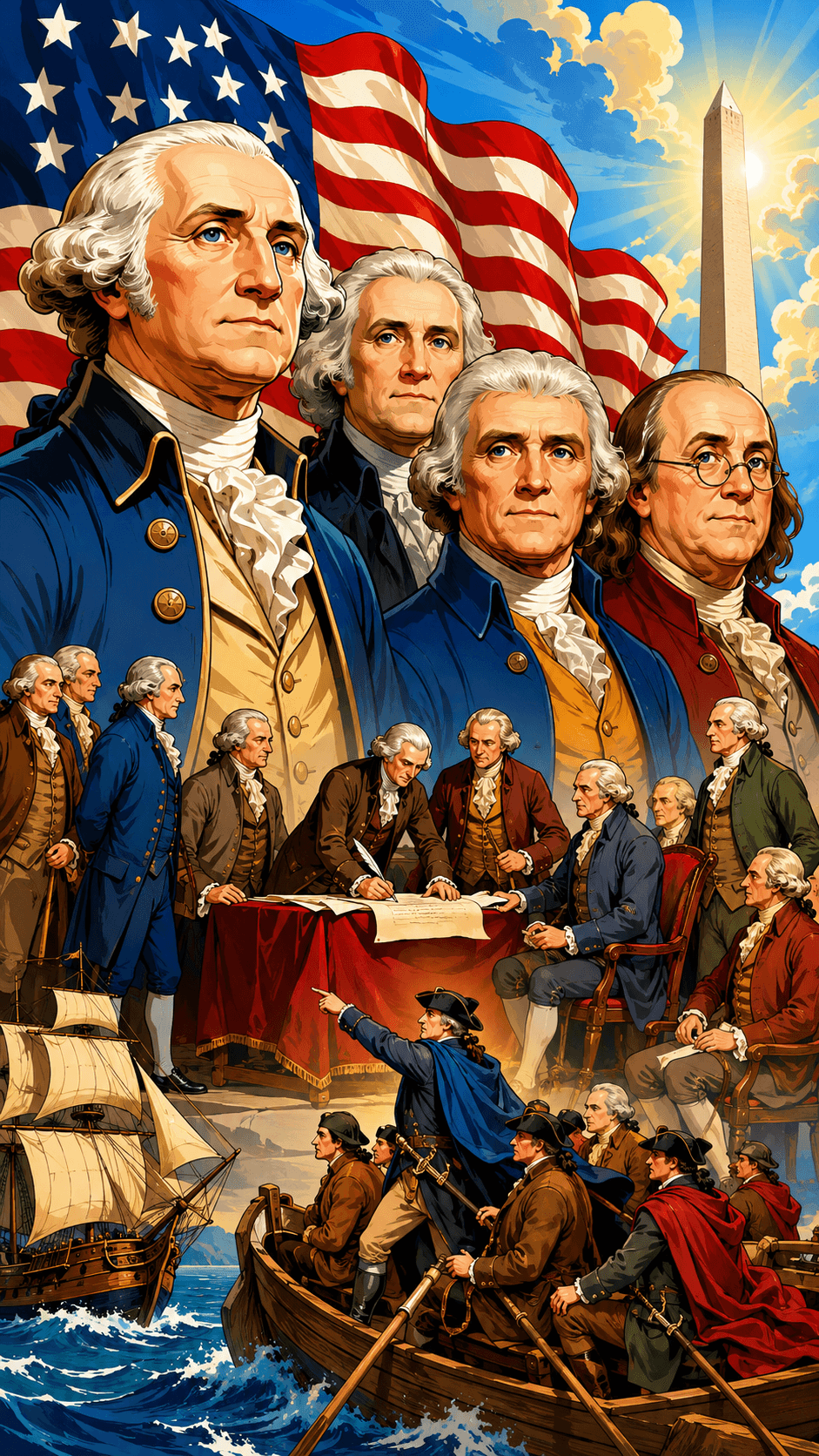
As the U.S. approaches its 250th anniversary, we delve into the lives, motivations, and complex legacy of the Founding Fathers who shaped the nation.
As the United States prepares to mark its Semiquincentennial on July 4, 2026, commemorating 250 years since the signing of the Declaration of Independence, the nation is prompted to reflect on its origins and the figures who laid its foundational stones. The "US turns 250" milestone invites a closer look at the American Founding Fathers â a diverse group of revolutionary leaders whose vision and actions forged a new republic. This anniversary provides a critical opportunity to understand not only their monumental achievements but also the profound complexities and contradictions embedded within their legacy.
Who Were the American Founding Fathers?
The term "Founding Fathers" collectively refers to a group of late 18th-century American revolutionary leaders who united the Thirteen Colonies, spearheaded the War of Independence from Great Britain, established the United States of America, and crafted its framework of government. While the precise list can vary, historian Richard B. Morris identified seven pivotal figures based on their leadership, longevity, and statesmanship: John Adams, Benjamin Franklin, Alexander Hamilton, John Jay, Thomas Jefferson, James Madison, and George Washington. Other prominent individuals frequently included are Samuel Adams, Patrick Henry, George Mason, and John Hancock, alongside the numerous signers of the Declaration of Independence and the U.S. Constitution. George Washington, revered as the commanding general of the Continental Army and the nation's first president, is often singularly identified as the "Father of the United States".
Architects of Independence and Governance
These individuals played distinct yet interconnected roles in the birth of the nation. George Washington's military leadership was indispensable in securing victory against the powerful British forces, and he later provided crucial stability as the first president, setting precedents for the executive branch. Thomas Jefferson, a gifted writer and statesman, famously authored the Declaration of Independence, articulating the revolutionary ideals of liberty, equality, and unalienable rights.
John Adams championed the cause of independence, serving as a key diplomat and helping negotiate the Treaty of Paris that formally ended the Revolutionary War. Benjamin Franklin, a polymath and America's most senior diplomat during the revolution, stands uniquely as the only person to have signed all four crucial founding documents: the Albany Plan, the Declaration of Independence, the Treaty of Paris, and the U.S. Constitution. James Madison, often hailed as the "Father of the Constitution," meticulously shaped the framework of American government and later sponsored the Bill of Rights, guaranteeing fundamental individual freedoms. Alexander Hamilton, a close aide to Washington during the war, became the nation's first Secretary of the Treasury, establishing critical financial systems, while John Jay served as the first Chief Justice of the United States.
Motivations for Revolution: Political, Economic, and Social Context
The drive for independence was fueled by a confluence of political, economic, and social grievances against British rule. Politically, colonists resented the increasing imposition of taxes and regulations by the British Parliament following the French and Indian War, particularly the principle of "taxation without representation". Decades of "salutary neglect" had allowed the colonies to develop a significant degree of self-governance, making British attempts to tighten control after 1763 deeply unpopular.
Economically, British mercantilist policies stifled colonial trade and manufacturing, dictating that colonies exist for the economic benefit of the mother country. The post-war economic downturn further exacerbated tensions, with a plummeting money supply and soaring interest rates impacting colonial livelihoods. The Founding Fathers envisioned a nation with greater economic freedom, where individuals could engage in entrepreneurial activities with credible assurances that they could retain the fruits of their labor. Socially, while hierarchies persisted, the colonial society was generally less aristocratic and more open to merit than European counterparts, fostering a "natural aristocracy" based on talent rather than lineage. This nascent culture of self-reliance and liberty, cultivated over decades, was a powerful force driving the demand for a new form of government "formed by reflection and choice".
Challenges, Compromises, and Enduring Debates
The path to forming the United States was fraught with challenges and difficult compromises. Beyond winning the war against a formidable adversary, the Founders grappled with establishing a stable government that could overcome the weaknesses of the preceding Articles of Confederation. The Constitutional Convention in 1787 saw intense debates over the balance of power between states and the federal government, as well as between the executive, legislative, and judicial branches, ultimately leading to a system of checks and balances.
However, the most profound and enduring criticism of the Founding Fathers revolves around the issue of slavery. Many, including prominent figures like George Washington, Thomas Jefferson, and James Madison, were slaveholders despite articulating ideals of liberty and equality. The Constitution included compromises such as the Three-Fifths Compromise and allowed the continuation of the slave trade until 1808, reflecting the deep entrenchment of slavery in the Southern economy and the Founders' commitment to maintaining a fragile union. This failure to decisively eradicate slavery left a devastating legacy that would culminate in the Civil War and continues to shape American society. Furthermore, the Revolution did not extend civic equality to women or Native Americans, whose lands were often subject to hostile government policies and displacement.
The Continuing Legacy of the Founders
As the US approaches its 250th anniversary, the legacy of the Founding Fathers remains a subject of intense study and ongoing national dialogue. Their commitment to republicanism, popular sovereignty, and individual rights, enshrined in the Declaration of Independence and the Constitution, provided a blueprint for a nation that has inspired democratic movements worldwide. The framework they created, with its emphasis on a government accountable to the people and a balance of powers, continues to be the bedrock of American governance.
Yet, acknowledging their imperfections and the historical context in which they operated is crucial. They were complex individuals, products of their time, with personal beliefs and biases that influenced their decisions. The contradictions, particularly surrounding slavery, serve as a potent reminder that the nation's journey toward "a more perfect union" is an ongoing process, continually striving to live up to the highest ideals articulated at its inception. The Semiquincentennial offers an opportunity to grapple with this multifaceted heritage, celebrating the enduring principles while critically examining the unresolved challenges they bequeathed, thereby fostering a deeper, more nuanced understanding of American identity.