The payment does not protect the veto. It buys back a vote in the one chamber where America counts for exactly one.
On 17 September 2026, UN spokesperson Farhan Haq told the daily briefing in New York that the United States had transferred money to the United Nations.
"We received $725 million yesterday from the United States for the UN regular budget," he said, "and we also received $102 million from the US for peacekeeping on Friday."
He also said what remained: "The US still owes $1.312 billion to the regular budget."
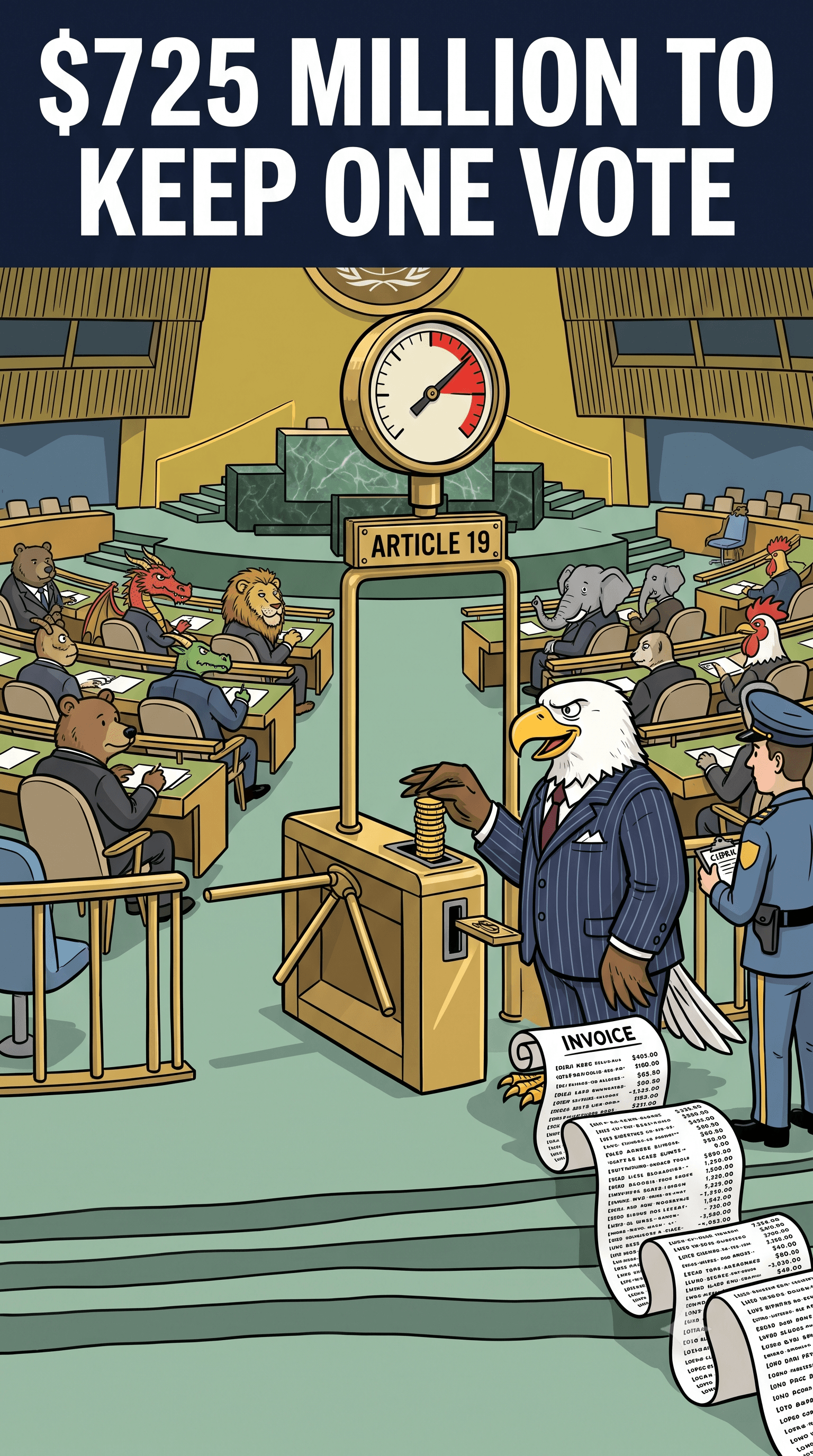
Paying $827 million while still owing $1.312 billion on one budget alone is an odd way to settle a debt. The sequencing only makes sense once you read the clause Haq mentioned in his next sentence — that with these payments, the US is "no longer in jeopardy of falling under Article 19 for 2027."
What Article 19 says
It is the shortest consequential provision in the UN Charter, and it reads in full:
A Member of the United Nations which is in arrears in the payment of its financial contributions to the Organization shall have no vote in the General Assembly if the amount of its arrears equals or exceeds the amount of the contributions due from it for the preceding two full years. The General Assembly may, nevertheless, permit such a Member to vote if it is satisfied that the failure to pay is due to conditions beyond the control of the Member.
Two sentences. No enforcement body, no proceedings, no vote to trigger it. The loss of the vote is automatic once the arithmetic crosses the line, and the Assembly's discretion runs only one way — it can forgive, not impose.
The vote it takes is not the veto
This is the part that gets misreported every time the clause surfaces.
Article 19 reaches the General Assembly. It does not touch the Security Council, and it does not touch the veto. A permanent member in arrears keeps its seat, keeps its blocking power over every binding resolution, and loses only its one vote among 193 in the chamber where it has no special weight at all.
Which sounds like a small thing, and mostly is — until you notice what the General Assembly controls. It approves the budget. It sets the scale of assessments that decides what each member is charged. It elects the non-permanent Security Council members, the Human Rights Council, and the judges of the International Court of Justice. It confirms the Secretary-General.
A country that pays 22% of the regular budget and cannot vote on that budget is in an unusually poor negotiating position. That is the exposure the transfer closed.
The arithmetic that set the number
The trigger is arrears equal to or exceeding the contributions assessed for the two preceding full years, measured at the start of each calendar year.
In December 2025 the General Assembly approved a regular budget of $3.45 billion for 2026. The United States is assessed at 22%, the ceiling rate — roughly $759 million a year, with the 2025 assessment somewhat higher on a larger budget.
Two years of that assessment therefore sits somewhere around $1.5 to $1.6 billion.
Now run the US position across the payment. Before the transfer, regular-budget arrears stood at $1.312 billion plus the $725 million just paid — a little over $2 billion, comfortably above the two-year line. After it, $1.312 billion, comfortably below.
So the payment was not a gesture toward the debt. It was the amount required to move one side of an inequality past the other before the 1 January 2027 measurement, and not a dollar more. The remaining $1.312 billion is not overdue in any sense Article 19 recognises. It is simply unpaid.
(The two-year threshold above is reconstructed from the published budget and the US assessment rate; the UN does not publish a running Article 19 countdown per member. Treat the figure as an approximation of the line, not as the Secretariat's own calculation.)
The hole this does not fill
Regular budget arrears are the smaller half of the problem.
PassBlue, tracking the payments, puts total US arrears across all UN budgets at roughly $4.2 billion after the transfers, down from about $5 billion — of which the larger share is peacekeeping rather than regular operations. Peacekeeping arrears carry no Article 19 consequence whatsoever. There is no clause that costs a member anything for not paying them.
That asymmetry explains the shape of the payment precisely. The regular budget got $725 million because the regular budget is the one with a penalty attached. Peacekeeping got $102 million because it does not.
PassBlue also reports that diplomatic sources expect a further $1.1 billion to follow for peacekeeping. That is a single anonymous-sourced expectation, not a confirmed transfer, and it should be held at that weight until money actually lands.
Why this week
The timing is not incidental. The transfer cleared days before the opening of the General Assembly's high-level week, when heads of state and government arrive in New York and the Assembly is the only room that matters.
There is no procedural reason the payment had to arrive in September rather than December; the measurement date is 1 January. There is an obvious presentational one.
What to watch
Whether the $1.1 billion peacekeeping payment materialises. If it does, the drawdown is a genuine policy shift. If it does not, this was a minimum payment on a single covenant and the position is unchanged.
What the 2027 assessment scale does. The scale is renegotiated periodically and the 22% ceiling is itself a political settlement. A US push to lower the ceiling would do permanently what a wire transfer does for one year.
Whether arrears drift back over the line during 2026. Nothing about this payment changes the underlying flow. If assessments continue to outrun transfers, the same clause produces the same deadline in twelve months, and the same size of cheque will be needed to clear it.
Sourcing note: The payment amounts, the outstanding regular-budget figure and the Article 19 quotation are from UN spokesperson Farhan Haq at the 17 September 2026 briefing, reported by Reuters. Outlets differ slightly on the transfer dates — Reuters places the regular-budget payment on 16 September and the peacekeeping payment on the preceding Friday, while PassBlue dates them 15 and 11 September. The ~$4.2 billion total arrears figure and the anticipated $1.1 billion peacekeeping payment are PassBlue's reporting, the latter sourced to unnamed diplomats. The $3.45 billion 2026 regular budget is the figure approved by the General Assembly in December 2025. Article 19 is quoted from the UN Charter.