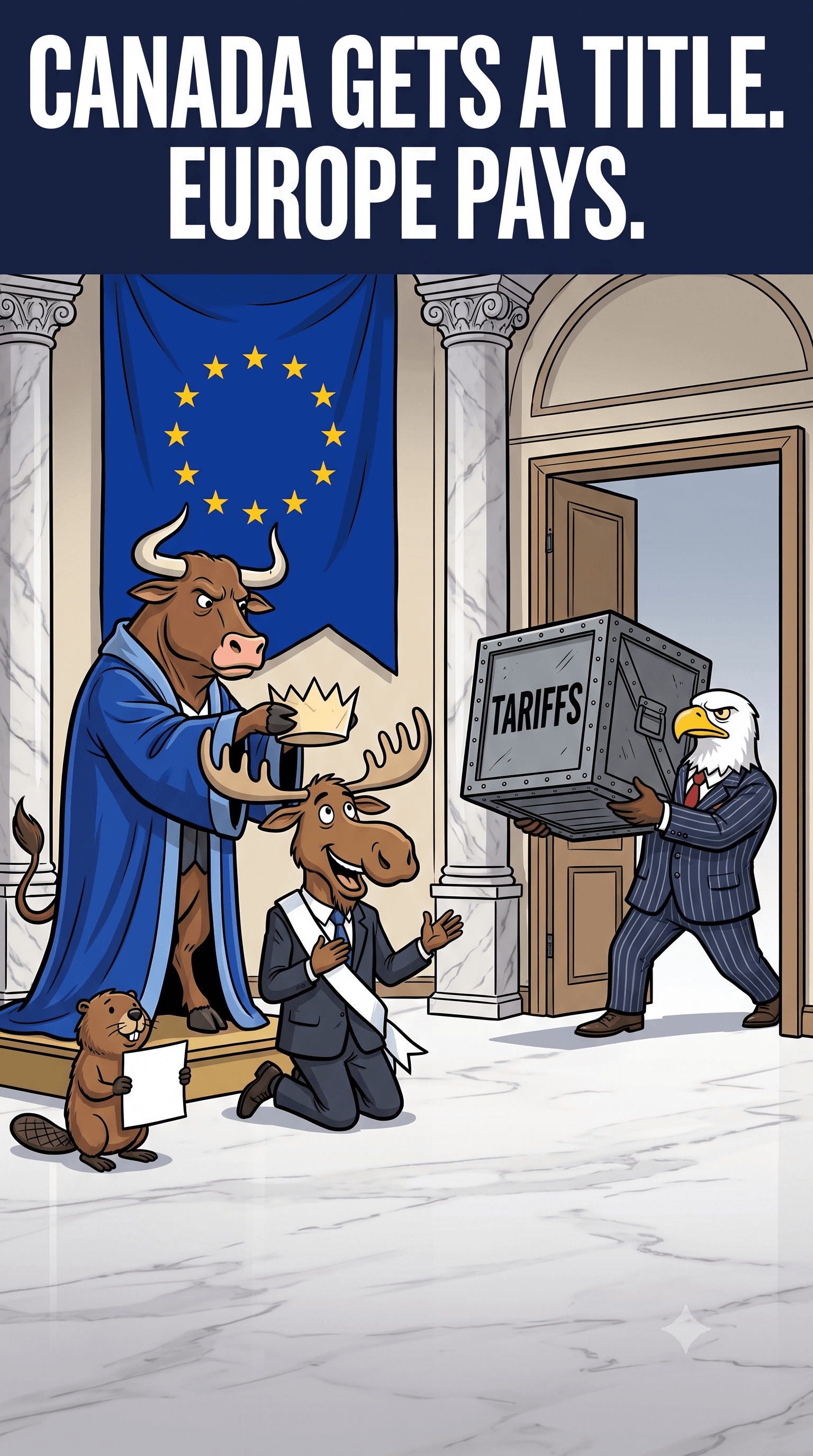
On 16 September 2026, in her State of the Union address in Strasbourg, European Commission President Ursula von der Leyen announced that she wanted to open the door for Canada to become the European Union's first "associate member." Prime Minister Mark Carney was in the chamber. The applause was long.
The announcement left one question untouched, and it is the only question that determines whether any of this matters: does an associate member vote?
The answer is no — and not as a matter of negotiation. As a matter of structure.
Why Canada can never be a member
Article 49 of the Treaty on European Union opens accession to "any European State" that respects the Union's values. Canada is not ordinarily understood to fall within that category, and no reading of the provision stretches the Atlantic.
Changing that would require formal treaty revision under Article 48 TEU: unanimity among all twenty-seven member states, followed by ratification in each one. Nobody in Strasbourg is proposing this, and nobody should expect it.
So full membership is off the table permanently, not temporarily. That is the starting condition, and it shapes everything that follows.
"Associate member" is not a legal category
There is no such status in EU law. The phrase does not appear in the treaties. It has no established rights attached to it, no accession path, no defined endpoint.
What does exist is Article 217 of the Treaty on the Functioning of the European Union, which permits the Union to conclude association agreements with third countries — arrangements establishing reciprocal rights and obligations, common action and special procedures. This is the instrument that would actually carry any Canada arrangement, and it has existed for decades.
The distinction matters more than it sounds. Whatever Canada eventually receives will come from the text of a negotiated agreement, not from the designation. "Associate member" is a political label placed on top of an ordinary legal instrument. The label confers nothing by itself.
As of this writing, the Commission has not published a legal basis for the proposal, nor a timeline.
The vote is structurally foreclosed
Article 16 TEU defines the Council as comprising "a representative of each member state." Article 14 TEU defines the composition of the European Parliament by reference to Union citizenship.
An international agreement concluded under Article 217 cannot alter either. It can create a joint committee to administer the agreement — CETA already has one — but a joint committee derives its authority from that agreement, not from the Union's institutions. No treaty-based arrangement can hand a non-member a Council seat or a vote while the treaties themselves remain unchanged.
This is why the question "will Canada get a vote" is not a detail awaiting negotiation. Answering yes would require the same Article 48 revision that full membership would.
What rule-taking costs: the EEA precedent
Iceland, Liechtenstein and Norway participate extensively in the internal market through the European Economic Area agreement. They apply substantial bodies of internal-market law. They contribute financially. They sit on joint institutions.
They do not vote on the rules they adopt.
The EEA also does not bring its members into the EU customs union or the common commercial policy — so even deep integration leaves the participant's legal status separate. Switzerland reached a comparable position by a different route, through a stack of bilateral sectoral treaties.
The precedent is instructive in both directions. It shows that very substantial access is achievable without membership. It also shows the standing price: adopting rules you had no part in writing.
Most of the offer already exists
This is the part the announcement obscured. Canada's practical relationship with the EU is already built, and it was built before Tuesday.
CETA has been provisionally applied since September 2017, providing trade preferences and limited mobility. Its temporary-entry provisions for businesspeople explicitly exclude general labour-market access, citizenship and permanent residence.
Horizon Europe: Canada joined Pillar II on 3 July 2024, allowing Canadian researchers to participate under specified conditions.
SAFE, the Security Action for Europe instrument, entered into force on 1 August 2026, permitting Canadian legal entities to take part in qualifying EU defence procurement.
The Security and Defence Partnership agreed in June 2025 is explicitly non-binding.
Set that against what von der Leyen described — research, defence, technology, critical minerals, mobility — and the overlap is nearly total. Ottawa's talks on Erasmus+ and mutual recognition of worker qualifications are real and would add something. But the architecture is standing. What was announced on Tuesday was principally a name for it.
What it would cost
SAFE already supplies the financial template, and it is worth reading closely.
Canada pays an administrative contribution of €2.5 million and an initial participation contribution of €7.5 million, with further contributions calculated on Canadian content in qualifying contracts.
More telling is a distinction buried in the instrument: participation in procurement is not the same as eligibility for financial assistance. Canadian entities may bid. Canada does not receive the SAFE loans available to member states.
That asymmetry — pay in, take part, do not draw down — is the shape association arrangements tend to take. Any broader agreement would need to specify its own terms, but SAFE is the nearest available guide to what "associate" costs in practice.
Who authorised this
The proposal has drawn procedural objections inside the Parliament. The left-wing MEP Manon Aubry challenged von der Leyen directly on the floor: "Who gave you the mandate?"
The complaint is not primarily about Canada. It is that a new tier of relationship with the Union was announced from the podium without a legal basis, without a timeline, and without the Parliament — and, by some accounts, without all member state governments — having been consulted. An Article 217 agreement would ultimately require Council approval and Parliament's consent. None of that has begun.
What to watch
A summit follows in Montreal in October. Two things there will tell you whether this is an arrangement or a gesture.
The first is whether any text appears, and whether it cites Article 217 TFEU. If it does, the shape becomes predictable immediately: an association agreement, joint committee, sectoral annexes, no vote.
The second is whether either side puts a number on Canada's contribution. Association agreements are priced. Until someone names a figure, the tier has no weight.
Until then, what Canada has been offered is a word — a good word, arriving at a useful moment for both capitals, and carrying no rights that Article 217 did not already carry.