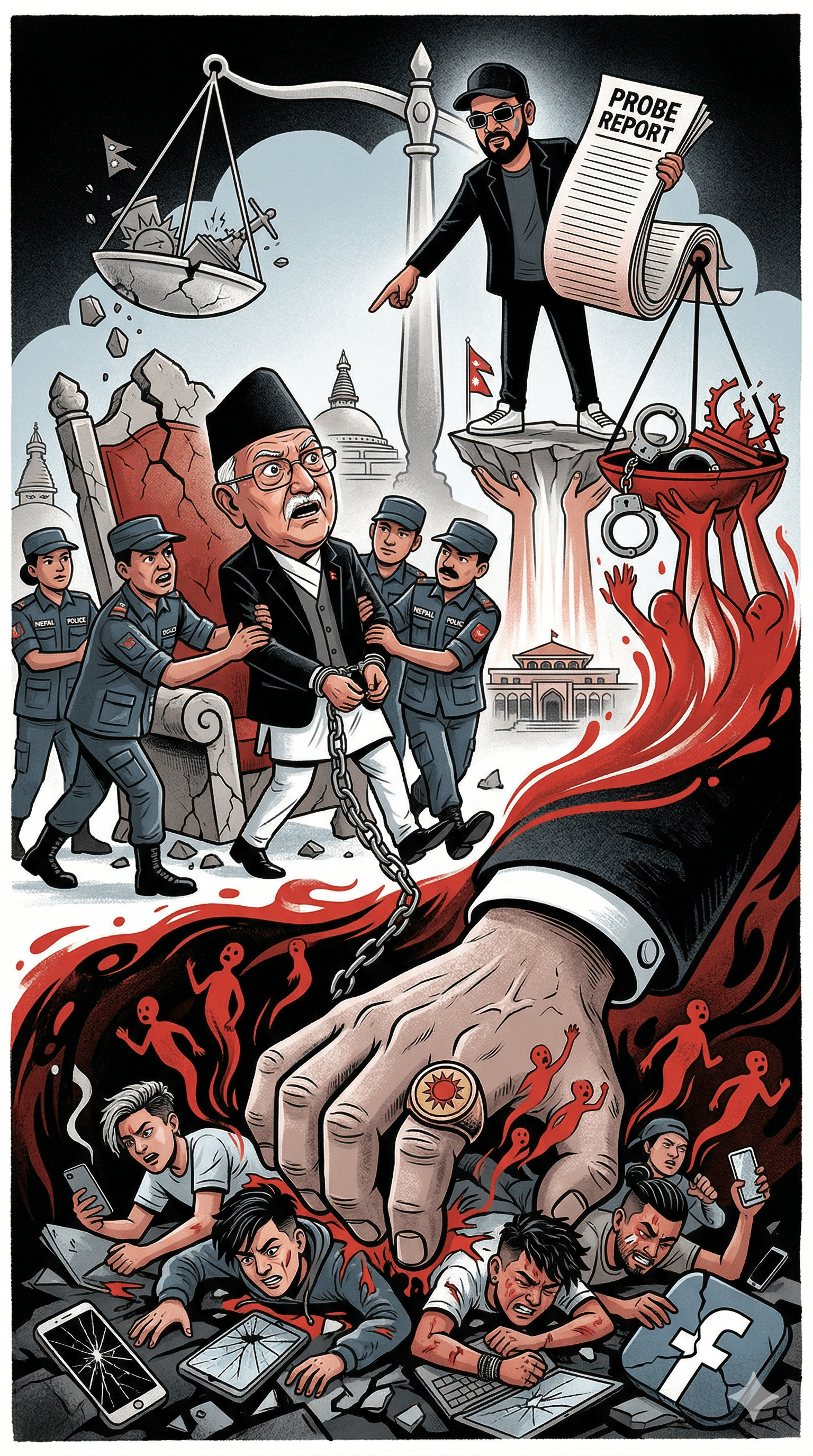
KATHMANDU — In a watershed moment for Nepal’s political establishment, former Prime Minister KP Sharma Oli was arrested early Saturday morning over his alleged role in the deadly suppression of the "Gen-Z" anti-corruption protests that rocked the Himalayan nation last year.
The early morning police operation at Oli's residence in Bhaktapur comes just one day after the country's newly elected Prime Minister, Balendra Shah, and his cabinet were sworn into office. Alongside Oli, former Home Minister and Nepali Congress leader Ramesh Lekhak was also taken into custody. Both veteran political figures face potential charges of criminal negligence and culpable homicide stemming from a state crackdown that left over 70 people dead in September 2025.
The Catalyst: Social Media Bans and the Gen-Z Uprising
The roots of Saturday’s arrests trace back to early September 2025, a period that fundamentally altered Nepal's modern political trajectory. Facing mounting criticism over economic stagnation, widespread unemployment, and political patronage, the Oli-led coalition government imposed a sudden ban on 26 social media platforms, including WhatsApp and Facebook.
What began as localized frustration over digital censorship rapidly spiraled into a nationwide, youth-led revolt. Dubbed the "Gen-Z Protests," tens of thousands of students and young citizens took to the streets of Kathmandu and other major cities on September 8 and 9. The demonstrations swiftly evolved into a broader anti-establishment movement targeting nepotism and systemic corruption.
The state's response was swift and violent. Security forces deployed riot gear, tear gas, and live ammunition. Over the course of the two-day unrest, at least 76 people—including several minors—were killed, making it one of the deadliest episodes of civil unrest in Nepal’s recent history. The ensuing public outrage, coupled with the arson of government buildings, ultimately forced KP Sharma Oli to resign, collapsing his government and paving the way for a transitional administration.
The Karki Commission Findings
Following the collapse of the Oli government, a high-level inquiry commission was formed under the leadership of former Special Court judge Gauri Bahadur Karki to investigate the excessive use of force.
The commission's exhaustive 900-page report, submitted earlier this month, painted a grim picture of state failure. While investigators did not establish that a direct "shoot-to-kill" order was issued by the senior leadership, they concluded that top officials exhibited gross criminal negligence. The report noted that security forces fired continuously for hours without any intervention from the Prime Minister’s Office or the Home Ministry to halt the bloodshed.
The Karki Commission formally recommended that KP Sharma Oli, Ramesh Lekhak, and then-Inspector General of Police Chandra Kuber Khapung be prosecuted under Sections 181 and 182 of Nepal’s National Penal Code. If formally charged and convicted of criminal negligence and culpable homicide, the accused could face up to 10 years in prison. The report also recommended systemic reprimands and legal actions against several other high-ranking police and intelligence officials.
A New Political Reality: The Rise of Balendra Shah
The timing of the arrests highlights a dramatic shift in Nepal’s balance of power. The detentions occurred less than 24 hours after Balendra Shah, a 35-year-old former rapper-turned-politician affectionately known as "Balen," took the oath of office as Prime Minister.
Shah’s Rastriya Swatantra Party (RSP) secured a landslide victory in the March 5, 2026, parliamentary elections, driven largely by the youth vote and a firm campaign promise to deliver justice for the victims of the September massacres. Shah even defeated Oli in his own long-standing constituency of Jhapa-5.
During its very first cabinet meeting on Friday evening, the new government bypassed traditional political delays and voted to immediately implement the Karki Commission’s recommendations.
"No one is above the law," declared newly appointed Home Minister Sudan Gurung—himself a prominent figure during the Gen-Z protests—in a social media statement following the arrests. "We have taken former Prime Minister KP Sharma Oli and former Home Minister Ramesh Lekhak under control. This is not revenge against anyone; it is just the beginning of justice. I believe the country will now take a new direction."
Backlash, Medical Evaluations, and Legal Next Steps
The arrests have predictably sent shockwaves through Nepal's traditional political elite. Following his detention, the 74-year-old Oli, who has a history of health complications including two kidney transplants, was admitted to the Tribhuvan University Teaching Hospital (TUTH) for a medical evaluation under police guard.
The Communist Party of Nepal (Unified Marxist–Leninist), or CPN-UML, which Oli chairs, has vehemently condemned the arrests. Party loyalists and senior leaders have labeled the government's actions a "political vendetta" designed to sideline opposition forces. Former Foreign Minister and CPN-UML leader Pradeep Gyawali publicly dismissed the probe commission's report, arguing it lacked sufficient legal grounds for detention and was drafted with malicious intent.
The party has convened emergency secretariat meetings to strategize a response, and sister wings of the CPN-UML have warned of potential counter-protests if their leader is not released.
Because the arrests occurred on a Saturday—a public holiday in Nepal—police spokespersons confirmed that both Oli and Lekhak remain in custody at the Kathmandu District Police Circle and are scheduled to be presented before the Kathmandu District Court on Sunday to formally begin legal proceedings.
Outlook and Implications
The arrest of a three-time former Prime Minister marks an unprecedented moment of accountability in South Asian geopolitics, signaling that the era of political impunity in Nepal may be coming to an end.
For the newly minted administration of Prime Minister Balendra Shah, the decisive action fulfills a core electoral mandate but also risks severe political polarization. The coming weeks will test the resilience of Nepal’s judiciary and law enforcement agencies as they navigate the high-stakes prosecution of the country's old guard. Whether this leads to a stable, reform-driven era or triggers a new wave of partisan unrest remains to be seen, but for the youth who marched in September 2025, Saturday's events represent a hard-fought step toward justice.