He came to power on an anti-corruption mandate. He called himself the broom that would sweep South Africa clean after the disastrous, scandal-ridden years of Jacob Zuma. Now, six years into his presidency, Cyril Ramaphosa faces the very charge he promised to eliminate — and his fate rests in the hands of the parliament he once controlled.
On Friday, May 8, 2026 — exactly thirty years after South Africa's Constitution was formally adopted — the Constitutional Court delivered a judgment that cleared the path for a full public impeachment hearing into President Cyril Ramaphosa's conduct in what has become known as the Phala Phala scandal. The ruling was unanimous. The consequences are seismic.
The Scandal: $580,000 Under the Cushions
The story begins on the night of February 9, 2020, at Ramaphosa's private Phala Phala Wildlife Game Farm in Limpopo province. A burglary took place. Foreign currency was stolen. That much is undisputed.
What is disputed — and what has consumed South African politics for four years — is everything else.
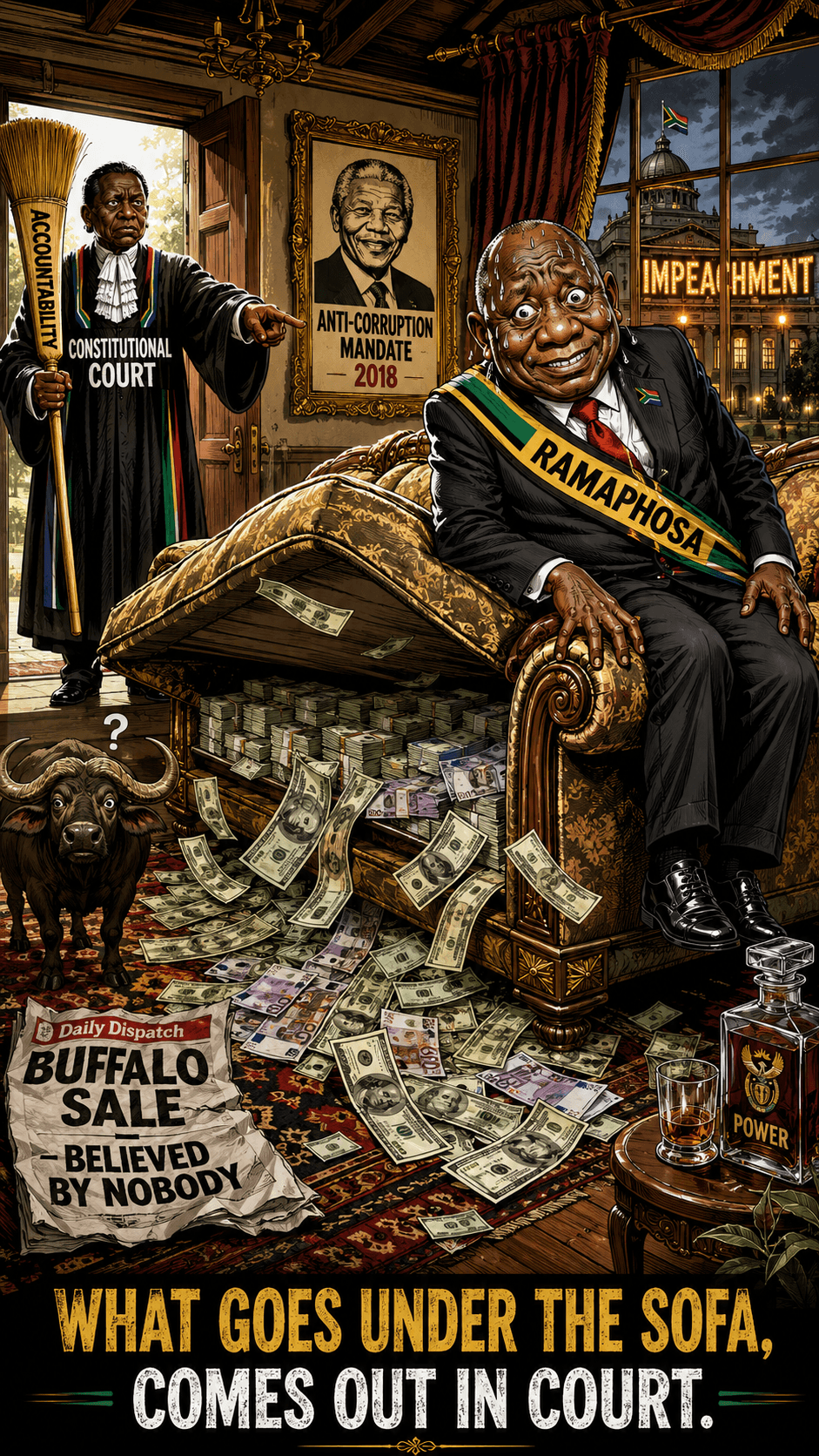
According to the official account, the money was kept in a safe in an office at Phala Phala and was intended to be banked after the festive season. However, Phala Phala's lodge manager, uncomfortable about leaving the cash in a safe accessible to several staff members, decided to store it below the cushions of a sofa in a rarely used spare bedroom in the President's residence, thinking no one would break into the President's house.
At the heart of the inquiry is the origin of the $580,000 — about R9.6 million — stolen that night. Ramaphosa has maintained that the money was payment for 20 buffaloes sold to a Sudanese businessman named Hazim Mustafa, who never took possession of the animals, with each valued at R400,000.
An independent panel, however, was unconvinced. It did not accept Ramaphosa's claims that the money had been the proceeds of a buffalo sale. It found that Ramaphosa had a case to answer over serious violations of the Constitution — including exposing himself to a conflict of interest, engaging in outside paid work, and potentially contravening the Prevention of Corrupt Activities Act.
The scandal deepened further when former State Security Agency head Arthur Fraser alleged the stolen amount was not $580,000 but somewhere between $4 million and $8 million — and that it had been illegally brought into the country by the president's advisor during trips to Saudi Arabia, Egypt, and Morocco.
Ramaphosa has denied all wrongdoing throughout.
The Cover-Up Allegation: Parliament Blocks the Process
An independent panel, chaired by former Chief Justice Sandile Ngcobo, was established to investigate. The 89-page report found prima facie evidence that Ramaphosa may have committed serious violations of the Constitution and the law, and that the president had a case to answer.
Then, in December 2022, the process hit a wall. The National Assembly voted against adopting the panel's report — after the ANC used its parliamentary majority to defeat the referral of the Section 89 report to an impeachment committee, effectively burying the matter.
Opposition parties cried foul. The Economic Freedom Fighters and the African Transformation Movement took the matter all the way to the Constitutional Court, arguing the parliamentary vote was unlawful. For nearly four years, the case worked its way through the legal system.
Then came May 8, 2026.
The Ruling: Parliament Acted Unlawfully
Chief Justice Mandisa Maya delivered the landmark ruling, finding that the National Assembly's decision not to refer the independent panel report to an impeachment committee was unlawful and invalid. The court directed that the Section 89 report must be referred to an impeachment committee for proper parliamentary scrutiny.
Within days, National Assembly Speaker Thoko Didiza moved to begin the process, confirming that parliament would implement the apex court's judgment. The impeachment process against Cyril Ramaphosa is now officially under way.
The symbolism was not lost on anyone. The same Constitution that Ramaphosa helped negotiate and then championed for three decades had just ordered him to face accountability before the nation.
Ramaphosa Refuses to Resign — But Fights Back
In a televised address on Monday, Ramaphosa was defiant. "While there have been calls in some circles that I should resign, nothing in the Constitutional Court judgement compels me to resign my office," he said. "Since a criminal complaint was laid against me in June 2022, I have consistently maintained that I have not stolen public money, committed any crime, nor violated my oath of office."
Behind the scenes, the political manoeuvring was already intense. Ramaphosa announced he would launch a review application of the Section 89 report — a legal move that could allow the ANC to argue the matter is sub judice and that parliamentary questions about his conduct should be paused until court proceedings conclude. Critics immediately called it a delaying tactic.
At the same time, the ANC's National Executive Committee met and reaffirmed its "full and continued support" for Ramaphosa, with Secretary-General Fikile Mbalula stating the party stood firmly behind its president.
Can He Actually Be Impeached?
The short answer is: probably not — but the process itself may be the punishment.
To impeach Ramaphosa, parliament would require a two-thirds majority — a threshold that is extremely difficult to reach. The ANC holds approximately 40% of seats in the National Assembly after losing its outright majority in the 2024 election. Even a simpler vote of no confidence, requiring only a 50% majority, is unlikely to succeed, as most coalition partners remain satisfied with Ramaphosa as president.
Political analyst Melanie Verwoerd noted that the South African Reserve Bank's investigation into the Phala Phala matter previously cleared Ramaphosa of exchange control violations — a finding made after the independent panel concluded its work, which could strengthen his position at any inquiry.
But the political cost is already accumulating. Rival factions inside the ANC have erupted, with some demanding Ramaphosa's resignation ahead of the November 4 local government elections. The African Transformation Movement has called his continued tenure "incompatible with the constitutional principles of accountability, transparency and the rule of law."
The Deeper Story: Democracy Holding, or Breaking?
Thirty years ago, South Africa wrote one of the most celebrated constitutions in the world — a document born from the ashes of apartheid, designed to ensure that no leader would ever again place themselves above the law. On the same date that constitution was adopted, its highest court used it to hold the sitting president to account.
Whether that represents democracy functioning as designed — or a political system beginning to fracture under the weight of its contradictions — depends on who you ask in Johannesburg today.
What is beyond dispute is this: the man who came to clean up South Africa is now the subject of an impeachment inquiry. And the sofa at Phala Phala, it turns out, could not hide the truth forever.