Beijing's Unregistered Church Leader, Pastor Ezra Jin Mingri, Released Amid Diplomatic Pressure
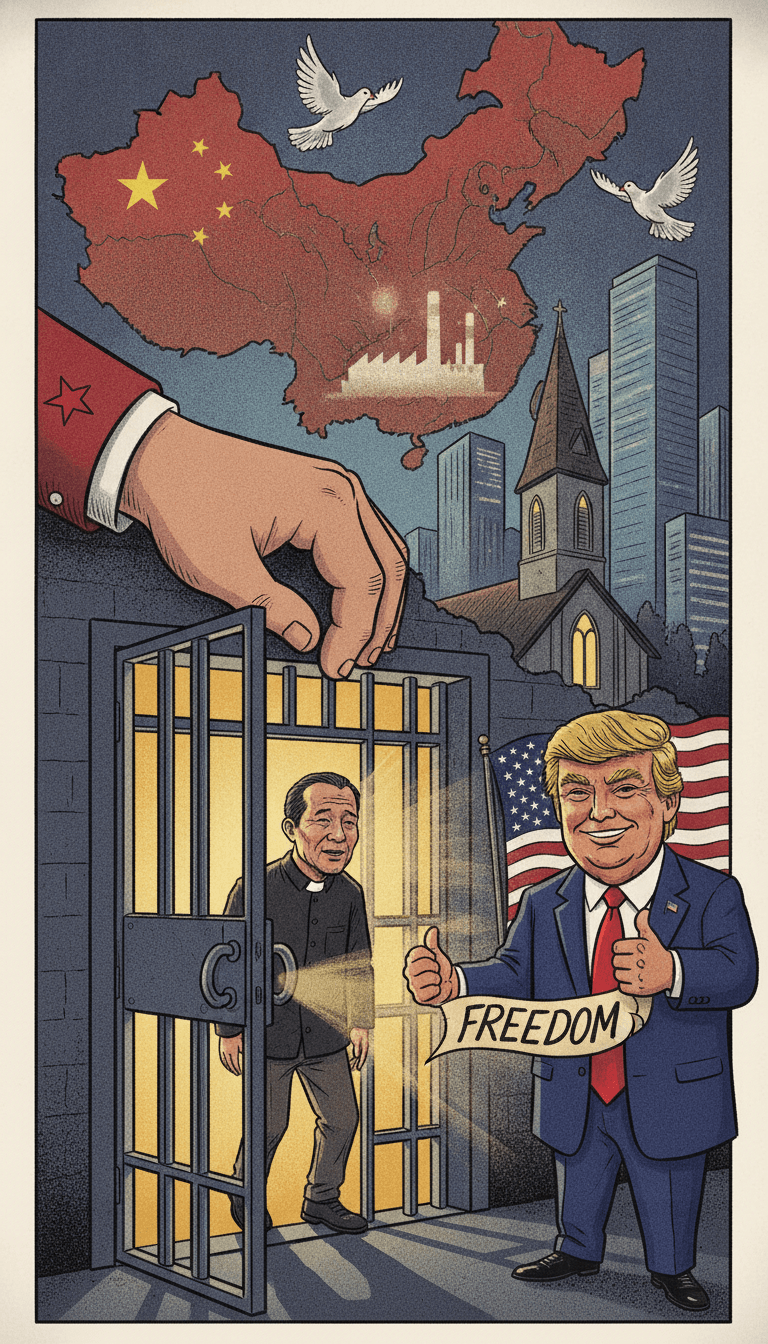
A significant development in the ongoing struggle for religious freedom in China has seen prominent underground church leader Pastor Ezra Jin Mingri released from detention. The release comes less than two months after then-U.S. President Donald Trump publicly pressed Chinese President Xi Jinping on the pastor's case during a high-profile state visit to Beijing. Pastor Jin's return to his family in the United States marks a rare win for international advocacy efforts targeting China's tightening grip on religious expression.
The news of Pastor Jin Mingri's freedom, confirmed by his family and rights advocates on Saturday, July 4, 2026, ignited hope among those monitoring Beijing's policies toward unregistered religious groups. He arrived in Los Angeles, reuniting with his American citizen family after nearly nine months of incarceration. His daughter, Grace Jin Drexel, expressed profound gratitude, acknowledging President Trump's efforts and the direct intervention of President Xi Jinping.
The Crackdown on Zion Church and Pastor Ezra Jin Mingri
Pastor Ezra Jin Mingri, also known as Jin Mingri, is the founder and spiritual leader of Beijing's Zion Church, one of China's largest and most influential unregistered Protestant congregations. Established in 2007, Zion Church rapidly grew, attracting thousands of worshippers in Beijing. Its expansion underscored a vibrant, albeit unsanctioned, Christian movement within the officially atheist nation.
The church first faced significant government pressure in 2018, when its main Beijing sanctuary was shut down after refusing demands to install surveillance cameras and join the state-approved church system. Undeterred, Pastor Jin and Zion Church adapted by shifting to a hybrid model of large online services and smaller, in-person house church gatherings across more than 40 cities in China. This approach reportedly allowed membership to grow to an estimated 10,000.
The latest—and most severe—crackdown occurred on October 10, 2025. Chinese authorities launched a coordinated nationwide operation, detaining Pastor Jin Mingri and approximately 30 other church leaders and members across multiple cities and provinces. Human rights organizations described it as the largest single crackdown on an urban unregistered church in four decades, signaling a clear escalation in the Chinese Communist Party's campaign to "Sinicize" religion, bringing all religious practice under tighter state control.
Pastor Jin and others were reportedly charged with "illegal use of information networks" under Article 287-1 of China's Criminal Law. The charge appeared directly linked to the Online Code of Conduct for Religious Professionals, implemented in September 2025, which restricted the online dissemination of religious content not approved by the government. The regulations directly affected churches like Zion that relied on digital platforms to conduct ministry outside state oversight.
U.S. Diplomatic Pressure and Trump's Direct Appeal
The detention of Pastor Jin Mingri quickly drew international condemnation, particularly from the United States. In October 2025, then-U.S. Secretary of State Marco Rubio condemned the arrests and called for the immediate release of the detained church leaders, arguing that the crackdown reflected the Chinese Communist Party's hostility toward Christians who resisted government interference in their faith.
The case gained greater diplomatic prominence during President Donald Trump's state visit to Beijing in May 2026. Speaking to reporters after returning to the United States, Trump confirmed that he had personally raised Pastor Jin's detention with President Xi Jinping, saying the Chinese leader had promised to "give serious consideration" to the matter. Such direct intervention by a U.S. president on an individual human rights case is relatively uncommon and underscored the administration's emphasis on religious freedom advocacy.
Pastor Jin's family, all U.S. citizens, had also campaigned actively for his release. He had been subject to a Chinese exit ban since 2018, preventing him from joining his wife and children in the United States. The family's sustained advocacy, combined with broader geopolitical considerations in U.S.-China relations, may have contributed to Beijing's eventual decision.
Implications for Religious Freedom and Geopolitics
The release of Pastor Ezra Jin Mingri is widely viewed as evidence that sustained international pressure—particularly at the highest diplomatic levels—can influence individual human rights cases. However, analysts caution against interpreting the move as a broader shift in China's religious policy. Under President Xi Jinping, authorities have continued to intensify restrictions on unofficial religious groups through church closures, surveillance, cross removals, restrictions on religious materials, and campaigns compelling believers to conform to state directives.
Even as Pastor Jin was released, the situation for many other Zion Church members remained uncertain. As of June 19, 2026, nine detained believers had reportedly been released on bail. However, nine other church leaders, including several pastors, continued to face more serious criminal charges such as "illegal business operations" and "fraud"—offenses that rights groups say are frequently used against religious leaders operating outside the state-approved system. Human Rights Watch stated that at least eight members of Zion Church remained in detention following Pastor Jin's release and continued to call for their freedom.
The case highlights the complex relationship between international human rights advocacy and geopolitical diplomacy. While the Chinese government rarely acknowledges responding to external pressure, the timing of Pastor Jin's release—following direct engagement between Trump and Xi—suggests a carefully calculated political decision within the broader context of U.S.-China relations.
For Pastor Jin and his family, the outcome represents a significant personal victory. At the same time, it underscores the ongoing challenges faced by unregistered religious communities throughout China and the continuing efforts of governments and human rights organizations to advocate for greater religious freedom amid tightening state control.