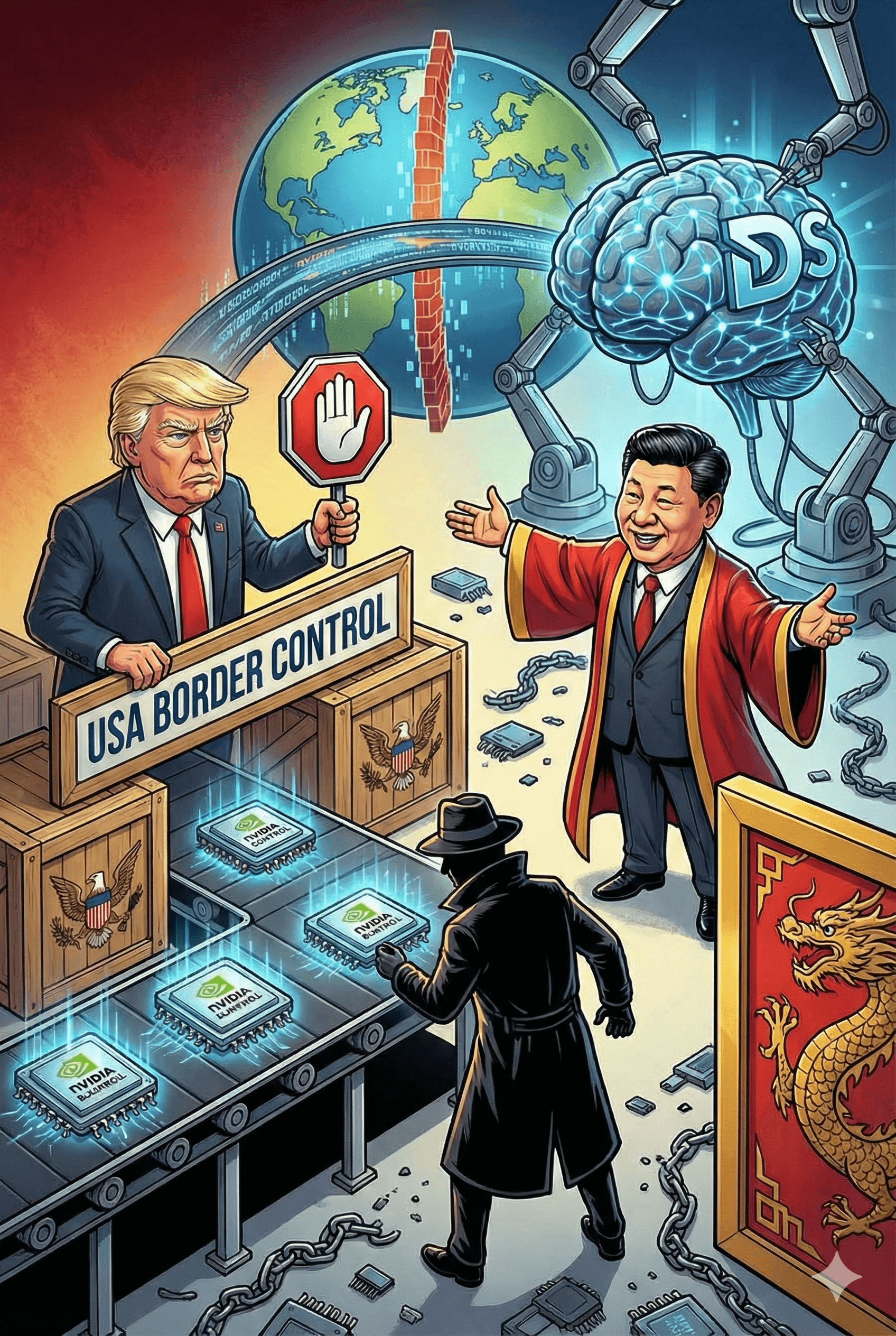
The global race for artificial intelligence supremacy has hit a major geopolitical flashpoint. According to recent statements from a senior U.S. administration official, the prominent Chinese artificial intelligence startup DeepSeek has successfully trained its forthcoming AI model using Nvidia’s highly restricted Blackwell processors.
This development represents a potential, high-stakes violation of strict U.S. export controls explicitly designed to prevent cutting-edge American semiconductor technology from reaching Chinese data centers. As DeepSeek prepares to launch its new AI model in the coming weeks, the revelation has reignited fierce debates in Washington regarding the effectiveness of international trade embargoes and the future of the U.S.-China tech war.
How DeepSeek Bypassed the US Export Ban
Under current U.S. Commerce Department regulations, the shipment of Nvidia’s flagship Blackwell chips to China is strictly prohibited. The Biden and subsequent Trump administrations established these export bans citing severe national security concerns, primarily the fear that advanced computing hardware could be diverted to supercharge China’s military modernization and cyber warfare capabilities.
Despite these rigorous restrictions, DeepSeek appears to have circumvented the U.S. export ban. U.S. intelligence suggests that a massive cluster of restricted Nvidia Blackwell chips is actively operating at a highly secure DeepSeek data center located in Inner Mongolia, an autonomous region in northern China.
While the official declined to disclose the exact methods the U.S. government used to gather this intelligence or how the covert procurement network smuggled the hardware across borders, the presence of the chips highlights major vulnerabilities in global tech supply chains.
The Erasure of Technical Indicators
To conceal their acquisition and use of American hardware, DeepSeek is reportedly undertaking complex measures to obscure the origins of their computing power. U.S. officials believe the Chinese AI firm is actively working to remove or mask internal technical indicators and digital fingerprints that would definitively prove the new AI model was trained on Nvidia’s processors. Whether these "technical scrubbing" efforts will successfully pass global scrutiny once the model is released remains to be seen, but the attempt underscores the covert nature of the operation.
The Core of the Controversy: National Security vs. Market Dominance
The confirmation of DeepSeek’s possession of Blackwell chips has deepened an already volatile political divide in Washington over how best to handle AI semiconductor restrictions.
The Political Divide in Washington
On one side of the aisle, defense hawks argue that any leakage of advanced AI technology is an unacceptable risk. Dr. Saif Khan, a former director of technology and national security at the White House National Security Council, noted that Chinese tech companies' reliance on smuggled hardware highlights their massive shortfall in domestic chip manufacturing. However, hawks argue this exact vulnerability is why the U.S. must tighten its grip, asserting that existing bans do not go far enough in preventing foreign military advancement.
On the other side, technology pragmatists warn that aggressive blockades may inadvertently harm American dominance. White House AI Czar David Sacks and Nvidia CEO Jensen Huang have previously voiced concerns that completely starving the Chinese market of advanced chips simply accelerates domestic self-reliance. They argue that prolonged embargoes force companies like Huawei to double down on producing native alternatives, which could eventually rival U.S. technology and freeze American companies out of a massive global market.
This philosophical clash was evident in late 2025 and early 2026 when President Donald Trump opened the door to allowing Chinese firms to purchase Nvidia's second-tier H200 chips in exchange for a 25% tariff. However, shipments of the H200 remain stalled due to heavy bureaucratic guardrails, making the Blackwell chip—Nvidia's absolute top-tier offering—an even more impossible legal acquisition for DeepSeek.
The "Distillation" Controversy and Data Harvesting
Adding another layer of controversy to DeepSeek’s rapid technological ascent are allegations regarding how the startup acquires its training data. U.S. officials and leading American AI developers allege that DeepSeek's upcoming model relies heavily on a technique known as "distillation."
Model distillation involves using older, highly capable AI models—such as those developed by OpenAI, Anthropic, Google, and xAI—to evaluate and generate high-quality data that is then fed into a newer, smaller model. Essentially, this allows a foreign competitor to piggyback on the billions of dollars and years of research invested by leading U.S. tech giants. Earlier this year, AI startup Anthropic openly accused DeepSeek and other Chinese "AI tigers" of harvesting its proprietary data to fast-track the training of their own systems, echoing similar warnings previously issued to U.S. lawmakers by OpenAI.
China's Official Response to the Allegations
Unsurprisingly, Beijing has firmly pushed back against Washington’s technological containment strategies. Responding to the mounting pressure, the Chinese embassy in Washington issued a statement condemning the U.S. government for "drawing ideological lines, overstretching the concept of national security, expansive use of export controls, and politicizing economic, trade, and technological issues."
At a recent Ministry of Foreign Affairs briefing, Chinese spokesperson Mao Ning stated she was unaware of the specific circumstances surrounding DeepSeek’s hardware procurement, but reiterated China’s long-standing opposition to Washington’s ongoing semiconductor blockades.
Outlook and Industry Impact: What’s Next for the AI Race?
The revelation that DeepSeek trained its latest AI model on Nvidia's Blackwell chips despite the US ban marks a pivotal moment in the global AI race.
Supply Chain Scrutiny: We can expect the U.S. Commerce Department and international intelligence agencies to aggressively crack down on third-party hardware intermediaries and underground smuggling rings. Countries acting as transshipment hubs may face intense diplomatic pressure or secondary sanctions.
Regulatory Retaliation: The incident may prompt the Trump administration to completely reverse its pending approvals for lesser chips like the H200, effectively freezing all legal AI semiconductor trade between the U.S. and China.
Market Volatility: As DeepSeek prepares to launch its new model, the tech sector will be watching closely. If the model proves to be a direct rival to top-tier Western offerings—built on smuggled American silicon and distilled American data—it will fundamentally challenge the narrative that export controls are sufficient to maintain U.S. AI supremacy.
Ultimately, this geopolitical chess match proves that while export controls create massive logistical friction, they are not an impenetrable shield. The global demand for computing power is simply too high, and the financial incentives too vast, to keep the "crown jewels" of technology locked inside a single border.
#Geopolitics #DeepSeek #Nvidia #BlackwellChip #ArtificialIntelligence #USChinaRelations #TechWar #Semiconductors #ExportControls #GlobalEconomy #TechNews #AI