The U.S. Department of Homeland Security (DHS) sparked widespread confusion and industry outrage over the weekend by announcing the suspension of two highly popular trusted-traveler programs—TSA PreCheck and Global Entry—amid an ongoing partial government shutdown. Following immediate and intense backlash from the travel industry and lawmakers, the agency reversed its decision regarding TSA PreCheck early Sunday morning. However, Global Entry remains suspended indefinitely, leaving millions of international travelers bracing for significant delays.
The Initial Suspension Announcement and Swift Reversal
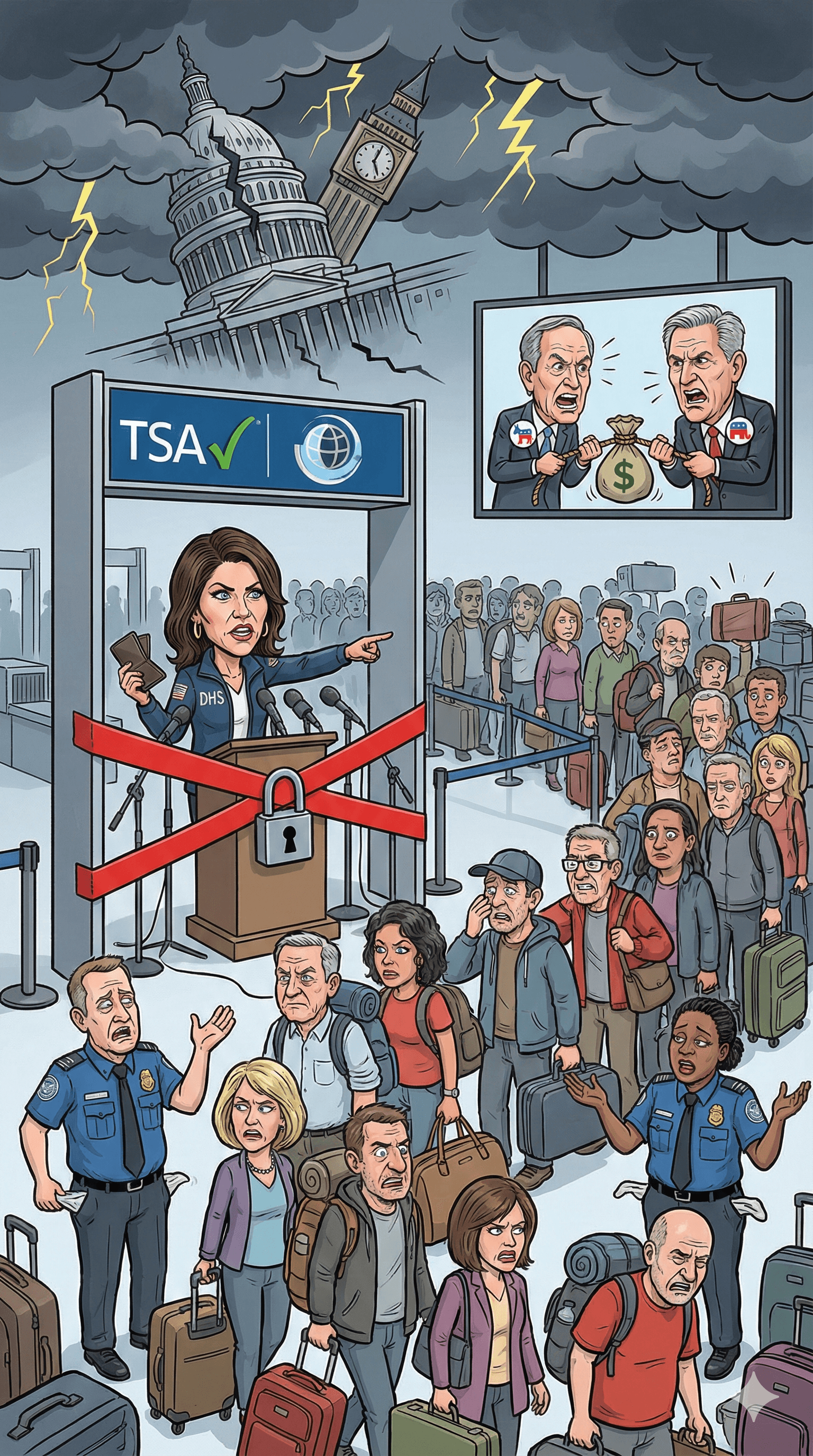
On Saturday evening, February 21, DHS Secretary Kristi Noem announced that starting at 6:00 a.m. ET on Sunday, the agency would temporarily halt both TSA PreCheck and Global Entry. The stated goal was to "refocus Department personnel on the majority of travelers" as staffing constraints tightened due to the partial government shutdown that began on February 14.
"Shutdowns have serious real-world consequences," Secretary Noem said in a statement, noting that the agency was forced to make "tough but necessary" decisions to mitigate the operational damage caused by the funding lapse.
The announcement sent shockwaves through the aviation sector. Yet, by Sunday morning, the Transportation Security Administration (TSA) issued a rapid correction, confirming that TSA PreCheck would remain fully operational.
"TSA PreCheck remains operational with no change for the traveling public," the agency stated on social media. "As staffing constraints arise, TSA will evaluate on a case by case basis and adjust operations accordingly."
According to a DHS official speaking anonymously to the press, the abrupt reversal was the result of urgent conversations between Secretary Noem, the White House, and TSA leadership after the initial rollout generated immediate public friction.
Global Entry Remains Halted for International Travelers
While the 20 million active members of TSA PreCheck can bypass standard screening lines, the suspension of Global Entry remains strictly in effect. Global Entry, a program managed by U.S. Customs and Border Protection (CBP), is utilized by over 10 million pre-approved, low-risk international travelers to expedite customs and immigration clearance upon entering the United States.
With Global Entry processing halted, CBP officers who typically manage the expedited automated kiosks are being reassigned to process the general arriving public. Consequently, international travelers returning to the U.S.—including U.S. citizens and permanent residents—must now use standard customs lines, which are expected to experience severe bottlenecks at major international hubs.
Additionally, the DHS confirmed that all courtesy and special privilege escorts at airports, such as those historically provided for members of Congress, have been suspended so that security personnel can focus entirely on standard operations.
Travel Industry Outcry and Political Backlash
The initial decision to suspend the trusted-traveler programs was met with fierce condemnation from both the travel industry and political leaders, who accused lawmakers of leveraging everyday citizens.
Chris Sununu, president and CEO of the trade association Airlines for America, which represents major carriers including American, Delta, Southwest, and United Airlines, heavily criticized the move. He stated that the travel industry was deeply concerned that the traveling public was being "used as a political football amid another government shutdown." He also emphasized that the extremely short notice gave travelers virtually no time to adjust their plans during a historically busy winter travel season.
U.S. Travel Association President and CEO Geoff Freeman echoed these sentiments, stating his organization was "glad" that the DHS avoided a "crisis of its own making" by keeping PreCheck open. "We are urging the same for Global Entry," Freeman added. "These Trusted Traveler Programs strengthen aviation security and improve screening efficiency. They are funded by user fees, and there is no reason at this time for them to be suspended."
On Capitol Hill, the reaction was swift. House Homeland Security Committee Democrats accused the administration of "kneecapping the programs that make travel smoother" and intentionally weaponizing the shutdown to punish the American public. Senate Majority Leader Chuck Schumer characterized the initial suspension as "bullying tactics," arguing that the administration was choosing to inflict pain on the public rather than negotiate on structural reforms.
The Root Cause: An Impasse Over Immigration and Border Policy
The chaos at the nation's airports stems directly from a partial government shutdown that is now entering its second week. Funding for the DHS lapsed at midnight on February 14 after congressional Democrats and the White House failed to reach a legislative agreement.
The political standoff centers heavily on funding for Immigration and Customs Enforcement (ICE) and CBP. Democrats are demanding significant overhauls to immigration enforcement operations following a highly controversial incident in Minneapolis last month, in which two U.S. citizens were fatally shot by federal immigration agents. President Donald Trump’s administration, meanwhile, remains firm on maintaining funding for its aggressive mass deportation campaign and border enforcement priorities.
Unlike the historic 43-day government shutdown of late 2025, this current lapse is narrowly confined to the DHS, meaning it affects roughly 13 percent of the federal civilian workforce. Still, the impact is immense. Approximately 61,000 TSA employees are currently working without pay. While ICE and CBP operations are largely insulated due to advance funding from a previous tax and spending bill, agencies like the TSA and the Federal Emergency Management Agency (FEMA) are highly vulnerable. Because of the shortfall, Secretary Noem announced that FEMA will halt all non-disaster-related responses—a critical pivot as a major blizzard currently threatens the East Coast.
Travel Implications and Future Outlook
As the partial government shutdown drags on with no immediate resolution in sight, travelers should prepare for localized and cascading disruptions.
For domestic flyers, TSA PreCheck lanes will remain open, but travelers should still anticipate longer wait times. The TSA's warning that it will evaluate staffing "on a case by case basis" signals that localized lane closures or consolidated checkpoints could occur if unpaid officers are forced to call out of work.
For international travelers, the ongoing suspension of Global Entry guarantees significantly longer processing times at border checkpoints. Passengers arriving from abroad are strongly advised to budget extra time for connecting flights and expect long queues at passport control.
The economic toll of the shutdown on the travel industry is also a looming concern. A similar government shutdown last year cost the travel sector and related industries an estimated $6.1 billion. If lawmakers cannot reach a funding agreement soon, the combination of suspended border programs, unpaid security personnel, and severe winter weather could create a perfect storm of travel chaos across the United States.
#GovernmentShutdown #TSAPreCheck #GlobalEntry #DHS #TravelNews #AirportSecurity #AviationNews #USPolitics #TravelDelays #BorderSecurity #KristiNoem #FrequentFlyer