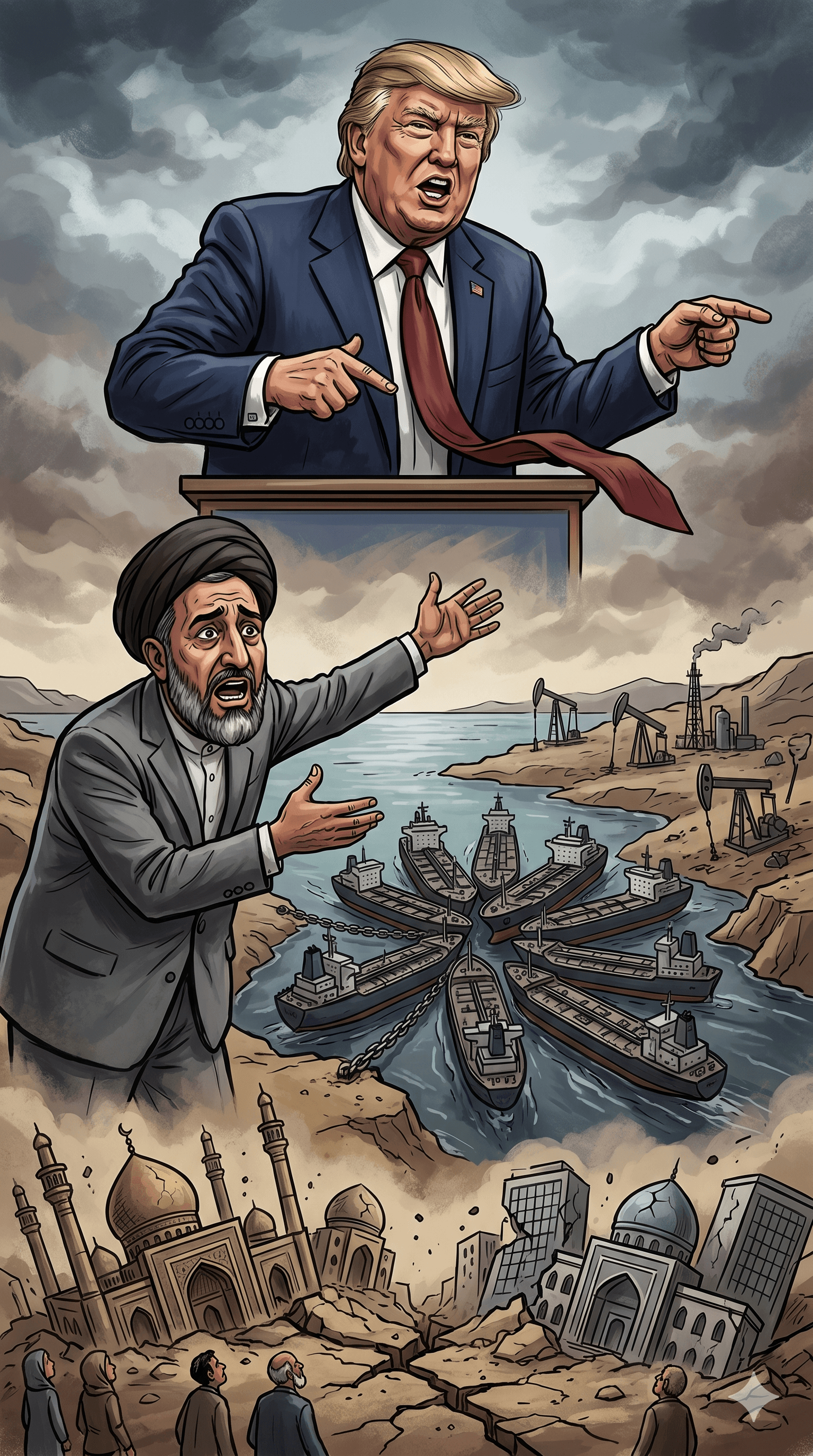
WASHINGTON D.C. — United States President Donald Trump claimed on Tuesday that Iran is currently experiencing a "state of collapse" and has actively approached Washington for assistance in reopening the strategically vital Strait of Hormuz. The bold assertion arrives amid a severe, months-long geopolitical standoff that has choked global energy markets, stranded thousands of commercial vessels, and sparked fears of a worldwide economic crisis.
The situation in the Middle East has remained volatile since a major military escalation in late February 2026. Now, amid a crippling "dual blockade," backchannel diplomatic maneuvers appear to be testing the waters for a potential de-escalation, though stark divisions remain over how to address Tehran’s nuclear ambitions.
The "State of Collapse" Claim
In a statement posted to his social media platform, Truth Social, early Tuesday, President Trump suggested that Tehran is grappling with severe internal pressures and is looking for an urgent off-ramp.
"Iran has just informed us that they are in a 'State of Collapse.' They want us to 'Open the Hormuz Strait,' as soon as possible as they try to figure out their leadership situation (Which I believe they will be able to do!)," the post read.
While the US President did not elaborate on the specific diplomatic channels used to deliver this message, the claim underscores the intense domestic and economic strain Iran is facing. Tehran has not officially confirmed any internal leadership crisis or verified the specific phrasing of the communication, but international observers note that the economic squeeze on the country has reached unprecedented levels.
The Dual Blockade: How the Strait of Hormuz Crisis Escalated
The current crisis traces its roots to the breakdown of nuclear negotiations in Geneva earlier this year. Following US and Israeli airstrikes on Iranian targets that began on February 28, 2026, Iranian authorities retaliated by effectively shutting down the Strait of Hormuz.
As the only maritime exit from the Persian Gulf, the Strait of Hormuz is a critical chokepoint. In peacetime, approximately 20 percent of the world’s oil and liquefied natural gas (LNG) supplies pass through its waters. In response to the strikes, Iran reportedly mined the narrow passageway—installing an estimated 6,000 mines—and mobilized its naval forces to block transit.
The situation escalated further on April 13, 2026, when the US Navy initiated a blockade of Iranian ports following the collapse of diplomatic talks in Islamabad. This resulted in what defense analysts are calling a "dual blockade": the US Navy blocking access to Iran, and Iran blocking access to the Gulf.
As a result, an estimated 2,000 commercial ships remain stranded in the region, waiting for safe passage. The closure has deeply rattled global energy markets, sending oil prices spiraling upward and leading to a sharp rise in gasoline and fuel costs for American consumers.
Iran's Diplomatic Overture and the Nuclear Deferment
Despite the ongoing military standoff, reports indicate that Tehran has formally submitted a proposal to Washington aimed at restoring maritime traffic. According to US administrative sources, the Iranian proposal offers a straightforward trade: Iran will reopen the Strait of Hormuz if the United States lifts its naval blockade of Iranian ports and agrees to halt hostilities.
However, the proposal comes with a significant caveat. Tehran reportedly wants to defer all critical discussions regarding its nuclear program and its stockpile of near-bomb-grade uranium to future negotiations.
This compartmentalization has triggered intense debate within the US administration. Critics argue that reopening the vital waterway without simultaneously addressing Iranian nuclear enrichment would effectively surrender one of Washington’s most powerful points of diplomatic leverage.
Divided Reactions Within the US Administration
President Trump and his national security team convened on Monday to review the Iranian proposal. While the White House confirmed that discussions took place, the administration appears highly skeptical of Tehran’s terms.
During the high-level briefing, Trump reportedly expressed deep reservations, signaling that he is not inclined to accept the plan in its current form.
Secretary of State Marco Rubio took a noticeably harder line against the overture. Rubio argued that Iran’s framework implies they have the authority to control international waters. "Those are international waterways," Rubio stated firmly. "They cannot normalize, nor can we tolerate them trying to normalize, a system in which the Iranians decide who gets to use an international waterway and how much you have to pay them to use it."
Shifting Geopolitical Alliances: Iran Looks to Russia
As negotiations with the West stall, Iran has intensified its diplomatic outreach to its eastern allies. On the same day Trump made his claims, Iranian Foreign Minister Abbas Araghchi met with Russian President Vladimir Putin in St. Petersburg.
Araghchi indicated that Tehran is weighing a US request to restart negotiations but blamed the failure of previous talks on "excessive" demands from Washington. The meeting highlights the broader geopolitical chess game at play, as Iran seeks to leverage its relationship with Moscow to counterbalance Western pressure.
Global Economic and Security Implications
The international community is watching the Strait of Hormuz crisis with mounting alarm. The continued blockade not only threatens global energy security but also the broader supply chain.
At the United Nations, dozens of nations have issued a joint call for the "urgent and unimpeded reopening" of the waterway. UN Secretary-General Antonio Guterres issued a stark warning this week, stating that the prolonged standoff risks triggering a global food emergency if shipping routes are not normalized soon.
Meanwhile, regional players are bracing for prolonged instability. Gulf leaders convened in Saudi Arabia on Tuesday to discuss a unified response to the ongoing conflict. Qatar issued a strong warning against using the Strait as a "pressure card," cautioning that the region cannot afford a "frozen conflict."
Impact and Outlook
The next phase of the US-Iran standoff remains highly uncertain. While Trump's assertion that Iran is in a "state of collapse" suggests Washington believes its maximum pressure campaign is working, the realities of the dual blockade are inflicting significant economic pain globally.
If the US administration formally rejects Iran's interim proposal, the standoff in the Strait of Hormuz is likely to continue, sustaining inflated energy prices and compounding global supply chain disruptions. Conversely, if a middle-ground agreement can be reached to clear the mines and lift the naval blockades, it could provide much-needed relief to international markets—even as the deeper conflict over Tehran’s nuclear ambitions remains unresolved.