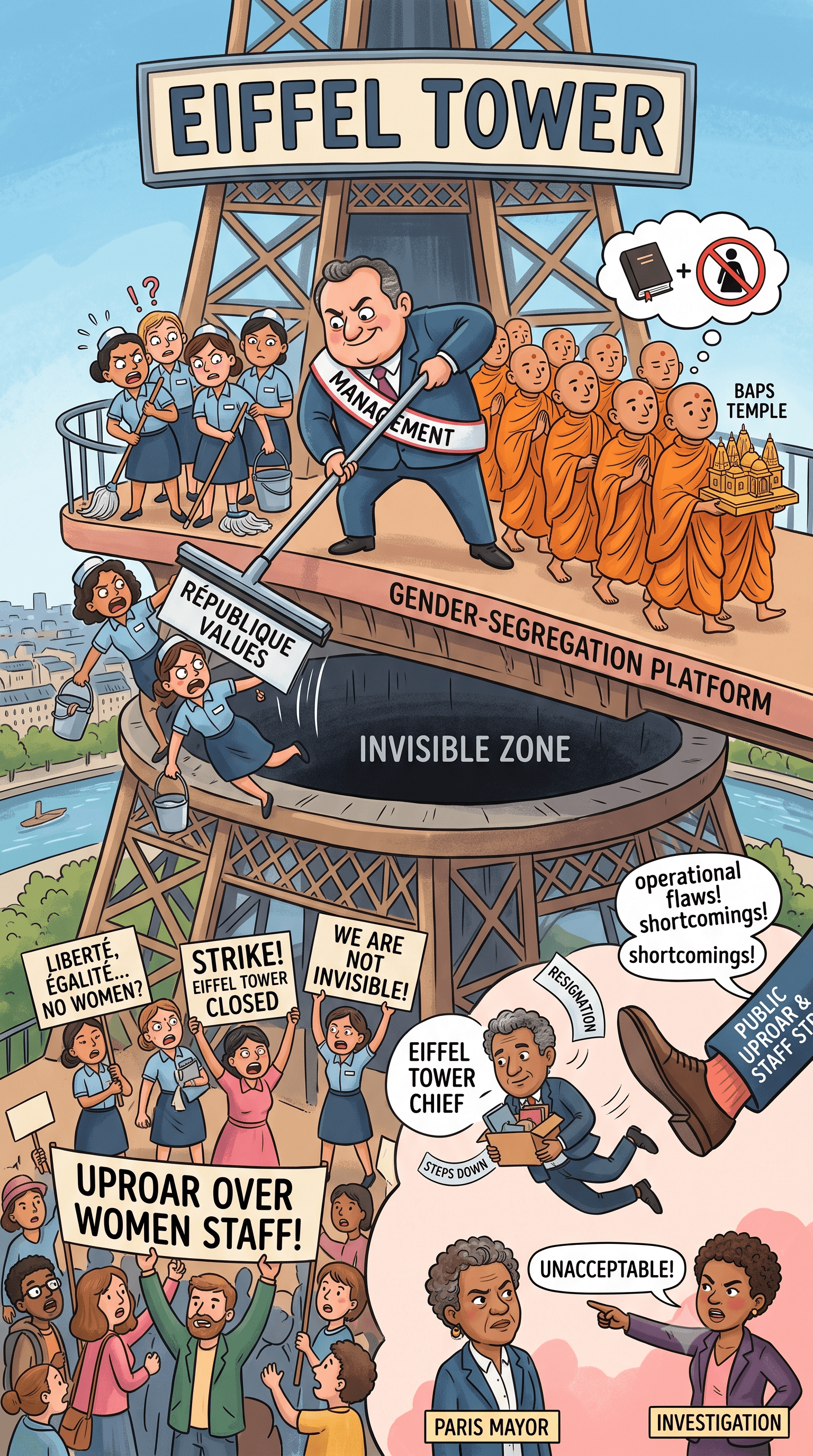
Paris’s most iconic landmark has found itself at the center of a major controversy involving gender equality, labor rights, and international religious delegations. Patrick Branco Ruivo, the director general of the Société d'Exploitation de la Tour Eiffel (SETE), will step down from his position at the end of the year. His upcoming departure follows widespread public uproar, staff strikes, and an internal investigation into the removal of female employees from their posts during a visit by a Hindu religious group, the Bochasanwasi Shri Akshar Purushottam Swaminarayan Sanstha (BAPS).
The Incident: What Happened at the Eiffel Tower?
The series of events that led to the resignation of the Eiffel Tower chief began in early September 2026. A private delegation of approximately 100 people linked to BAPS visited the Eiffel Tower. The group was in the French capital to celebrate the inauguration of a traditional Hindu stone temple and participated in a cultural boat procession on the River Seine on September 5.
During the delegation's visit to the monument, female employees working at the Eiffel Tower were reportedly asked to step away from their designated posts. Staff union representative Diane Davoine detailed that women were instructed to leave their workstations so that male employees could replace them. Furthermore, female staff members were explicitly told not to cross or walk through certain areas of the monument while the BAPS delegation was present.
These directives provoked immediate outrage among the workforce. In a collective statement, Eiffel Tower staff condemned the "professional instructions that led to female employees being sidelined, replaced and made invisible because of their sex". Female employees expressed that the situation made them feel "humiliated".
Staff Strike and Monument Closure
The profound dissatisfaction among the employees culminated in a walkout. On September 7, 2026, the staff staged a strike to protest the removal of their female colleagues, forcing the complete closure of the Eiffel Tower for the day. The closure of one of the world's most visited paid monuments quickly elevated the incident to national and international news, drawing intense scrutiny to the managerial decisions made by SETE.
The labor action highlighted a severe internal conflict regarding the prioritization of a private delegation's requests over the fundamental rights of the monument's workers. SETE management eventually admitted that the BAPS delegation had requested to "limit interactions with women," a request that the company later acknowledged should never have been accepted.
Investigations and the Chief's Resignation
In the wake of the strike and the ensuing public relations crisis, multiple investigations were launched. Paris Mayor Anne Hidalgo ordered a separate investigation to thoroughly examine the circumstances surrounding the removal of the female staff members.
Simultaneously, SETE conducted an independent probe into the incident. The findings of this internal investigation were highly critical of the monument's leadership. The company released a statement concluding that "operational flaws and shortcomings" in the organization of the visit resulted in the "unacceptable" sidelining of female employees.
As a direct consequence of these findings, it was announced on September 29, 2026, that Patrick Branco Ruivo would be leaving his post at the end of the year. Ruivo had been serving as the director general of SETE since 2018. SETE President Ariel Weil reinforced the organization's stance by publicly restating the Eiffel Tower's commitment to republican values and the strict equality of men and women.
Reactions from BAPS and International Responses
The incident has drawn official responses from the various entities involved. BAPS, a prominent worldwide religious and civic organization within the Swaminarayan sect of Hinduism, issued a statement following the controversy. The organization maintained that it had coordinated with the Eiffel Tower's management strictly to minimize disruption to staff and visitors ahead of the delegation's arrival. BAPS further asserted its commitment to the principles of equality, mutual respect, and service to all, regardless of gender, stating that these values are at the core of their tradition's teachings and global community work.
On the diplomatic front, the incident prompted a brief response from the Indian government. On September 8, the Ministry of External Affairs (MEA) addressed the controversy, stating that the matter was strictly "between the entities concerned" and did not warrant diplomatic intervention.
Broader Implications for French Republican Values
From an analytical perspective, this controversy strikes at the heart of French societal principles. France is a nation that fiercely defends its republican values, particularly gender equality and secularism in the public sphere. The Eiffel Tower is not merely a tourist attraction; it is a global symbol of the French Republic. The revelation that the management of such an iconic state-associated entity compromised on gender equality to accommodate the cultural preferences of a visiting delegation has deeply resonated with the French public and politicians.
The swift action taken by Paris Mayor Anne Hidalgo and the SETE board underscores the low tolerance for workplace discrimination in France. The incident is likely to prompt a comprehensive review of how private VIP visits are managed at major French heritage sites, ensuring that the fundamental rights of employees are not negotiated or compromised.
Outlook and Impact
The departure of Patrick Branco Ruivo marks a significant leadership transition for the Eiffel Tower. As SETE prepares for new management in the coming year, the immediate focus will undoubtedly be on repairing relations with the staff union and implementing rigid protocols to prevent similar occurrences. SETE's leadership has already indicated that measures and internal training programs promoting gender equality will be rapidly implemented.
For global organizations and world-renowned tourist landmarks, the Eiffel Tower controversy serves as a stark reminder of the complexities involved in accommodating diverse international delegations. It highlights the absolute necessity of establishing clear boundaries that align with local laws and fundamental human rights, ensuring that hospitality never comes at the cost of employee dignity and equality.