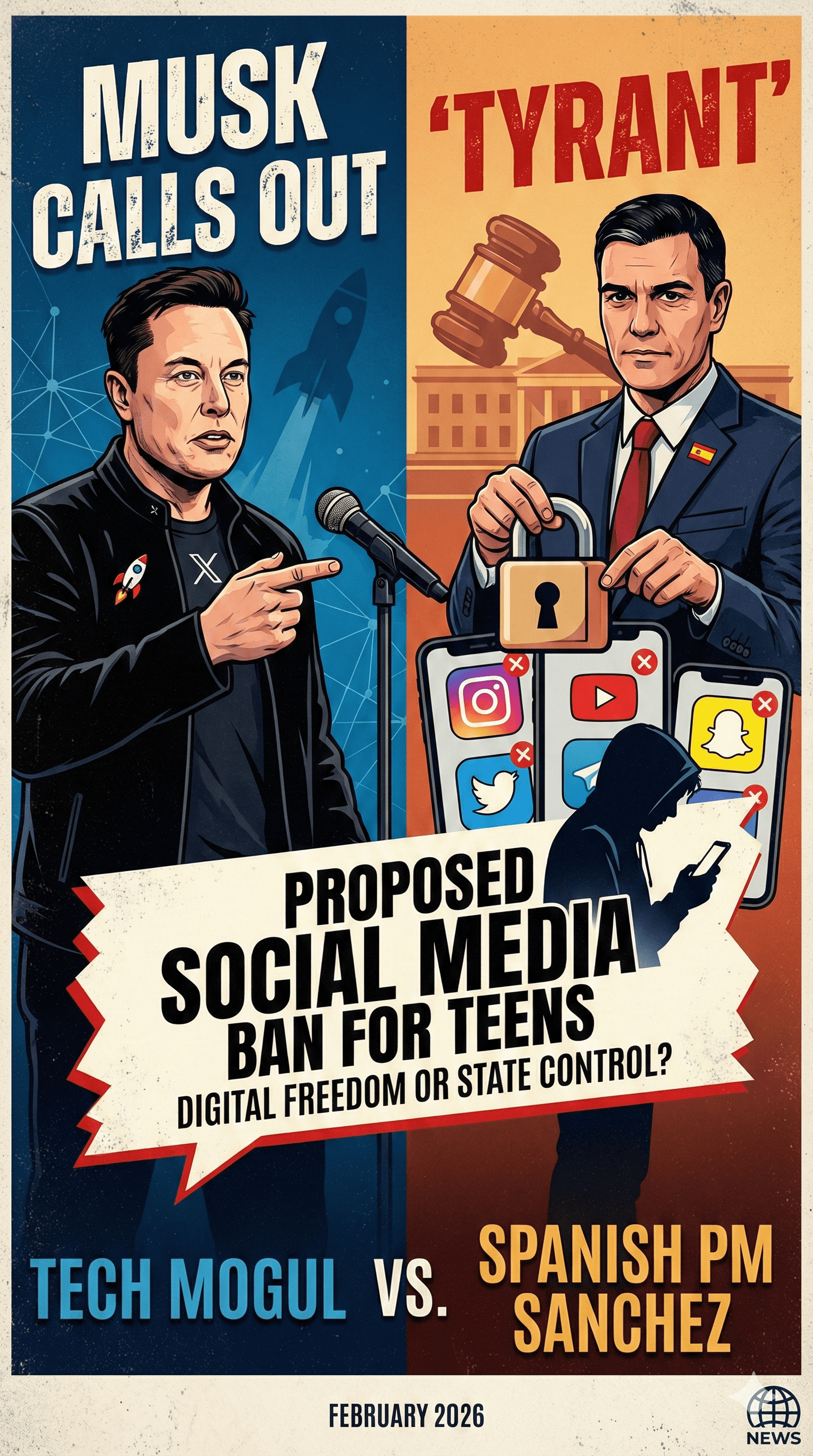
MADRID / SAN FRANCISCO – A fiery new clash has erupted between the tech world and national government as Elon Musk, owner of the X platform (formerly Twitter), publicly labeled Spanish Prime Minister Pedro Sánchez a "tyrant." The sharp rebuke follows Sánchez's controversial proposal to implement a nationwide ban on social media access for all teenagers under the age of 16 in Spain.
This latest confrontation highlights the intensifying global battle over who should regulate the digital lives of minors: tech companies or the state.
The 'Tyrant' Accusal: Musk's Strong Rebuke
Known for his unfiltered commentary, Musk took to his own platform, X, to denounce the Spanish Prime Minister's legislative push. In a series of posts, Musk argued that the proposed ban is a gross overreach of government power and an infringement on individual liberty.
"Calling this 'protection' is a joke. This is what a tyrant does. You don't protect free speech by banning it for an entire generation," Musk posted, adding, "Governments should not be the ultimate arbiters of information. This is a slippery slope toward total state control." His comments were accompanied by a meme depicting Sánchez as a padlock-wielding authoritarian, an image that quickly went viral.
Musk’s stance resonates with a segment of the public that views such government intervention as paternalistic and a threat to digital rights. His supporters argue that education and parental controls, not blanket bans, are the solution to online safety concerns.
Sánchez's Proposal: Protecting Minors or Overreach?
Prime Minister Pedro Sánchez announced the proposed legislation earlier this week, framing it as a necessary measure to combat the "mental health epidemic" among Spain's youth. The bill, if passed, would require social media platforms like Instagram, TikTok, and Snapchat to implement rigorous age-verification systems to block users under 16.
"We cannot stand idly by while our children are exposed to harmful content, cyberbullying, and addictive algorithms that are proven to damage their well-being," Sánchez stated in a press conference. "This is not about censorship; it is about protecting the vulnerable. The state has a duty to step in when the market fails to protect our children."
The Spanish government points to recent studies linking excessive social media use in adolescents to increased rates of anxiety, depression, and self-harm. Supporters of the ban argue that tech companies have consistently put profit over safety, necessitating government intervention.
The Global Debate: Digital Freedom vs. State Control
The clash between Musk and Sánchez is a microcosm of a larger, global debate centered on the tagline from the recent viral poster: "Digital Freedom or State Control?"
Many nations are currently grappling with similar issues. From the UK's Online Safety Act to various state-level bills in the US, governments are attempting to legislate the digital space. However, critics like Musk argue that these laws are often clumsy, ineffective, and prone to abuse, potentially silencing marginalized voices and hindering the free flow of information.
Tech policy experts are divided. Some believe that age-gating the internet is technically unfeasible and easily circumvented by tech-savvy teens. Others argue that without the threat of significant government sanctions, social media giants will never take the necessary steps to make their platforms safer by design.
As the Spanish parliament prepares to debate the bill, the eyes of the world are on Madrid. The outcome of this legislative battle could set a precedent for how other countries approach the complex and contentious issue of regulating social media for the next generation.