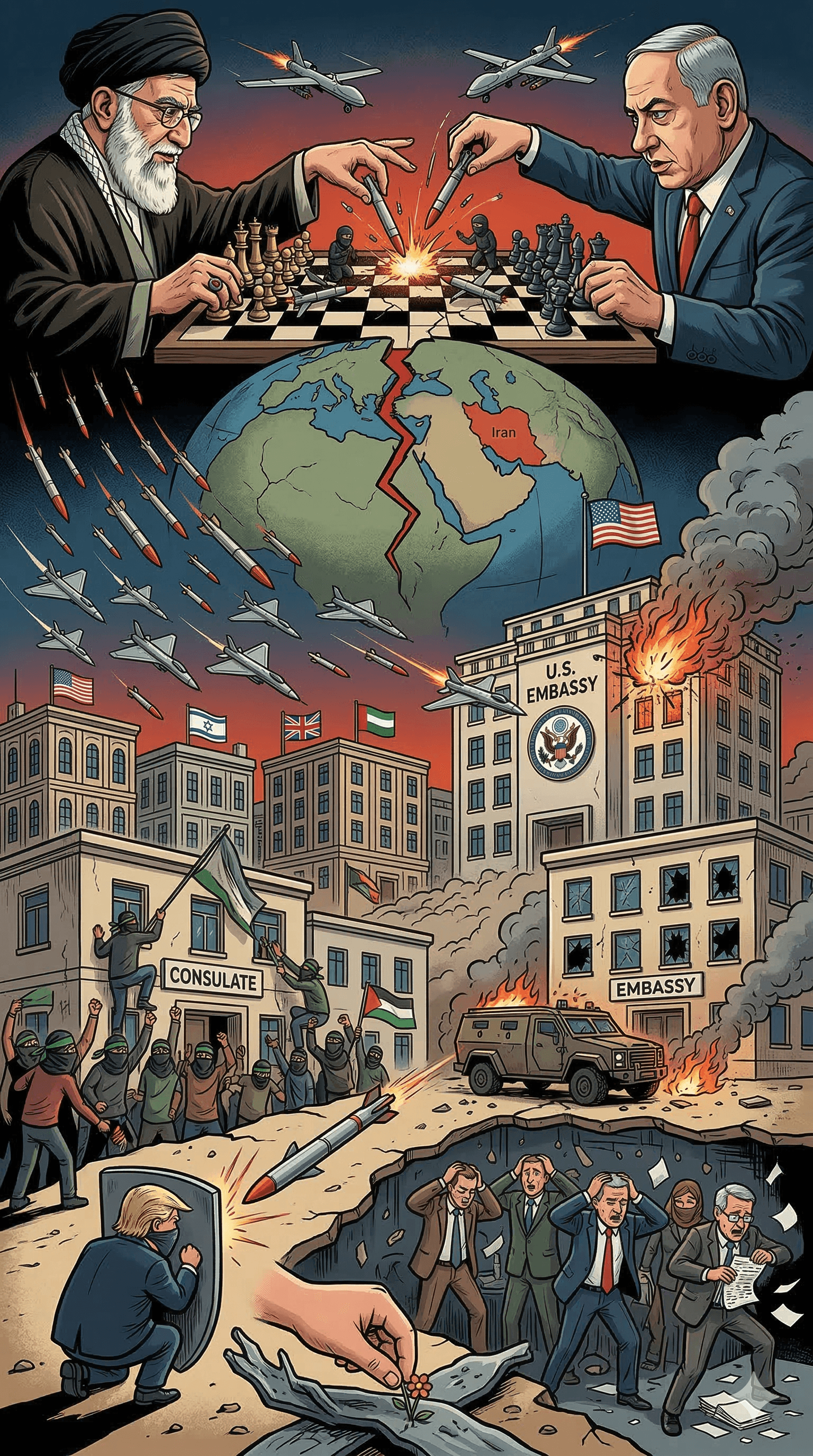
MARCH 17, 2026 — The traditional sanctity of diplomatic missions, once considered "sovereign soil" and protected by centuries of international law, has effectively collapsed as the conflict between the United States, Israel, and Iran enters a devastating new phase. Over the past three weeks, a series of precision strikes and retaliatory drone swarms have turned embassies and consulates across the Middle East into active combat zones, signaling a fundamental breakdown in the global diplomatic order.
A Targeted War on Sovereign Soil
The current crisis was ignited on February 28, 2026, when a combined U.S.-Israeli operation launched surprise airstrikes across Iran. The initial wave targeted high-value leadership, reportedly killing Supreme Leader Ali Khamenei and several top military officials. Since then, the conflict has rapidly devolved into a regional conflagration where diplomatic facilities are no longer off-limits.
According to reports from human rights observers and regional ministries, the "Twelve-Day War" of 2025 has been eclipsed by the current escalation. In just the last 14 days, U.S. and Israeli diplomatic missions in Bahrain, Kuwait, Qatar, Saudi Arabia, and the United Arab Emirates (UAE) have all sustained damage from Iranian-linked drone and missile attacks.
The Siege of the Baghdad Diplomatic Support Center
The most persistent flashpoint remains Iraq, where the Baghdad Diplomatic Support Center (BDSC)—a sprawling logistical hub for American diplomats—was struck again this week. On March 10, a swarm of six drones targeted the facility; while five were intercepted by air defense systems, one impacted a guard tower, forcing personnel to "duck and cover" for hours.
The U.S. State Department has issued a formal condemnation, attributing the strike to "Iran-backed terrorist militias." However, the Iraqi government has found itself in a precarious position, condemning the violation of its sovereignty while struggling to restrain the Islamic Resistance in Iraq—a coalition of armed groups that has claimed responsibility for daily attacks since the February 28 offensive began.
Regional Escalation: Riyadh, Dubai, and Kuwait City
The targeting of embassies has not been limited to Iraq.
Saudi Arabia: On March 3, a drone attack struck the U.S. embassy in Riyadh. Recent damage assessments indicate that parts of the facility, including the CIA station on the upper floors, are "unrecoverable."
UAE: The U.S. consulate in Dubai was hit by an Iranian drone on the same day, causing a massive fire captured in viral social media footage.
Kuwait: The U.S. embassy in Kuwait City was targeted by projectiles, leading to the immediate closure of the mission and the evacuation of non-essential staff.
In response to these threats, the Trump administration has ordered the evacuation of non-essential diplomatic personnel from over a dozen countries across West Asia, citing "unprecedented safety risks."
The Erosion of International Law
The targeting of diplomatic missions marks a departure from the 1961 Vienna Convention on Diplomatic Relations, which established the principle of the "inviolability" of embassy premises. Analysts point to the April 1, 2024, Israeli strike on the Iranian consulate in Damascus as the historical turning point that "normalized" attacks on diplomatic annexes.
By 2026, this tit-for-tat dynamic has accelerated. Iran’s Foreign Minister, Abbas Araghchi, recently stated that the war would only end when Tehran receives guarantees that its sovereign territory—including its foreign missions—will no longer be targeted. Conversely, U.S. Secretary of Defense Pete Hegseth has indicated that military operations will continue until Iran's "ballistic missile program is decimated."
Economic and Social Fallout
The "Embassy War" has sent shockwaves through the global economy. As the conflict spreads to the Gulf states, oil prices have surged, and commercial shipping through the Strait of Hormuz has plummeted.
The closure of embassies has also stranded thousands of migrant workers and tourists across the region. Human rights organizations report that over 1,351 civilians have been killed since the February 28 strikes, with the damage to diplomatic facilities further complicating efforts to coordinate humanitarian aid or provide consular assistance to trapped foreign nationals.
Outlook: A Region Without "Safe Zones"
As of mid-March 2026, the Middle East is entering a state of "exhausted realignment." With the assassination of key Iranian leaders and the subsequent rise of Mojtaba Khamenei, the "Axis of Resistance" is increasingly decentralized, leading to more unpredictable attacks on soft targets like diplomatic quarters.
The international community, including the United Nations, has condemned the retaliatory strikes on Gulf states, but diplomatic leverage is at an all-time low. Without a ceasefire, the very concept of an embassy as a neutral, safe space for negotiation may become a relic of the past, replaced by fortified bunkers in an era of perpetual regional war.
#News #Geopolitics #IranWar2026 #MiddleEastConflict #Diplomacy #USForeignPolicy #IsraelIran War #GlobalEconomy #BreakingNews #InternationalLaw #StraitOfHormuz #Baghdad