As the 2026 Iran War escalates on Day 121, Tehran launches drone and missile attacks on Bahrain and Kuwait, triggering US retaliatory strikes near the Strait of Hormuz. Fragile peace talks are now imperiled.
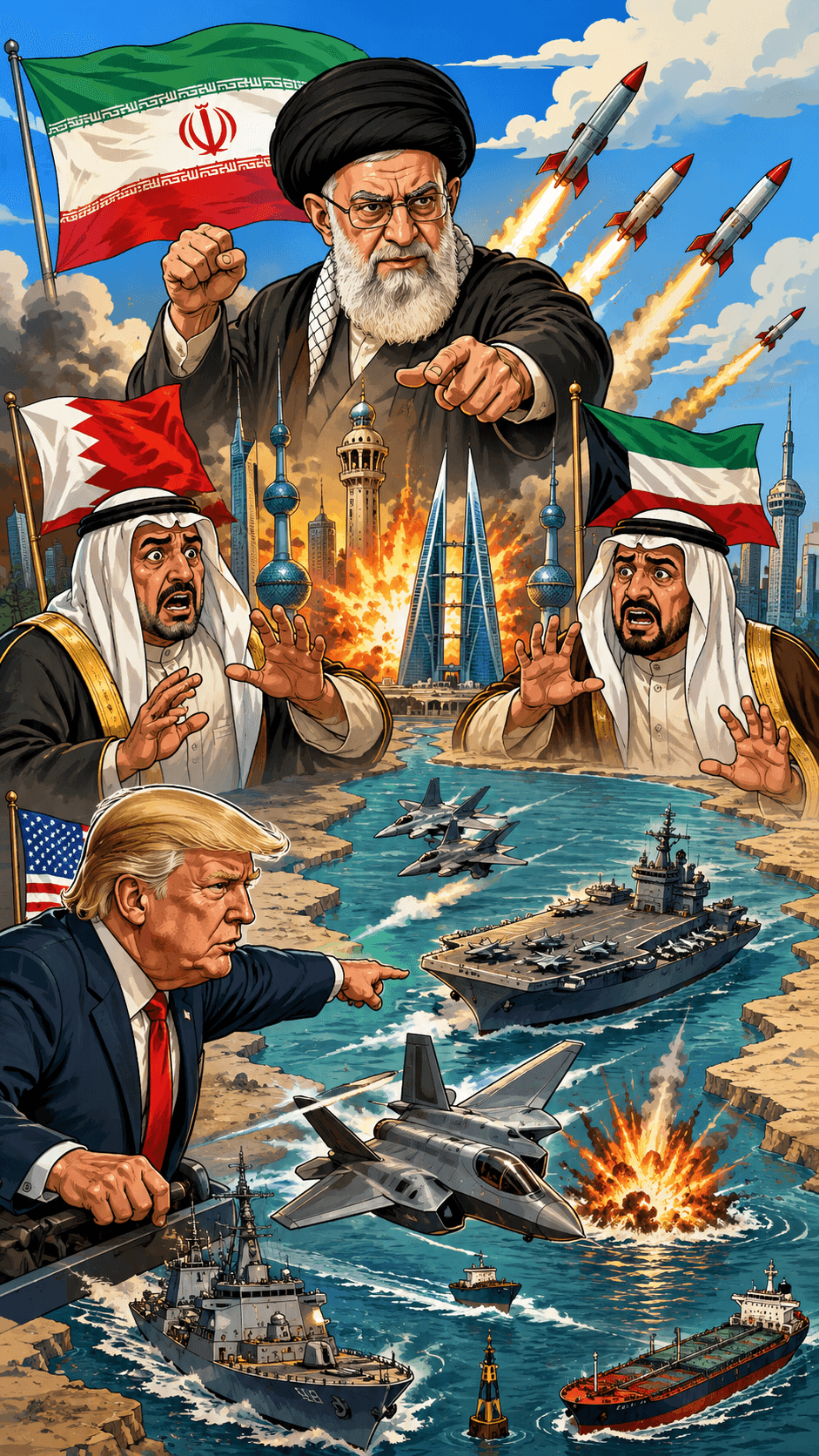
DUBAI — The volatile Iran War entered its 121st day with a dramatic escalation on Sunday, June 28, 2026, as Iran launched drone and missile attacks targeting Bahrain and Kuwait. These retaliatory strikes came hours after the United States conducted its own airstrikes against Iranian military infrastructure near the strategic Strait of Hormuz, severely jeopardizing a fragile ceasefire and ongoing peace negotiations. The deepening crisis underscores the precarious security situation in the Persian Gulf, a critical artery for global energy supplies.
The renewed crossfire marks a significant setback for diplomatic efforts aimed at de-escalating the four-month-old conflict, which began on February 28, 2026. With both sides accusing the other of violating an interim peace deal signed earlier this month, fears are mounting over the potential for a broader regional conflagration.
Escalating Tensions in the Strait of Hormuz
The immediate catalyst for Sunday's attacks appears to be heightened tensions surrounding the Strait of Hormuz. A multinational maritime body, overseen by the U.S. Navy, announced Saturday its intention to expand a shipping route near Oman for both inbound and outbound traffic. This move was explicitly challenged by Tehran, which insists it alone must govern the strait, a vital waterway that historically carries a fifth of the world's oil and natural gas. Iranian Foreign Minister Abbas Araghchi reiterated Tehran's stance during a visit to Iraq, warning that any external interference in the strait's arrangements would "lead to further complications" and delay its reopening.
The U.S. military's Central Command (CENTCOM) confirmed it launched fresh airstrikes against Iran, hours after a Panama-flagged tanker, the M/T Kiku, was reportedly hit by an Iranian drone in the Strait of Hormuz early Saturday morning. CENTCOM stated its forces targeted Iranian military assets, including surveillance infrastructure, communication systems, air defense sites, drone storage facilities, and mine-laying capabilities. U.S. President Donald Trump, in a social media post, accused Iran of repeatedly violating the ceasefire agreement and warned of severe consequences, stating that "the Islamic Republic of Iran will no longer exist!" if the U.S. is "forced to militarily complete the job."
Iran's Retaliatory Strikes on Gulf Nations
In direct response to the U.S. actions, Iran's paramilitary Revolutionary Guard (IRGC) announced early Sunday that its navy and aerospace forces had launched joint missile and drone operations. These strikes specifically targeted U.S. military sites in Kuwait and Bahrain.
In Bahrain, the Interior Ministry reported that Iranian strikes damaged a residential building near the international airport. While no fatalities were reported, photos released by the ministry showed an 8-story building with its top floor destroyed, windows blown out, and rubble scattered. Bahrain hosts the U.S. Navy's 5th Fleet, whose base had been subjected to repeated attacks throughout the ongoing war. A U.S. official also confirmed two one-way attack drones approached the U.S. Navy base, with one being shot down and the other landing harmlessly.
Kuwait also came under attack, with its army confirming that air defenses detected and intercepted two ballistic missiles. Fortunately, no injuries or material damage were reported in Kuwait, which hosts a significant U.S. Army base. Sirens sounded across Kuwait City following the attacks.
Diplomatic Fallout and Implications
The latest exchange of hostilities deals a severe blow to the fragile interim peace deal reached between the U.S. and Iran earlier this month. The memorandum of understanding (MoU) was designed to halt fighting, remove a U.S. blockade, lift sanctions, and facilitate the reopening of the Strait of Hormuz, with a 60-day period allotted to finalize the details. However, this recent escalation threatens to torpedo the agreement before it can be fully implemented.
Iranian officials have warned that continued U.S. attacks could lead to a "complete halt" in negotiations to end the war. This stance reflects the deep mistrust and divergent interpretations of the ceasefire agreement between Washington and Tehran. The prospect of further diplomatic breakdown carries significant risks for regional stability and the global economy.
Economically, the continued disruption and uncertainty surrounding the Strait of Hormuz, a critical chokepoint for oil shipments, could lead to increased volatility in global energy markets. The previous closure of the strait for most of the conflict had already caused oil prices to surge. The current escalation, even with a limited impact on shipping so far, signals renewed threats to supply stability.
Outlook
As the conflict enters its fifth month, the direct exchange of fire between Iran and Gulf nations hosting U.S. forces marks a dangerous new phase. The core issue of control over the Strait of Hormuz remains a primary flashpoint, with Iran vehemently opposing any arrangements that circumvent its authority. With President Trump issuing strong warnings and Iran threatening to abandon peace talks, the path toward a lasting resolution appears increasingly fraught with peril. The international community watches anxiously as efforts to contain the Iran War face their most severe test yet.