BRUSSELS — Transatlantic trade tensions have reached a new boiling point this week as the European Union forcefully rejected demands from the Donald Trump administration to renegotiate its landmark environmental regulations. The diplomatic standoff unfolded simultaneously with the release of a bombshell White House report accusing the EU and over 40 other nations of facilitating a massive network for Chinese exporters to evade US tariffs.
The dual-front confrontation underscores the widening rift between Washington and Brussels. While the US seeks to crack down on global supply chains that bypass its aggressive tariff regime, the EU is standing firm on its regulatory autonomy and climate-focused trade policies, warning that its domestic laws are not open for American interference.
'The Great Transshipment Scam': US Accuses EU of Enabling China
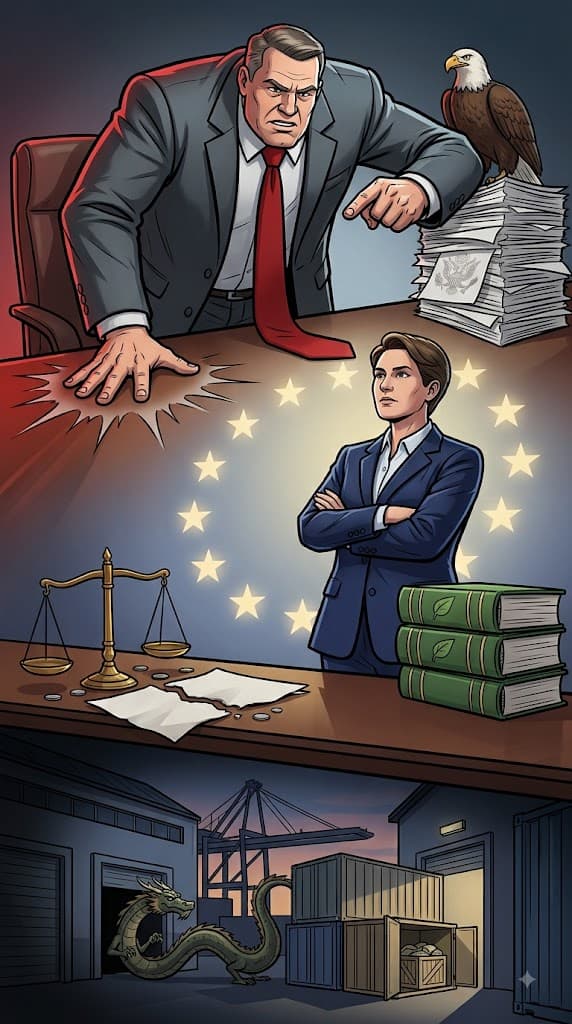
At the center of the recent escalation is a 25-page White House report released on August 13, 2026, bluntly titled The Great Transshipment Scam: Rise, Scope, and Costs. Prepared by the White House Office of Trade and Manufacturing Policy under the direction of top trade adviser Peter Navarro, the document alleges that Chinese manufacturers are circumventing high US tariffs by laundering their exports through third-party countries.
According to the Trump administration, goods originating in China are being sent to intermediary nations where they undergo minor processing, repackaging, or relabeling before being shipped to the US under a new declared country of origin. The White House estimates that this illicit practice involves between $40 billion and $303 billion in trade, directly undermining the sweeping tariffs President Trump first imposed on Beijing.
The report controversially names the European Union as a prominent enabler, classifying the bloc as a "Tier 1 Diversified Scale Leader" within China's "Shadow Transshipment Network". US officials specifically pointed to a "Central and Eastern European Processing Belt"—comprising Poland, the Czech Republic, Hungary, and Romania—where they allege Chinese components are tested, finished, and repackaged for the American market.
Navarro warned that countries facilitating this indirect entry of Chinese goods could face severe trade sanctions if they fail to close these loopholes. To combat the evasion, Navarro announced the deployment of an AI-powered customs system called "Detective Border," designed to scrutinize global supply chains and identify fraudulent shipments to recover tens of billions in tariff revenue.
US Targets EU Green Rules as ‘Protectionism’
Concurrently, the Trump administration has intensified its trade pressure on a second front: Europe's expanding framework of green rules. On August 12, US Ambassador to the EU Andrew Puzder published an op-ed in The Financial Times, sharply criticizing the EU's Carbon Border Adjustment Mechanism (CBAM) and new corporate supply chain sustainability directives.
Puzder characterized these environmental regulations as disguised protectionism, arguing that they create unreasonable burdens on American commerce. He demanded that Brussels align its green rules with the recently enacted EU-US trade deal—which instituted a baseline 15% US import duty on most EU goods—warning that the United States would take retaliatory action if a solution was not found to ease the regulatory impact on US companies.
"Protesting against US national security measures while erecting protectionist barriers reveals a striking double standard," Puzder stated, asserting that the EU's carbon tax differs from US tariffs "in form but not in substance".
Brussels Defends Regulatory Autonomy
The European Union was quick to push back against both the transshipment allegations and the attacks on its environmental policies.
European Commission spokesperson Arianna Podesta responded firmly to the US ambassador’s threats, stating that while the EU is open to constructive dialogue on tariff issues, its internal rules framework and regulatory autonomy are strictly "not up for negotiation".
Addressing the specific attacks on CBAM—which entered its definitive phase earlier in 2026—the Commission rejected the characterization of the climate tool as a traditional tariff. "It is non-discriminatory, WTO-compatible, and applies equally to all third countries based on verified embedded emissions, irrespective of origin," an EU spokesperson noted. The EU maintains that CBAM is an essential environmental measure designed to prevent "carbon leakage"—a scenario where companies move production to countries with weaker climate policies—and is entirely distinct from the punitive, unilateral tariffs deployed by Washington.
Regarding the accusations of enabling China tariff evasion, the European Commission stated it was engaging with US officials to better understand the transshipment report. However, the EU emphasized that the very report acknowledges that transshipment risks in Europe are embedded within broad, legitimate trade flows. Brussels cautioned that being named in the report should not be interpreted as evidence that the EU systematically or legally facilitates customs fraud, and it reiterated its commitment to tackling illegal trade practices through standard customs cooperation.
The Broader Economic Context
These renewed disputes expose a fundamental tension in global trade dynamics. Under the Trump administration, the gap between the tariffs applied to China and those applied to third countries has widened dramatically. While these differentiated duties were designed to penalize Beijing, they have inadvertently created massive economic incentives for tariff arbitrage—pushing global supply chains into complex rerouting schemes.
Simultaneously, Europe's strategic shift toward a green economy is fundamentally altering how it trades with the world. By linking market access to carbon emissions and deforestation regulations, the EU is effectively exporting its climate policies globally. The US, heavily reliant on traditional energy and manufacturing models, increasingly views these green rules not as environmental stewardship, but as an economic threat to American industrial competitiveness.
Impact and Outlook
Looking ahead, the friction between the US and the EU is poised to create significant volatility for global supply chains. If Washington follows through on threats to penalize European nations for alleged China tariff evasion, it could trigger a retaliatory spiral reminiscent of past tariff wars. The impending deployment of the US AI customs tracking system means enforcement will become more aggressive and less flexible for allied nations.
Furthermore, the US pushback against EU green rules places multinational corporations in a precarious position. Businesses will have to navigate a fragmented global landscape where complying with Europe's strict environmental standards could invite punitive measures from a US administration intent on protecting American commerce. As trade policy becomes inextricably linked to climate action and geopolitical rivalries, the transatlantic economic alliance faces its most severe stress test in years.