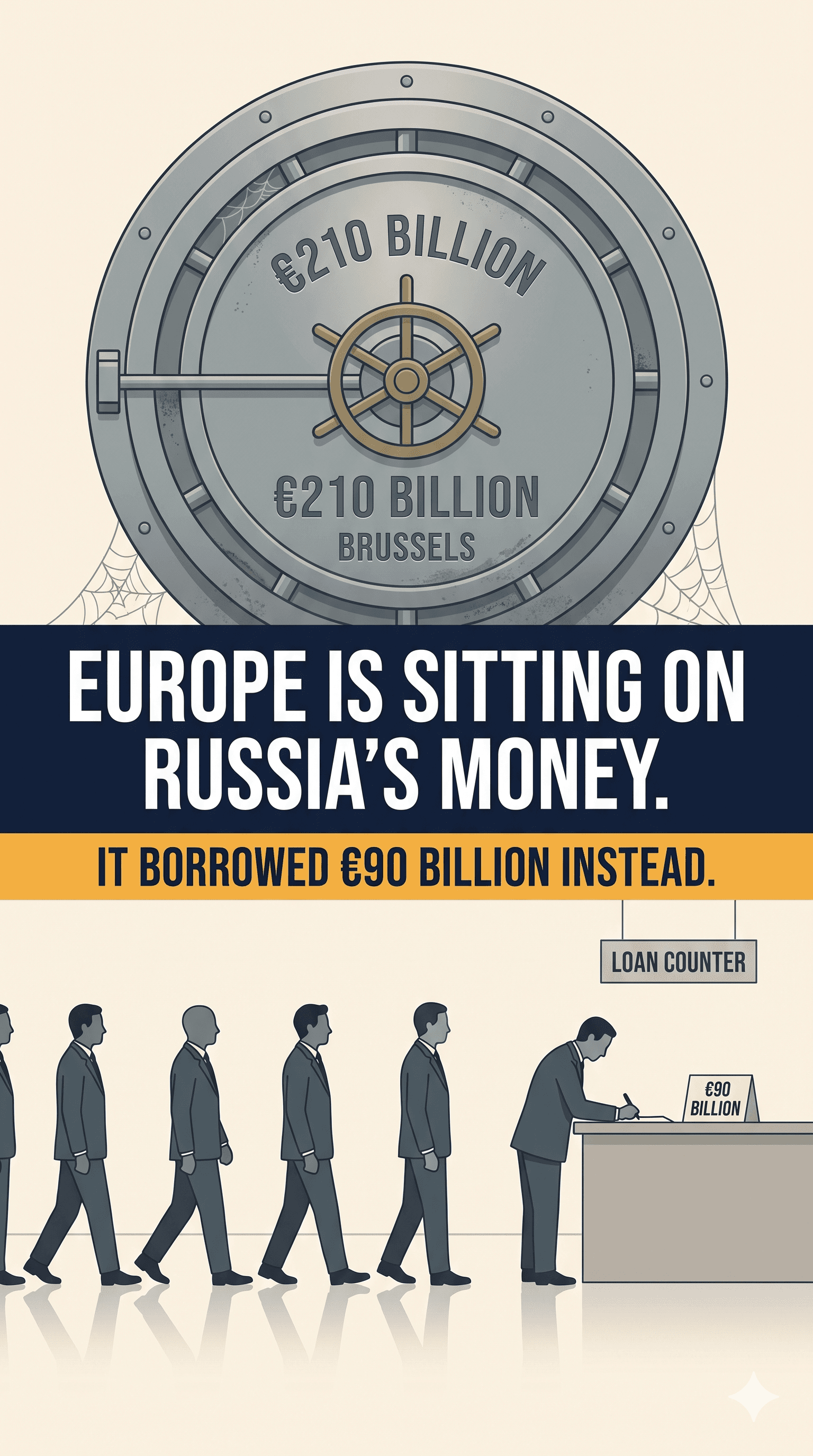
Roughly €210 billion of Russian central-bank assets sit immobilised in the European Union. About €185 billion of that is held in a single Belgian institution — Euroclear, the Brussels clearing house. (Reports from last year put the Euroclear figure nearer €193 billion; the number moves, and we are using the Belgian prime minister's current one.)
Ukraine needs money. The IMF put its 2026–27 requirement at around €137 billion.
In December 2025, the EU considered a "reparations loan" — lending Ukraine against those frozen Russian assets. Belgium blocked it. Instead the European Council approved a €90 billion loan, €45 billion a year for 2026 and 2027, funded by the EU borrowing on capital markets.
So: Europe is holding €210 billion of Russian money, and went to the bond market to borrow €90 billion of its own.
At the European Council summit on 15–16 October 2026, Kyiv asked leaders to reopen it. Zelensky requested a further €70 billion for next year. Sweden, the Netherlands, Spain, Poland and the Baltic states back using the assets. Belgium, Italy and France resist.
On 21 October, Belgian Prime Minister Bart De Wever told his parliament the Commission will not propose new mechanisms. He criticised Dutch PM Rob Jetten for saying on radio that he wanted to "take that money," warning that "even that kind of language" could have legal consequences. A colleague, he said, told him he had gone through the debate "as if I had gone over that debate with a flamethrower."
THE CASE FOR USING IT
Stated at full strength, because an argument you only present weakly isn't an argument.
Russia caused the damage. Reparations are not a novel concept. A state that destroys another state's infrastructure pays for it, and the money is already sitting there.
The alternative is European taxpayers carrying the debt instead. The €90 billion is borrowed. It will be repaid by Europeans, with interest, for a war Europeans did not start — while €210 billion of the responsible party's money sits in a vault in Brussels.
€90 billion does not cover it. The IMF's figure was €137 billion. Ukraine's finance minister Serhii Marchenko says the loan is not enough and puts the 2027 gap at roughly $78 billion, with a near-term ask of about $27 billion. Zelensky asked for €70 billion more this month.
Delay is a decision. Every month the argument continues is a month Ukraine funds a war on an overdraft.
THE CASE AGAINST
Also at full strength, and it is better than most people assume — this is not simply Belgium being obstructive.
One country carries the risk. €185 billion of it is in Euroclear, a Belgian institution. If this goes wrong, Belgium — population 12 million — is exposed to the litigation and the liability. Russia's central bank has already sued Euroclear. De Wever's objection is partly that other leaders want to spend money his country is holding and his courts would be defending.
The legal basis is genuinely contested. Immobilising assets is one thing. Lending against them, or confiscating them, is another, and the lawyers do not agree.
And the serious one: the reason that money is in Brussels at all. Central banks park reserves in Europe because Europe is the boring, safe, predictable place where your money does not get taken. That reputation is the product. If Europe spends it, every central bank on earth — China's, India's, Saudi Arabia's, Brazil's — reprices the risk of holding euros.
That cost does not appear on any balance sheet this year. It would appear over decades, in the price Europe pays to borrow and in the euro's standing as a reserve currency. It might be far more than €210 billion. It might be nothing. Nobody knows, and that is precisely the problem.
Hungary's Viktor Orbán called the scheme a "dead end." De Wever's own summary: "For me, the reparations loan was not a good idea."
THE COMPLICATION NOBODY MENTIONS
Here is the fact that spoils the easy version of this story in both directions.
Draft conclusions for the October summit record that only €14.9 billion of the €45 billion earmarked for Ukraine in 2026 has actually been disbursed — partly because Ukraine's parliament has not adopted required anti-corruption and tax reforms.
So the money Europe did commit is not flowing either. Which means "Europe won't pay" and "Ukraine isn't getting the money" are both true, and neither is entirely about the frozen assets.
And a third party has entered. On 15 October a US proposal was reported under which Europe would transfer part of the frozen assets to Washington's control. German Chancellor Friedrich Merz has said they should remain under European control. So the question is no longer only whether to use the money — it is also who gets to decide.