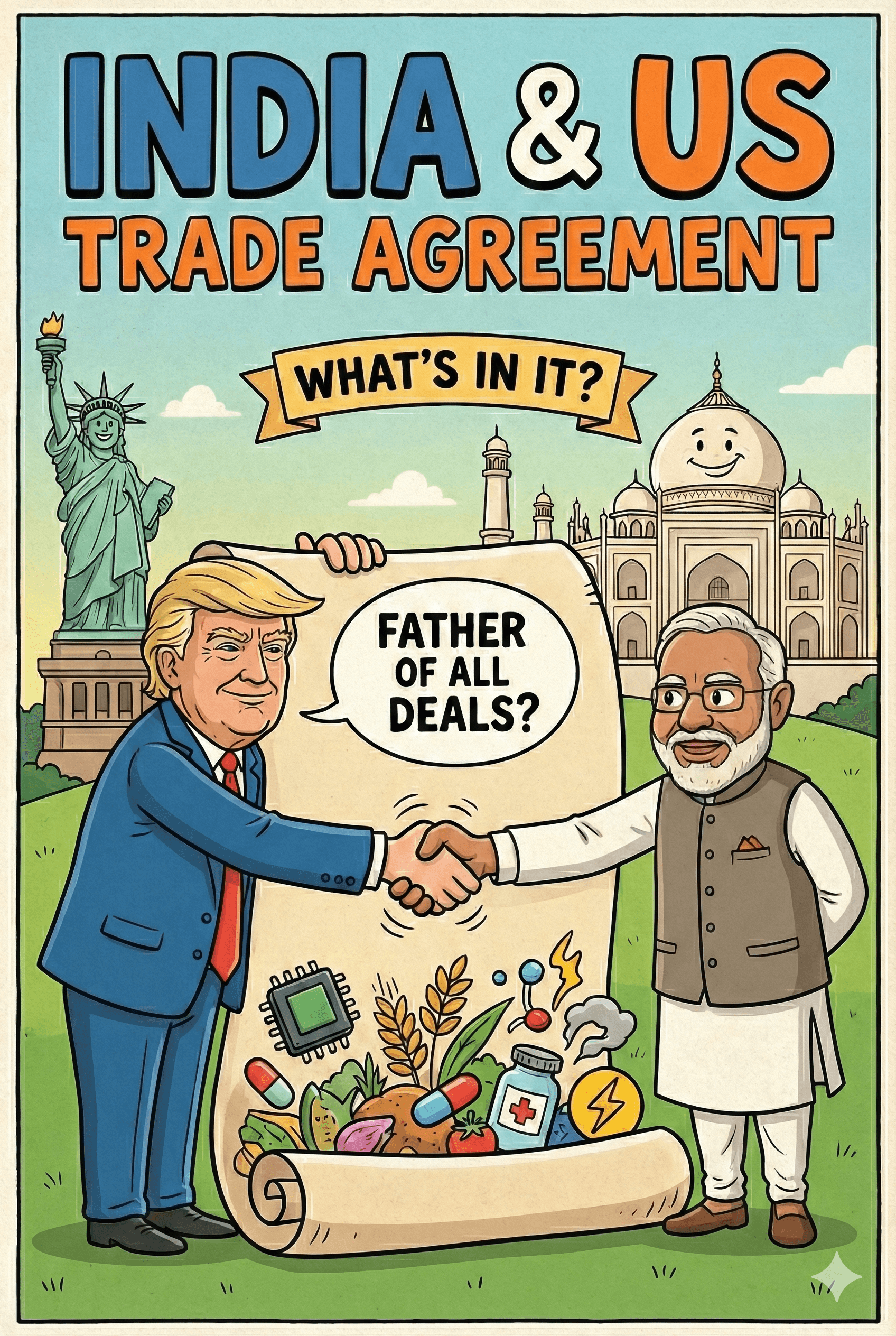
Just days after sealing the "Mother of All Deals" with the European Union, India has reportedly clinched the "Father of All Deals" with the United States.
In a massive geopolitical shift, US President Donald Trump and Prime Minister Narendra Modi have announced a breakthrough trade agreement that slashes tariffs, reshapes energy alliances, and promises to flood the market with new investments. The deal, confirmed after a high-stakes phone call between the two leaders on Monday, has sent the Indian stock market soaring and signaled a major thaw in India-US relations after months of trade tension.
Here is a breakdown of the pact that industrialists are calling the Father of All Deals.
🚨 The Headlines: What is in the Deal?
According to official statements from the White House and New Delhi, the agreement rests on three massive pillars: Tariff Reduction, Energy Shifts, and Defense Spending.
1. Tariffs Slashed Significantly 📉
For India: The US has agreed to cut the "reciprocal tariff" on Indian goods from the punitive 25% (and up to 50% in some sectors) down to 18%. This is a critical relief for Indian exporters—particularly in IT, textiles, and gems & jewelry—who were facing steep levies imposed by the Trump administration in 2025.
For the US: In return, President Trump announced that India has agreed to reduce tariffs and non-tariff barriers on US goods to "Zero" in specific sectors. While the Indian government has not yet released a sector-by-sector breakdown, this could mean cheaper American electronics, heavy machinery, and agricultural products entering the Indian market.
2. The Russian Oil Pivot 🛢️
In perhaps the most controversial geopolitical move, President Trump stated that PM Modi has agreed to stop buying Russian oil.
The Shift: To replace Russian crude, India will reportedly increase imports from the United States and potentially Venezuela.
The Goal: Washington views this as a strategic move to cut off Russia's revenue stream, a demand the US has pressed for years. India has historically maintained that its energy purchases are dictated by market economics and energy security, making this a significant policy pivot if fully implemented.
3. The $500 Billion Commitment 💰
The deal isn't just about taxes; it involves massive capital flow. India has reportedly committed to purchasing over $500 Billion worth of American products, including:
Energy (Oil, Gas, & Coal)
Civilian Aircraft & Defense Technology
Agricultural Products
🧐 Why is it Called the "Father of All Deals"?
The nickname, coined by industrialist Harsh Goenka, highlights the scale of India's recent diplomatic winning streak.
The "Mother": Just last week, India concluded a massive Free Trade Agreement (FTA) with the European Union, creating a combined market of over 2 billion people.
The "Father": This US deal followed immediately after. By securing favorable terms with the Western world's two largest economic blocs (EU and US) within days of each other, analysts believe India has pulled off a diplomatic coup.
"First the Mother of all deals with EU, now the Father of all deals with US - great achievement by PM Modi government! Patience pays." — Harsh Goenka (RPG Enterprises)
📈 Market Reaction: Sensex on Fire
The markets reacted with euphoria. The BSE Sensex surged over 2,300 points, reclaiming the 83,000 level, while the Nifty50 crossed 25,800.
Top Gainers: IT services (expecting smoother US business), Pharma (lower export duties), and Energy stocks.
Currency Impact: The Indian Rupee strengthened significantly against the dollar as fears of a prolonged trade war evaporated.
🗣️ The Opposition View
The deal has drawn sharp criticism from the opposition. The Congress party expressed deep skepticism regarding the concessions made.
"Mogambo Khush Hai": Senior leader Jairam Ramesh quipped, "Mogambo Khush Hai" (The villain is pleased), implying that India has capitulated to American pressure.
Sovereignty Concerns: Critics are questioning whether stopping Russian oil imports—a long-standing pillar of India's strategic autonomy—compromises India's independent foreign policy. There are also concerns about how "zero tariffs" on US agricultural goods might impact domestic Indian farmers.
🔮 What’s Next?
While the "handshake" has happened, the fine print is still being written. The world is watching to see if India completely halts Russian oil imports as claimed, or if a middle path emerges. For now, however, the "Trade War" is officially over, and the "Era of Deals" has begun.