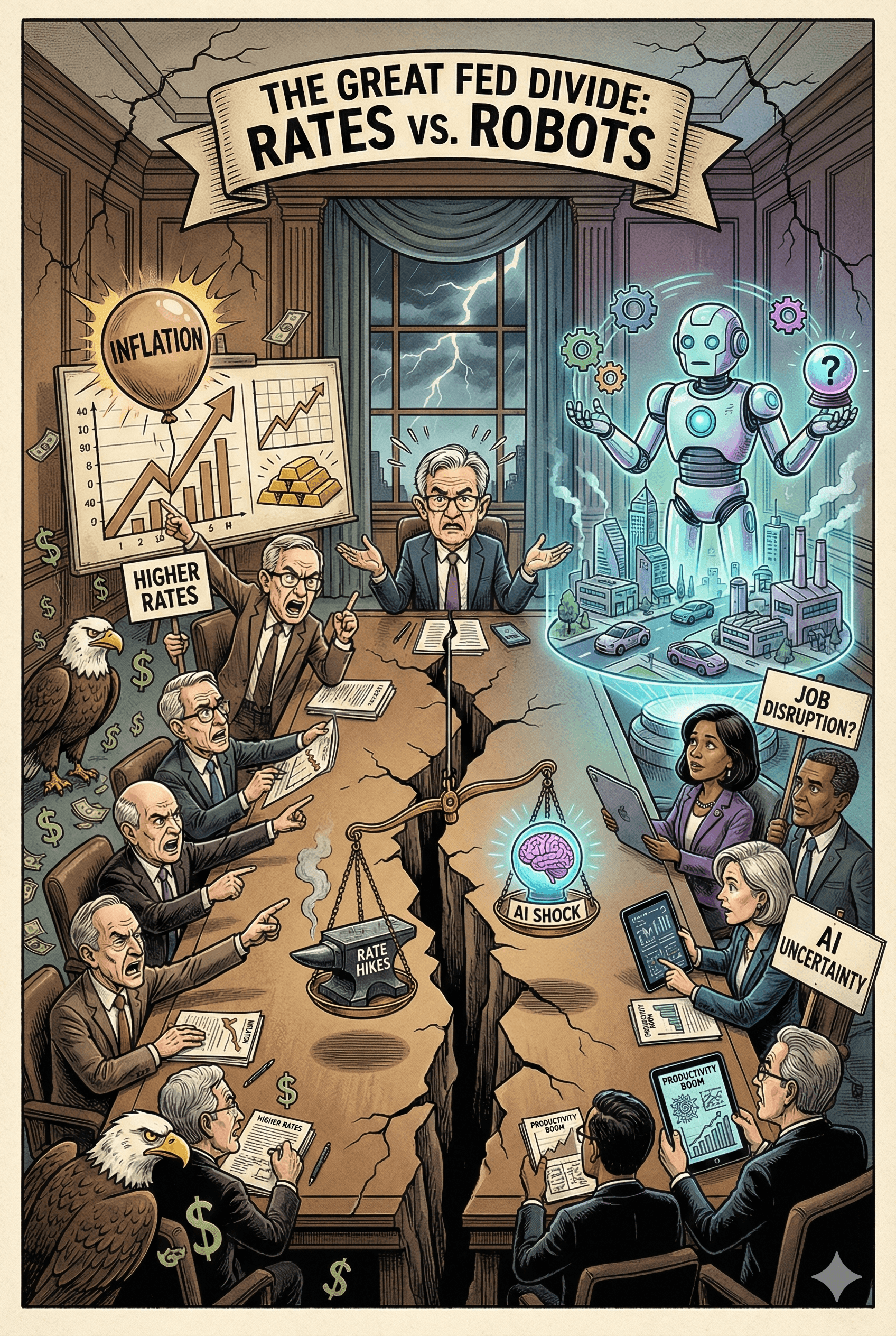
WASHINGTON D.C. — The latest minutes from the Federal Reserve’s January 2026 policy meeting have laid bare a deepening internal divide over the future of U.S. monetary policy. Released this week, the records from the January 27–28 Federal Open Market Committee (FOMC) gathering reveal a central bank grappling not only with stubbornly persistent inflation but also with the sweeping, unpredictable economic disruptions triggered by artificial intelligence (AI).
While the decision to hold the benchmark interest rate steady at 3.50% to 3.75% was largely anticipated, the underlying discussions exposed a fractured committee. Policymakers are torn between the necessity of rate cuts to support a transitioning labor market and the potential need for further rate hikes to quash lingering inflation. Complicating matters is a new variable dominating the policy debate: how the rapid adoption of generative AI will impact labor, productivity, and financial stability.
A Divided Federal Reserve: To Cut, Hold, or Hike?
The January FOMC meeting concluded with a 10–2 vote to maintain the federal funds rate, following three consecutive rate cuts in late 2025. However, the veneer of consensus quickly fades upon closer inspection of the minutes.
The records indicate that "several" participants favored a two-sided approach to future policy guidance, explicitly leaving the door open to raising interest rates if inflation remains above the Fed's 2% target. This hawkish undertone contrasts sharply with the views of the two dissenting voters, Governors Christopher Waller and Stephen Miran, who advocated for an immediate 25-basis-point rate cut, citing stabilizing labor conditions and the need to prevent unnecessary economic cooling.
Most policymakers cautioned that the path to 2% inflation is proving "slower and more uneven than previously expected." With the Personal Consumption Expenditures (PCE) price index remaining elevated near 3% and core inflation metrics showing stickiness—partially driven by rising goods prices and recent tariff policies—the majority of the committee agreed that further evidence of disinflation is required before additional easing can be justified.
Political Crosswinds and the Incoming Warsh Era
This internal policy rift arrives at a highly sensitive political juncture. President Donald Trump has consistently pressured the Federal Reserve to lower borrowing costs, arguing that high rates are stifling corporate investment and burdening American households.
The division within the FOMC underscores the immense challenge awaiting Kevin Warsh, President Trump’s nominee to succeed Jerome Powell as Fed Chair in May 2026. Warsh will inherit a committee deeply split on the fundamental direction of monetary policy. While the Trump administration pushes for rapid rate reductions to fuel growth, a significant faction of Fed officials remains fiercely protective of the central bank's independence and hyper-focused on inflation risks.
AI’s Economic Disruption: A Double-Edged Sword
For the first time, the macroeconomic implications of artificial intelligence took center stage as a primary agenda item during an FOMC meeting. The minutes reveal a robust debate over whether AI will act as a disinflationary miracle or a catalyst for localized economic shocks.
The Productivity Boom Hypothesis
Optimists within the Fed, a view shared by incoming Chair Kevin Warsh, suggest that AI could unleash a historic productivity boom. By drastically improving efficiency in sectors ranging from computer coding to pharmaceutical research, AI could increase the supply of goods and services, acting as a powerful disinflationary force. If AI-driven productivity surges, it could theoretically allow the Fed to lower interest rates without triggering runaway inflation.
The Disruption and Inflation Risks
Conversely, more cautious officials warned of the immediate hurdles. Federal Reserve Governor Michael Barr recently highlighted the dual nature of AI as a "general-purpose technology." While long-term benefits are likely, Barr and others warned of severe short-term labor disruptions as AI displaces workers in administrative, professional, and service sectors.
Furthermore, the minutes noted acute financial and infrastructural risks tied to the AI boom. Policymakers pointed to the immense energy demands of AI data centers, which could strain the power grid and drive up localized energy costs, thereby fueling inflation. Participants also expressed concern over "opaque private markets" financing the AI infrastructure buildout and warned that AI-driven optimism has pushed equity valuations to elevated, potentially unstable levels.
Labor Market Stabilization Amidst Automation Fears
The Fed’s dual mandate requires balancing price stability with maximum employment. According to the minutes, the vast majority of officials believe the labor market has stabilized, with downside risks diminishing compared to late 2025.
However, business contacts across multiple Fed districts expressed hesitation in hiring. This caution is driven not only by general economic uncertainty but specifically by the looming integration of automation and AI technologies. Companies are weighing heavy capital expenditures in AI against traditional payroll expansions, leaving the long-term outlook for employment in a state of flux.
Outlook and Market Impact
The revelation of a divided Fed has injected fresh volatility into financial markets. Following the release of the minutes, equities experienced downward pressure, led by selloffs in software and semiconductor stocks amid renewed anxieties over AI disruption and delayed rate cuts. Simultaneously, the U.S. dollar strengthened on the back of the Fed's unexpectedly hawkish tone.
Looking ahead, the Federal Reserve appears locked into a "wait-and-see" holding pattern. Futures markets, which had aggressively priced in early 2026 rate cuts, have recalibrated. According to the CME FedWatch tool, markets now overwhelmingly expect the Fed to keep rates unchanged through its March and April meetings, pushing the timeline for potential easing to June—shortly after Kevin Warsh is expected to take the helm.
As the U.S. economy navigates the crosscurrents of sticky inflation, political pressure, and the dawn of the AI age, the Federal Reserve's path forward has rarely been more complex or consequential.
#FederalReserve #FOMC #InterestRates #MonetaryPolicy #Economy #AI #ArtificialIntelligence #Inflation #JeromePowell #Geopolitics #USPolitics #FinanceNews