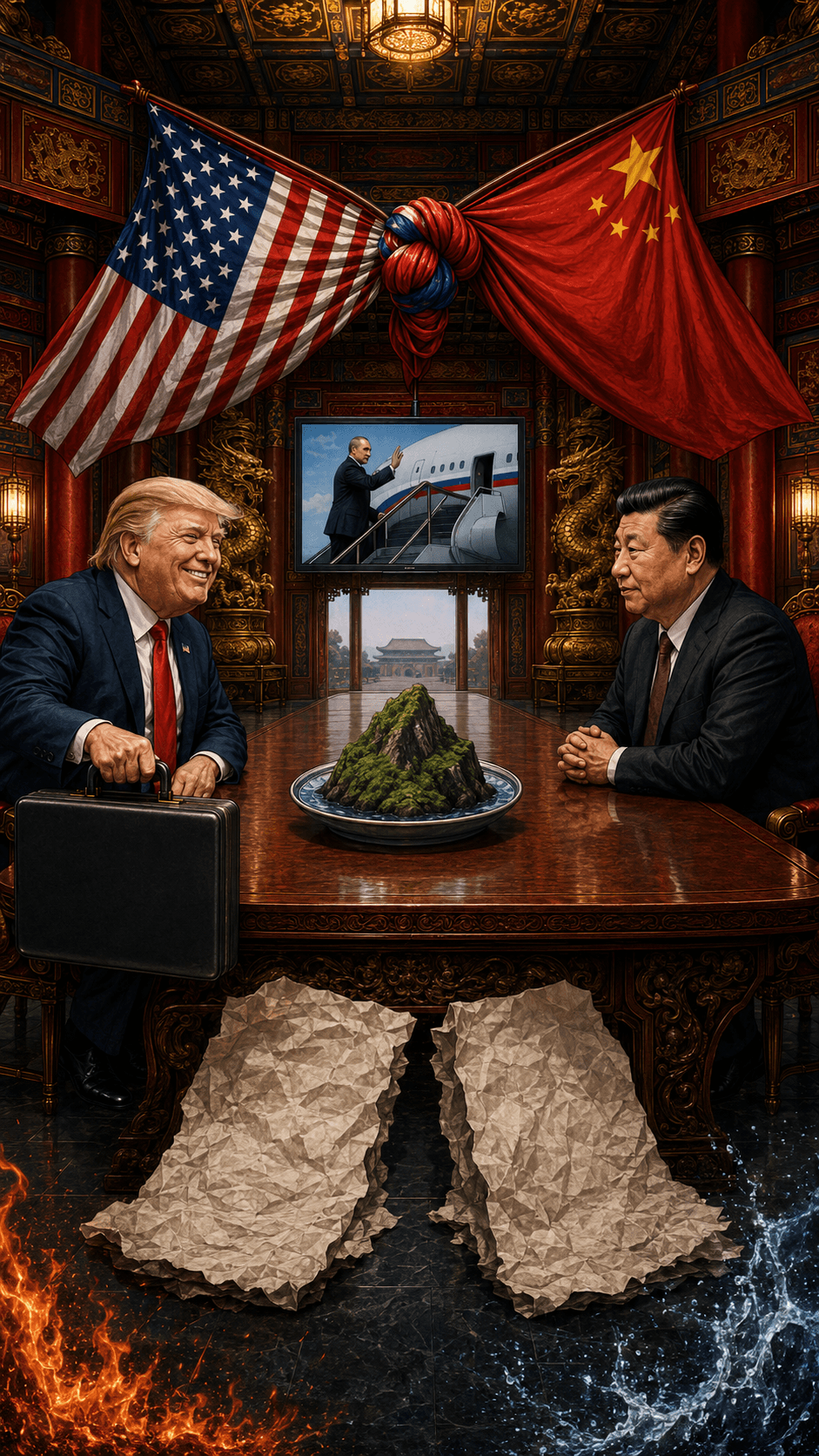
The pageantry was immaculate. Brass bands played. Children waved American and Chinese flags. An honour guard stretched across the steps of the Great Hall of the People. And then, once the cameras were ushered out and the doors closed, China's president delivered one of the starkest warnings ever spoken directly to an American leader.
"If Taiwan is handled properly, the bilateral relationship will enjoy overall stability," Xi Jinping told Donald Trump on Thursday in Beijing. "Otherwise, the two countries will have clashes and even conflicts, putting the entire relationship in great jeopardy."
It was not a threat wrapped in diplomatic language. It was a red line, spoken plainly, at a summit the entire world was watching.
The Summit: Nine Years in the Making
Thursday's meeting was the first visit to China by a sitting U.S. president since Trump himself travelled to Beijing in 2017 — a gap of nearly nine years in which the world's two largest economies fought a trade war, decoupled their technology sectors, clashed over the South China Sea, and watched each other's militaries expand at a historic pace.
The day began with Trump and Xi shaking hands outside Beijing's Great Hall of the People. Inside, before reporters were ushered out, both men offered carefully positive words. Xi said: "A stable bilateral relationship is good for the world. We should be partners, not rivals." Trump called Xi a friend and a "great leader," saying the two had always been able to work out their disagreements.
Trump also brought the top 30 American CEOs in the world with him — a theatrical display of economic firepower. "Every single one of them said yes," Trump said. "I wanted only the top. And they're here today to pay respects to you and to China." The White House confirmed one of Trump's core goals was to secure purchasing agreements in aerospace, agriculture, and energy.
The atmosphere, by all accounts, was warm. The substance was anything but simple.
The Taiwan Warning: China's "First Red Line"
In the lead-up to the summit, Chinese state media had referred to Taiwan as "the first red line" in the bilateral meeting. Xi did not disappoint Beijing's hardliners.
Xi stressed to Trump that the Taiwan question is "the most important issue in China-U.S. relations" and reiterated Beijing's position that Taiwan independence and peace in the Taiwan Strait "are as irreconcilable as fire and water." He warned the U.S. must exercise "extra caution" — language that diplomats and analysts noted was unusually direct for a formal summit setting.
Xi also asked whether the U.S. and China could avoid the "Thucydides Trap" — the historical pattern in which a rising power and a ruling power inevitably clash. The reference was deliberate: China is no longer the rising power asking to be accommodated. It is a peer competitor issuing terms.
What made the moment more striking was what happened after. China's official readout of the summit placed Taiwan front and centre. The White House readout of the same meeting did not mention Taiwan at all. Two leaders, one meeting, two completely different accounts of what mattered most.
Taiwan Responds — Quietly
Taipei watched the summit from across the strait with barely concealed anxiety. Taiwan's government Cabinet spokesperson Michelle Lee said that Taipei is grateful for firm U.S. support. "The U.S. has also repeatedly reiterated its firm and clear position of support for Taiwan," she said.
U.S. Secretary of State Marco Rubio sought to calm nerves, saying U.S. policy on Taiwan is "unchanged as of today." When asked whether Xi asked Trump not to sell weapons to Taiwan, Rubio said the topic "did not feature prominently" in discussions — though he acknowledged the U.S. had sold arms to Taiwan as recently as December, which Beijing "were very upset about."
The reassurances were notable precisely because they were needed.
What Was Actually Agreed
Beyond Taiwan, the two sides did find common ground — carefully, narrowly, and on terms both could live with.
Both sides agreed that the Strait of Hormuz must remain open to ensure global energy flows. Xi expressed opposition to militarising the strait and signalled interest in buying more U.S. oil. Both leaders agreed that Iran should not be allowed to obtain a nuclear weapon.
The two governments agreed to develop a "constructive China-U.S. relationship of strategic stability" — a phrase that sounds reassuring until you notice it commits neither side to anything concrete.
Both sides also said they want to see de-escalation of the Iran war, though their reasons are very different: the U.S. wants a quick resolution to restore its credibility; China wants the Strait reopened so its oil supply can flow again.
At the evening state banquet, Trump went a step further — inviting Xi to visit the United States in September. Xi did not publicly commit.
The Confidence Gap: China in 2026 Is Not China in 2017
Perhaps the most important subtext of the entire summit was one that no official readout captured: China arrived in Beijing more confident than it has ever been in dealings with Washington.
"China comes into this meeting far more confident than in 2017, when it feared even a small rise in U.S. tariffs. In the last year, Xi has been able to push back and neutralise much of Trump's actions," said Scott Kennedy, senior adviser at the Center for Strategic and International Studies.
China was the first major economy to retaliate against Trump's "liberation day" tariffs in April 2025. It matched every U.S. move on semiconductors, rare earths, and student visas — and it did not blink. The country that once feared Trump now negotiates with him as an equal — and on some issues, from a position of leverage.
The Iran war handed Beijing an unexpected card: as Iran's largest oil buyer, China's cooperation — or lack of it — directly affects whether the Strait of Hormuz reopens. That reality hovered over every handshake and every toast.
What Happens Next
The summit concludes Friday. Putin arrives in Beijing days after Trump leaves. The diplomatic relay is no accident — it is a signal that Beijing intends to remain at the centre of every major geopolitical negotiation of 2026.
Taiwan was not resolved in Beijing. It never is. But Xi made one thing unmistakably clear: the island is not a side issue, not a bargaining chip, and not something Washington can quietly table in exchange for a trade deal. It is, in Beijing's words, the relationship itself — handle it wrong, and everything else falls apart.
Trump said the relationship between China and the USA is "going to be better than ever before." Xi said cooperation benefits both sides, while confrontation harms both. Somewhere between those two statements lies the truth — and somewhere in the Taiwan Strait, the world's most dangerous unresolved question waits for an answer that neither leader was willing to give on Thursday.