Standfirst: Zelensky says he will intensify strikes on Russian refineries in response to what he calls Moscow's "new doctrine" of hitting civilian infrastructure. Here is what that campaign has already done inside Russia — and why your diesel bill is now downstream of two separate wars.
On 3 October 2026, speaking in an interview conducted with air raid sirens audible in the background at the presidential offices, Volodymyr Zelensky said Ukraine would step up strikes on Russian oil refineries.
His stated reason was a shift he described in Russian targeting. "We saw documents and we know that they allow them to attack infrastructure," he said. "This is the goal of the operation."
What he calls Moscow's new doctrine is reported as an expansion of strikes onto civilian infrastructure — logistics routes, schools, hospitals — intended to make cities including Kyiv difficult to live in before winter. Recent Russian strikes have hit energy and telecoms, road and rail, and, for the first time, bridges across the Dnipro.
"We have to respond in any way we can," Zelensky said. And then a qualification that is doing a lot of work: "But we will not respond, of course, just like them, on any civilian objects."
That sentence is the whole legal argument of this campaign, and we will come back to it. First, the scale of what is already happening, because it is considerably larger than the coverage suggests.
What the refinery campaign has already done
This is not a threat of a new campaign. It is a promise to intensify one that has been running for years and has already achieved something close to a strategic result.
The strikes. More than 305 strikes on Russian oil facilities between February 2022 and 25 June 2026 — 59 of them in the first five months of 2026 alone. Twenty-one of Russia's thirty-eight large refineries have been hit since January 2025.
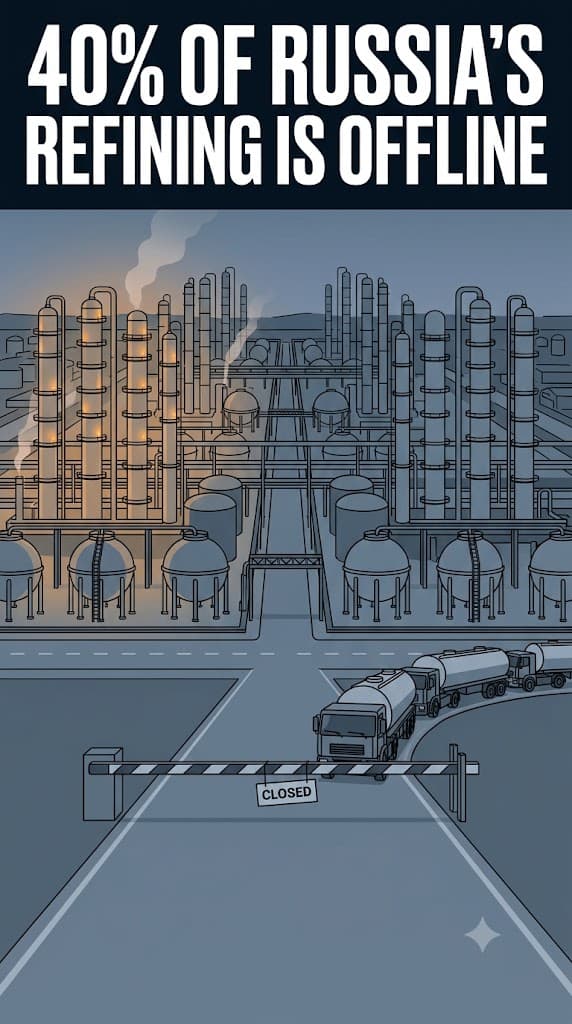
The capacity. By 4 July 2026, Ukraine's General Staff put Russian refining capacity disabled at 42.74%. Finland's President Alexander Stubb independently gave the figure as around 40% in the same period. By August, 54% of all Russian refineries had sustained damage.
Those two estimates come from an interested party and a sympathetic government respectively, which is worth saying plainly. But they converge, and the downstream evidence is harder to argue with.
The deficit. In July 2026, Russian output ran at roughly 75,000–80,000 tonnes a day against domestic demand of 115,000–120,000. That is a shortfall of about a third.
What that looked like on the ground. By 2 July, more than 78 of Russia's 83 regions were affected. Thirty-eight imposed sales restrictions. Three — Penza, Irkutsk and Zabaykalsky Krai — declared states of emergency; Crimea and Sevastopol had done so on 26 June. An estimated 50 million Russians, around 35% of the population, were affected.
By 19 August, petrol availability at filling stations was reported at 28%, with 90% of Moscow stations out of AI-92. Rationing appeared: 40–60 litre limits per customer, odd-and-even number plate days in six regions, QR-code allocation systems.
And the exports stopped. Russia — normally one of the world's largest exporters of refined product — moved from intermittent bans to a fuel export ban in July 2026, after Deputy Prime Minister Alexander Novak floated a total diesel export ban in June. A country that sells fuel to the world started buying it: Russian regulators were offering 78,000 roubles a tonne while Indian and Moroccan suppliers asked 110,000–130,000.
Why this matters far outside Russia
Here is the connection almost nobody is drawing, and it is the reason this story belongs to everyone.
The world is currently running two separate wars that are both destroying refined-fuel supply at the same time, and they are not related to each other at all.
In the Gulf, the closure of the Strait of Hormuz has taken more than a fifth of global oil trade out of the market and driven US diesel to a national average of $6.285 a gallon — up 68% in a year. In Russia, a drone campaign has taken roughly 40% of a major exporter's refining offline and removed its exports from the market entirely.
Crude and refined product are not the same thing. You can have barrels and still have no diesel, because diesel has to be made somewhere, and the places that make it are finite, expensive and — as both of these wars have now demonstrated — fragile.
Diesel is where the two wars meet. It is also the fuel that moves freight, runs farm equipment, powers generators and drives ships, which is why a diesel shock becomes a food shock on a lag of months. Bangladesh, Pakistan and Kenya are not party to either conflict and are paying for both.
The legal line Zelensky drew, and whether it holds
Now back to that sentence: we will not respond, of course, just like them, on any civilian objects.
He is asserting a distinction, and it is a real one in law, though it is narrower than it sounds.
Under the law of armed conflict, a lawful military objective is an object whose nature, location, purpose or use makes an effective contribution to military action and whose destruction offers a definite military advantage. An oil refinery that fuels an army and funds a state generally qualifies. Refineries have been treated as legitimate targets in most modern conflicts, and a state at war cannot reasonably claim its war machine runs on something other than fuel.
Schools and hospitals do not qualify. They carry specific protection, and they lose it only in narrow circumstances.
So the distinction Zelensky is drawing is coherent: dual-use industrial infrastructure on one side, specifically protected civilian objects on the other.
Where it gets harder — and an honest explainer has to say so — is that the Russian fuel crisis described above fell on 50 million civilians. Rationing, dry pumps and emergency declarations across 78 regions are not confined to the military supply chain. The legal test is not "did civilians suffer"; it is whether the object was a military objective and whether the expected civilian harm was excessive relative to the military advantage. Those are judgements, made case by case, and not ones this piece can settle.
What can be said is that "we hit refineries, they hit hospitals" is a defensible distinction in law, and that it is not the same as saying civilians are unaffected.
What is reported and what is asserted
Reported by multiple outlets: Zelensky's statement and quotations of 3 October; the characterisation of Moscow's new doctrine; Russian strikes on energy, telecoms, rail and the Dnipro bridges.
Figures from an interested party: the 42.74% capacity estimate is Ukraine's General Staff. Stubb's 40% is a sympathetic government. Treat both as directionally supported rather than audited.
More robust: the domestic Russian shortages, regional emergencies, rationing schemes and export bans, which are visible in Russian regulatory decisions and price data rather than in anyone's claim.
Not established: the "documents" Zelensky says Ukraine has seen have not been published, and his account of a formal Russian doctrine rests on that unpublished evidence.
What to watch
Whether the export ban holds through winter. An exporter that cannot export loses revenue the war depends on. This is the metric the campaign is actually aimed at.
Whether Ukraine's strike range keeps extending. A refinery at Perm sits roughly 1,500 kilometres from Ukrainian territory. Reach, not volume, is what determines how much of Russia's refining base is actually exposed.
Global diesel cracks, not crude. The spread between crude and diesel prices is the number that tells you whether refining capacity, rather than oil supply, is the binding constraint. With Hormuz and Russia both impaired, that spread is the thing to watch.
And whether Russian strikes on Ukrainian energy intensify in return. Zelensky's statement is explicitly reciprocal. Reciprocal escalation on energy infrastructure, going into winter, in a country at these latitudes, is a civilian emergency with a date on it.