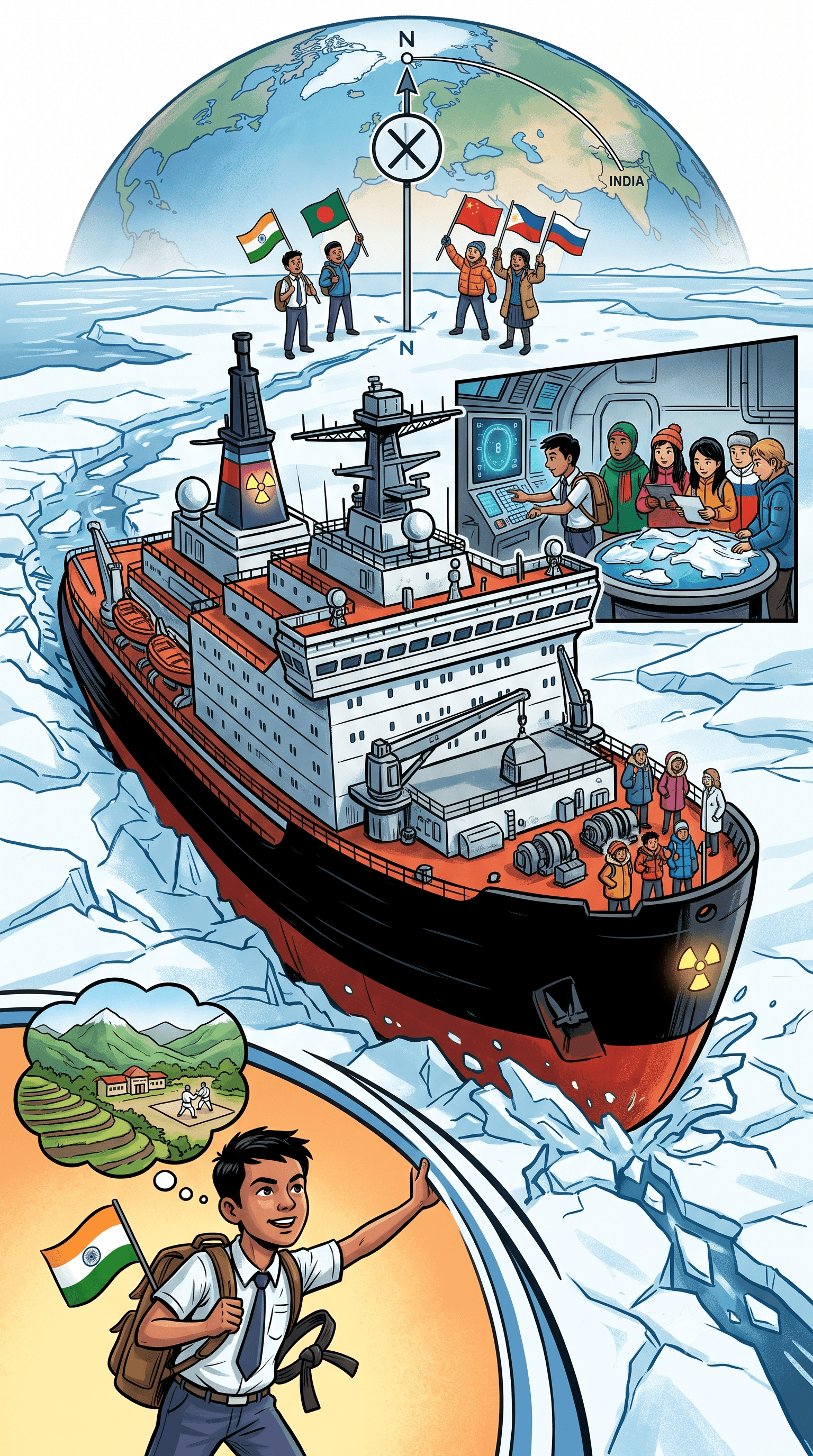
The journey from the pine-covered hills of Chakrata in Uttarakhand to the frozen, unforgiving wilderness of the Arctic is a path few can ever imagine. Yet, for 15-year-old Indian student Lucky Rawat, this extraordinary voyage has become a reality. Representing India on a prestigious global stage, the Uttarakhand teen has embarked on a once-in-a-lifetime journey to the geographic North Pole aboard Russia’s legendary nuclear-powered icebreaker, 50 Let Pobedy (50 Years of Victory).
As the sole Indian participant in the internationally acclaimed "Icebreaker of Knowledge" expedition, Rawat is joining young minds from across the globe in a mission dedicated to scientific discovery, environmental awareness, and cultural exchange.
What is the 'Icebreaker of Knowledge' Expedition?
The "Icebreaker of Knowledge" is an exclusive international educational and scientific project supported by Russia’s state nuclear corporation, Rosatom. Designed to inspire the next generation of scientists, environmentalists, and global leaders, the program brings together highly talented students between the ages of 14 and 16.
This year’s seventh edition of the expedition has successfully brought together participants from 22 different countries, including India, Bangladesh, China, Brazil, South Africa, and Russia. The 10-day voyage officially commenced with a grand departure ceremony at the FSUE Atomflot base in Murmansk, a northern Russian port city. Under the command of Captain Ruslan Sasov, the vessel set sail across the Barents Sea, navigating toward the geographic North Pole at 90° North latitude, before planning its return via the Franz Josef Land archipelago.
The Vessel: Aboard the Nuclear Icebreaker 50 Let Pobedy
The expedition takes place aboard the 50 Let Pobedy, one of the world's most powerful nuclear icebreakers. Operated by Rosatom, this specialized vessel is capable of crushing through multi-year Arctic ice up to several meters thick. For the participating students, travelling on a nuclear icebreaker offers an unparalleled look into advanced maritime engineering and atomic energy applications. As Rosatom Director General Alexey Likhachev noted, Russia’s unique nuclear-powered icebreaker fleet allows international students to experience cutting-edge technologies found nowhere else, safely transporting them to one of the Earth's least accessible frontiers.
Lucky Rawat: Uttarakhand’s Ambassador to the Arctic
For India, the spotlight shines brightly on Lucky Rawat. Hailing from Chakrata, a picturesque hill town in Uttarakhand traditionally known for its scenic Himalayan beauty rather than for producing international scientific ambassadors, Rawat’s achievement has sparked immense regional and national pride.
Speaking to the press before his departure, Rawat expressed his excitement and understanding of the journey's magnitude. "I am from Chakrata in Uttarakhand and have come here as India’s ambassador for this expedition. It is a 10-day expedition during which we will travel to the North Pole. We will be among the very few people who have actually reached the North Pole," he stated.
Beyond his academic curiosity, Rawat is also a skilled judoka. His background in martial arts has fostered a deep sense of discipline, endurance, and focus—qualities that are highly beneficial when undertaking a rigorous journey to the harsh Arctic environment. His father, Ram Singh, expressed immense pride in his son’s accomplishment, emphasizing the dedication it took for a boy from a remote hill town to earn a seat on a nuclear icebreaker bound for the top of the world.
A Demanding Three-Stage Selection Process
Securing a spot on the "Icebreaker of Knowledge" expedition was a formidable challenge. The competition attracted over 5,000 ambitious applicants from across the participating nations. To earn the single seat allocated to India, Rawat had to clear a demanding three-stage international online evaluation. This rigorous selection process tested the students' scientific aptitude, problem-solving skills, and overall knowledge of global environmental issues. Ultimately, only one student was selected from each participating country, ensuring that the final crew represents the brightest young minds from their respective regions.
Science, Climate, and Global Collaboration
The core objective of the North Pole expedition goes far beyond mere tourism; it is a floating classroom dedicated to Arctic ecosystems and climate science. As the nuclear icebreaker carves its way through the polar ice caps, the students are engaging in hands-on learning, participating in lectures, and observing the fragile Arctic environment firsthand.
The curriculum covers a wide array of critical topics, including climate change, biodiversity conservation, sustainable development, and advanced technologies. The Arctic region is currently warming faster than any other part of the planet, making it a crucial ground for scientific observation. By bringing students from countries like India, Bangladesh—represented by Md. Malekul Salehin Prottoy—and China directly to the ice, the program fosters a global perspective on environmental stewardship.
Furthermore, the expedition serves as a powerful exercise in cultural diplomacy. Teenagers from the Global South and the BRICS nations are living, learning, and collaborating in close quarters, breaking down cultural barriers while isolated in the frozen expanse of the Barents Sea.
Geopolitical Context: Russia, Rosatom, and the Arctic
While the expedition is firmly rooted in education, political analysts note that it also carries subtle geopolitical and economic undertones. The Arctic is increasingly becoming a zone of strategic importance due to melting sea ice, which is opening up new maritime routes like the Northern Sea Route (NSR) and exposing vast, untapped natural resources.
Russia, which possesses the longest Arctic coastline and the world’s only fleet of nuclear icebreakers, uses initiatives like the "Icebreaker of Knowledge" to exercise soft power and showcase its technological dominance in polar navigation. Through Rosatom, Moscow is demonstrating its capability to safely and sustainably operate in the High North. Inviting students from strategic international partners—such as India and China—aligns with Russia’s broader foreign policy goals of diversifying its global partnerships and promoting the Northern Sea Route as a viable, year-round global transit corridor for the future.
Outlook: Inspiring the Next Generation of Global Leaders
The journey from Uttarakhand to the North Pole highlights the evolving nature of global education and the borderless reality of climate science. As Lucky Rawat and his international peers reach 90° North latitude, they are doing more than just planting flags; they are laying the groundwork for future international collaboration and environmental advocacy.
When these young ambassadors return to their respective countries, they will bring back invaluable firsthand knowledge of the Arctic’s fragile ecosystem and the technological marvels required to navigate it safely. The "Icebreaker of Knowledge" expedition stands as a testament to the fact that talent and curiosity know no geographical boundaries—proving that a dedicated Indian student from the hills of Uttarakhand can indeed make it to the very top of the world.