Europe is facing one of its most severe diplomatic and security crises in recent years following a thwarted sabotage operation on German soil. Tensions between Berlin and Moscow have reached a boiling point after the German government formally accused Russia of orchestrating an attempted drone attack at Leipzig/Halle Airport in early August 2026. The incident, which targeted critical logistics operations supplying Ukraine, has triggered sweeping diplomatic expulsions and fierce rhetorical exchanges.
With European airspace security already on high alert, the Leipzig incident highlights the growing threat of hybrid warfare and asymmetrical sabotage. Here is a detailed breakdown of the events, the findings of the German investigation, and the rapidly escalating diplomatic fallout.
The Leipzig/Halle Airport Incident: Anatomy of an Attempted Sabotage
In early August 2026, a highly coordinated but ultimately unsuccessful sabotage attempt unfolded at Leipzig/Halle Airport, one of Europe’s most vital air cargo hubs. The primary target was an Antonov cargo aircraft loaded with ammunition destined for Ukraine.
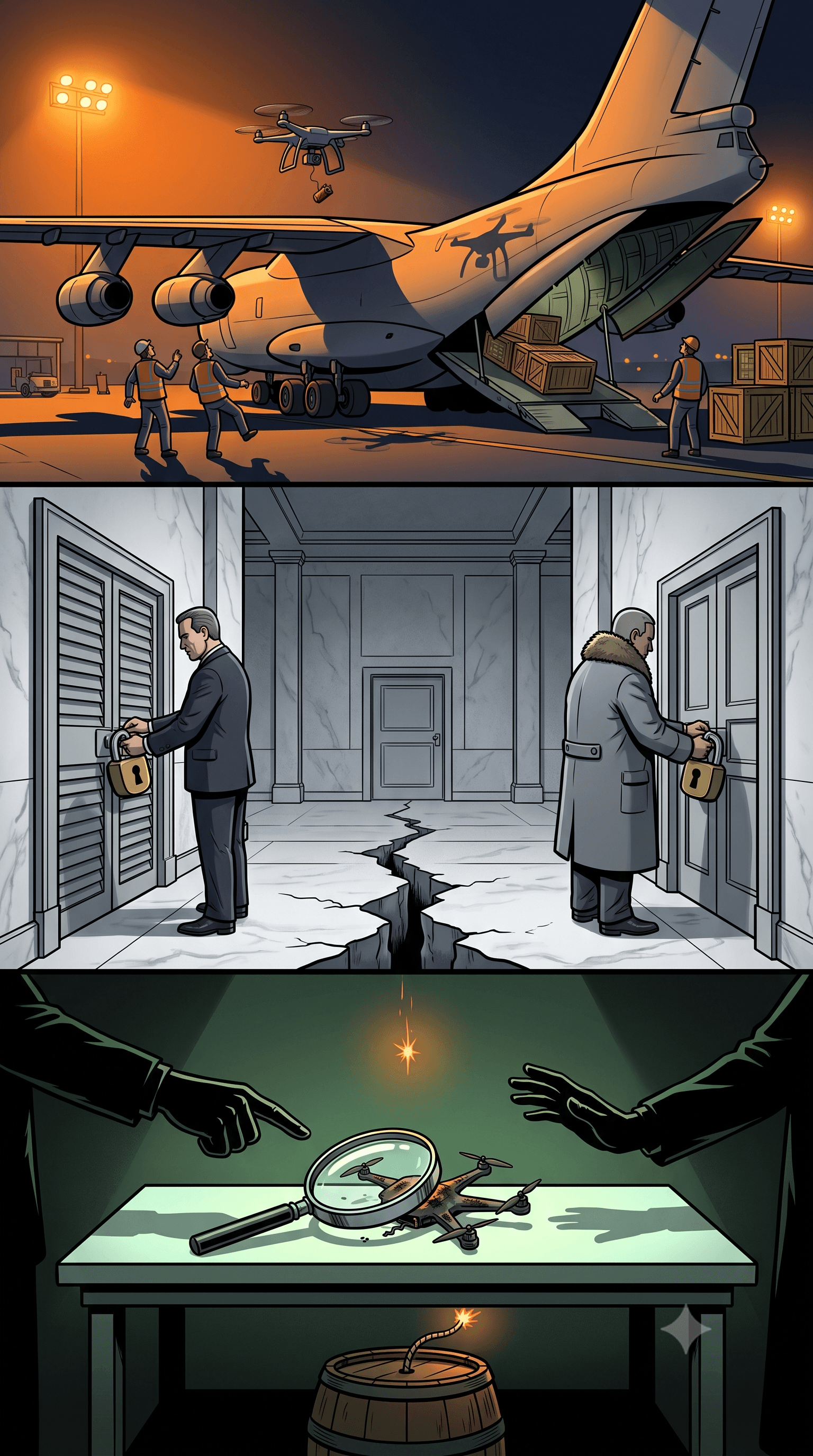
According to the findings of the German investigation, a small quadcopter drone breached the airport's perimeter and hovered above the transport aircraft. The drone was carrying a payload of approximately 800 grams of PETN and Semtex—a highly potent combination of plastic explosives capable of causing catastrophic damage to the aircraft and the surrounding tarmac.
A disaster was averted due to a mechanical failure; authorities reported that the explosive failed to detonate because of a defective detonator. Furthermore, investigators discovered that two additional aircraft at the facility had been struck by suspected drones that also failed to detonate, pointing to a multi-pronged attack that was thwarted only by technical malfunctions rather than preventative security measures.
Germany’s Investigation and Firm Diplomatic Response
Following a rigorous investigation, the German government reached a definitive conclusion on September 1, 2026: Russia was responsible for the attempted sabotage. Berlin officially categorized the incident as a deliberate act of state-sponsored aggression aimed at disrupting European supply lines.
The response from European leadership was swift and uncompromising. EU Foreign Policy Chief Kaja Kallas publicly described the foiled bombing as a "state-sponsored terrorist attack," signaling a unified European stance against the incident.
In Berlin, Chancellor Friedrich Merz took immediate and decisive executive action. Asserting his administration's firm defense posture, Merz ordered the immediate closure of the Russian Consulate General in Berlin. Furthermore, he mandated the shutdown of the Russian House, a prominent cultural center in the capital, effectively severing key diplomatic and cultural channels.
Addressing the nation, Chancellor Merz delivered a stern warning to foreign adversaries. He stated unequivocally that anyone who attacks Germany must know that the nation is fiercely determined to defend its constitutional state, its democracy, its open society, and its territorial integrity.
Moscow's Retaliation and Lavrov's Firm Denial
The diplomatic rupture was predictably met with immediate reciprocal measures from Moscow. In a tit-for-tat escalation, the Russian government ordered the closure of Germany's Goethe Institutes in Moscow, Saint Petersburg, and Yekaterinburg, striking a heavy blow to decades of cross-cultural and educational exchange.
On September 6, 2026, Russian Foreign Minister Sergei Lavrov issued a fierce public response, categorically denying any Russian involvement in the Leipzig/Halle Airport incident. Lavrov dismissed the German investigation's findings, explicitly accusing Berlin of planting evidence at the scene to unjustly frame Russia and manufacture a pretext for military escalation.
Fact-Checking Lavrov's Statements
In the immediate aftermath of Lavrov's address, several syndicated news headlines and social media summaries claimed the Russian Foreign Minister explicitly stated that "Germany wants another war."
However, a thorough verification of official transcripts and reliable diplomatic sources cannot confirm that Lavrov ever used this exact phrase. It is crucial to separate verified official statements from editorialized headline paraphrasing.
What can be independently verified is that Lavrov used highly inflammatory language to describe the situation. He called the German accusations against Russia "by and large the start of a real war." Furthermore, directing his ire at the current German leadership, Lavrov argued that Chancellor Merz’s aggressive push to make Germany the leading military power in Europe meant that Merz was "in effect declaring war on Russia."
A Broader Context of European Security
The attempted bombing in Leipzig cannot be viewed in isolation. Over the past two years, there has been a documented surge in unauthorized drone sightings over critical European infrastructure, including major international airports, military bases, and energy facilities.
This environment has forced European nations to rapidly rethink domestic security protocols. In Germany, the government has been actively accelerating initiatives to strengthen drone defenses around critical national infrastructure. The failure of Leipzig/Halle’s perimeter security to detect the initial incursions before the drones reached the aircraft underscores a significant vulnerability in conventional airport defense systems against off-the-shelf, low-flying quadcopters weaponized with military-grade explosives.
From an analytical standpoint, the use of small, hard-to-detect drones carrying lethal payloads represents a shift toward deniable, low-cost hybrid warfare tactics. While the German government remains resolute in its attribution of the attack to Moscow, the Russian denials highlight the contested nature of modern asymmetric sabotage.
Outlook and Implications
The bilateral relationship between Germany and Russia has now entered a deep freeze, characterized by mirrored retaliation and a slow but steady slide toward broader geopolitical escalation. With cultural and diplomatic channels being actively dismantled, the mechanisms for de-escalation are severely diminished.
As the German government moves to further fortify its domestic defenses and military posture, Europe remains bracing for potential secondary incidents. The Leipzig drone attack, though operationally a failure, has successfully detonated a new diplomatic crisis, cementing a volatile new reality for European security.
#Germany #Russia #DroneAttack #LeipzigAirport #FriedrichMerz #SergeiLavrov #EuropeanSecurity #Geopolitics #HybridWarfare #Diplomacy #NewsUpdate #GlobalAffairs