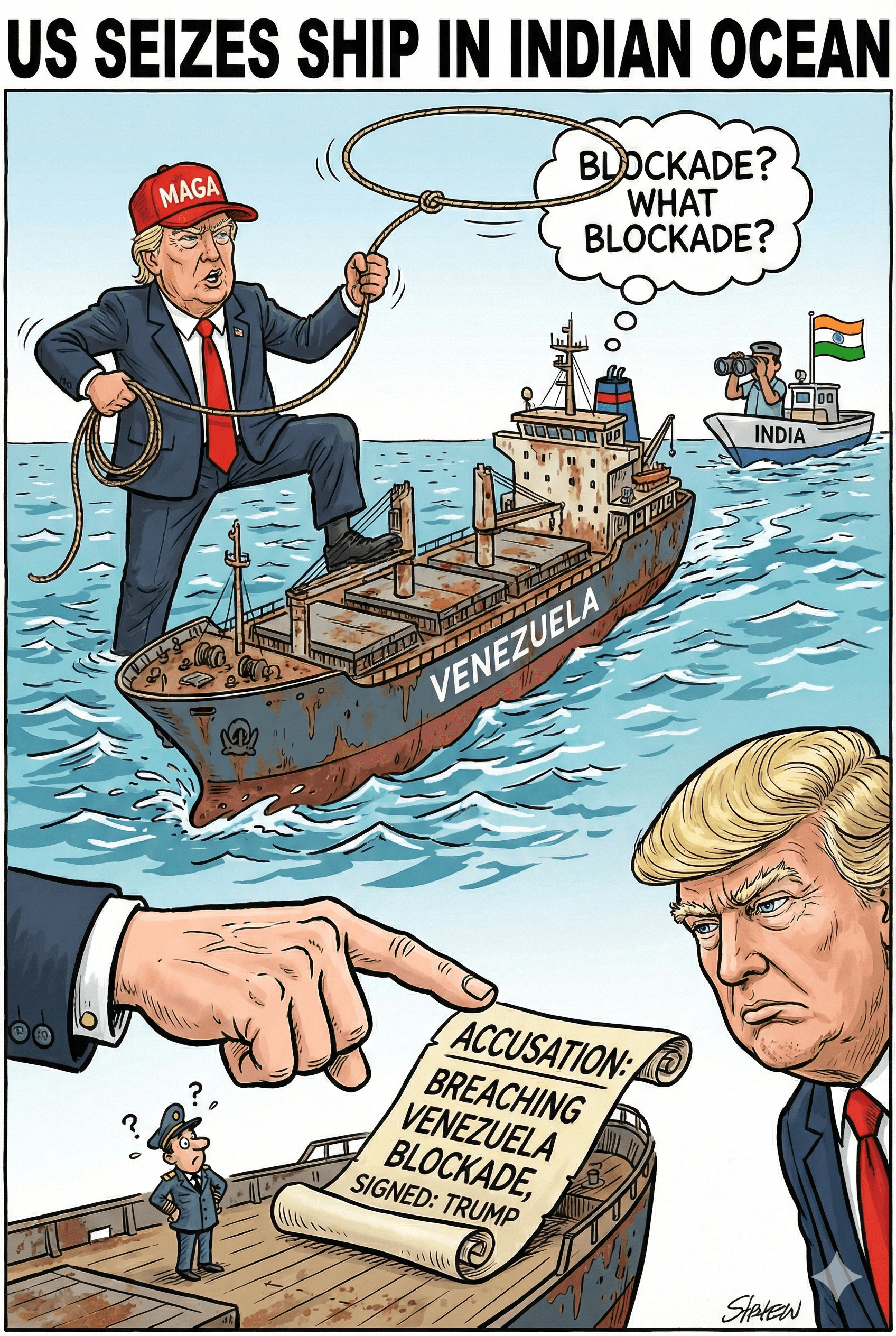
In a dramatic escalation of the United States' "Maximum Pressure" campaign against the Venezuelan government, US Naval forces have intercepted and seized a commercial vessel in the international waters of the Indian Ocean. The operation, executed under the direct authority of the Trump administration, marks a significant expansion of American sanctions enforcement, signaling that the blockade against Venezuelan resources now extends effectively worldwide.
The seizure occurred early Monday morning, approximately 400 nautical miles west of the Maldives. Pentagon officials confirmed that the vessel, a Panamanian-flagged bulk carrier identified as the Oceanic Titan, was boarded by a visit, board, search, and seizure (VBSS) team from a US destroyer. The ship is accused of carrying illicit dual-use technology destined for Caracas and attempting to transport Venezuelan crude oil to Asian markets via "dark fleet" tactics.
The Return of "Maximum Pressure"
The operation underscores a pivotal shift in the Trump administration's foreign policy strategy in 2026. While previous enforcement of the Venezuela blockade was largely concentrated in the Caribbean Sea and the Atlantic Ocean, this interdiction in the Indian Ocean demonstrates a new willingness to leverage US naval supremacy in far-flung theaters.
“The President has made it clear that there is no safe harbor for those who aid and abet regimes that threaten the stability of the Western Hemisphere,” stated White House Press Secretary Karoline Leavitt during a briefing this morning. “Whether you are in the Gulf of Mexico or the Indian Ocean, if you are breaching US sanctions and fueling the Maduro regime, we will find you, and we will seize your assets.”
This move is being interpreted by geopolitical analysts as a "shot across the bow" not just to Venezuela, but to global adversaries such as China and Iran, who have historically utilized complex maritime routes to bypass Western sanctions.
The "Dark Fleet" and the Indian Ocean Route
Intelligence sources suggest that the Oceanic Titan was part of the so-called "Dark Fleet"—a shadow network of aging merchant vessels that operate without insurance, frequently disable their Automatic Identification Systems (AIS), and engage in ship-to-ship transfers to obscure the origin of their cargo.
For years, Venezuelan oil has been clandestinely shipped to buyers in Asia. Typically, these ships would traverse the Atlantic and round the Cape of Good Hope. However, as US Coast Guard and Navy patrols tightened the net around the Atlantic, smugglers have increasingly utilized trans-shipment hubs in the Middle East and the Indian Ocean to "wash" the cargo’s documentation.
“The seizure of a ship this far east is unprecedented in the context of Latin American sanctions,” explains Dr. Marcus Thorne, a senior fellow at the Center for Maritime Strategy. “It implies that US intelligence has achieved a level of persistent surveillance over these dark hulls that we haven't seen before. They tracked this cargo through multiple transfers, waiting for the ship to enter international waters where a seizure could be executed with the least amount of collateral diplomatic damage.”
Diplomatic Ripples in New Delhi and Beijing
The location of the seizure—the Indian Ocean—adds a layer of diplomatic complexity. While the operation took place in international waters, the Indian Ocean is a sensitive geopolitical zone, heavily monitored by the Indian Navy and increasingly patrolled by the People’s Liberation Army Navy (PLAN).
Sources in New Delhi indicate that the Indian government was notified of the operation only "moments before" it commenced. While India maintains a strategic partnership with the United States, there is growing unease in the Global South regarding the extraterritorial application of US domestic law on the high seas.
The reaction from Beijing, likely the ultimate destination for the vessel’s cargo, was swift and sharp. The Chinese Foreign Ministry issued a statement condemning the seizure as "an act of piracy" and a violation of the "freedom of navigation."
"The United States is treating the global commons as its own backyard," the statement read. "Unilateral sanctions have no basis in international law, and this long-arm jurisdiction destabilizes global trade."
The Economic Fallout
Energy markets reacted nervously to the news. While Venezuela’s current oil output is a fraction of its historical peak, the psychological impact of the US Navy enforcing an embargo in a major global shipping lane caused Brent Crude futures to spike by 2.3% in early trading.
Shipping insurers are also scrambling to assess the risk. If the US Navy is now actively boarding merchant vessels in the Indian Ocean under the guise of sanctions enforcement, insurance premiums for vessels carrying "grey zone" cargo—or even legitimate vessels trading with politically sensitive nations—could skyrocket.
"This creates a compliance nightmare for the maritime industry," says Elena Rossini, a global shipping analyst in London. "Every captain and ship owner now has to worry that a US destroyer might be over the horizon if their paperwork has even a loose connection to a sanctioned entity."
A Message to Caracas
In Caracas, the Venezuelan government denounced the seizure as an "imperialist aggression." President Maduro appeared on state television, flanked by military generals, vowing that the country would not be suffocated by the blockade. However, inside sources suggest the mood in the Miraflores Palace is grim. The loss of the Oceanic Titan represents not just a financial loss of millions of dollars in cargo, but a logistical catastrophe. If the Indian Ocean route is closed, the regime has few remaining avenues to export its resources.
Conclusion: A New Era of Naval Diplomacy
As the Oceanic Titan is towed toward a US-allied port—rumored to be Diego Garcia—for processing, the world is witnessing a new era of naval diplomacy. The Trump administration has signaled that its economic warfare capabilities are not limited by geography.
The message is stark: The blockade is total. The ocean is transparent. And the reach of the United States Navy is absolute.
For the captains of the "Dark Fleet," the vastness of the Indian Ocean, once a refuge, has just become a trap.