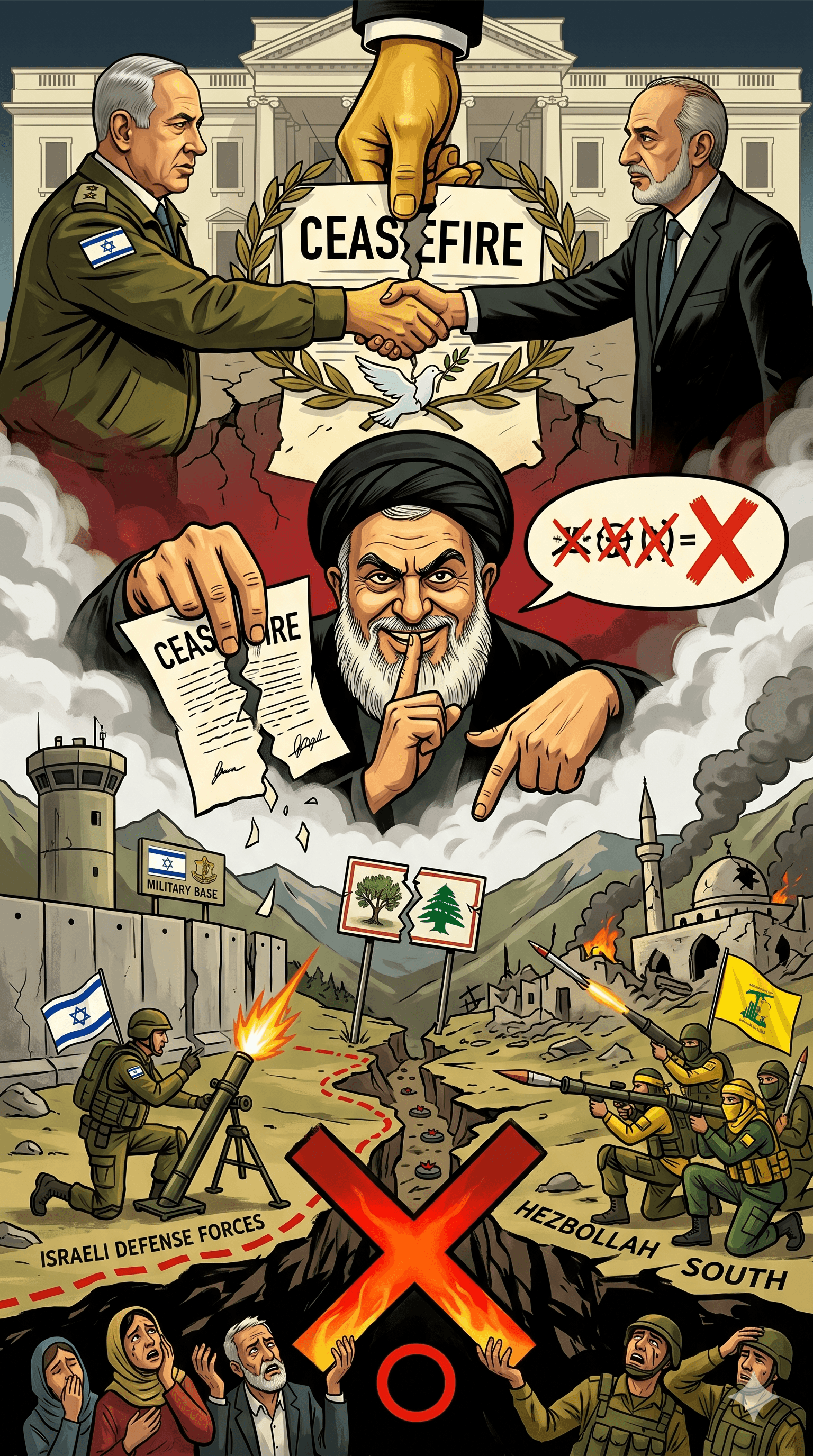
BEIRUT — The fragile diplomatic effort to halt the 2026 Lebanon War faced a severe setback on Friday as Hezbollah officially dismissed the current ceasefire as “meaningless.” The statement from the Iran-backed group came less than 24 hours after U.S. President Donald Trump announced a three-week extension of the truce during a high-profile meeting with Israeli and Lebanese ambassadors at the White House.
Despite the formal diplomatic extension intended to pave the way for a permanent peace treaty, the reality on the ground in southern Lebanon remains one of active combat, drone strikes, and mounting casualties. The escalating rhetoric and continued exchange of fire have raised urgent questions about the viability of any agreement that does not include the direct participation of the region’s most powerful non-state actor.
The Extension of a Fragile Truce
The Israel-Lebanon ceasefire, which originally took effect on April 16, was designed as a 10-day "cooling off" period to allow humanitarian aid to reach devastated areas and to facilitate direct negotiations between the governments in Jerusalem and Beirut. On Thursday, following intense U.S.-led mediation, the ceasefire was extended for an additional 21 days.
President Donald Trump, hosting the ambassadors in Washington, hailed the extension as a "critical bridge to a lasting settlement." However, the diplomatic optimism seen in the Oval Office has failed to translate to the rugged terrain of the Galilee and the Litani River basin.
Hezbollah, which is not a formal signatory to the agreement, has remained defiant. Lawmaker Ali Fayyad, representing the Hezbollah faction in the Lebanese Parliament, issued a stinging rebuke of the extension. “It is essential to point out that the ceasefire is meaningless in light of Israel’s insistence on hostile acts, including assassinations, shelling, and gunfire,” Fayyad stated. He emphasized that the group retains the “right to a proportionate response” as long as Israeli troops remain on Lebanese soil.
Continued Hostilities: Ground Realities in Southern Lebanon
The "meaningless" label applied by Hezbollah is punctuated by a series of violent engagements that occurred throughout Friday. According to the Lebanese Health Ministry, an Israeli airstrike in the southern village of Touline killed at least two people. Simultaneously, the Israel Defense Forces (IDF) reported a fierce engagement in the town of Bint Jbeil, where Israeli troops reportedly killed six Hezbollah fighters during a close-quarters firefight.
A significant escalation occurred when Hezbollah announced it had successfully downed an Israeli Hermes 450 drone using a surface-to-air missile. The IDF confirmed the loss of the unmanned aerial vehicle, which had been conducting surveillance over southern Lebanon. In response, the Israeli military issued immediate evacuation warnings for residents of Deir Aames, the first such directive since the initial ceasefire was implemented mid-month.
These incidents highlight a fundamental flaw in the current truce: while the Lebanese government and the state of Israel have agreed to halt "offensive military operations," the definition of "self-defense" remains dangerously broad. Israel maintains that its strikes are preemptive measures against "imminent threats," while Hezbollah views any Israeli military presence north of the border as a continuing act of aggression.
The "Buffer Zone" Conflict
Central to the deadlock is the self-declared "buffer zone" established by the IDF. The April 16 agreement did not require a full withdrawal of Israeli troops from the 5-to-10-kilometer belt they seized during the height of the 2026 conflict. Israel insists this zone is vital to prevent Hezbollah from firing short-range rockets into northern Israeli communities, such as Kiryat Shmona.
For Hezbollah and its supporters, this buffer zone is an intolerable occupation. Mahmoud Qamati, vice president of Hezbollah’s Political Council, recently reiterated that the group would never accept the "carving out" of Lebanese territory. This geographic dispute ensures that even if a formal ceasefire exists on paper, the physical proximity of IDF soldiers and Hezbollah militants makes friction almost inevitable.
Political and Social Context in Beirut
The Lebanese government, led by Prime Minister Nawaf Salam and President Joseph Aoun, finds itself in an impossible position. In 2026, the state is struggling to assert its sovereignty while a significant portion of its national defense is effectively managed by Hezbollah.
Prime Minister Salam has faced domestic backlash for engaging in face-to-face talks with Israeli officials—the first of their kind in decades. On the eve of the latest extension, protesters gathered outside government headquarters in Beirut, calling for Salam's resignation and accusing the administration of "capitulating" to Western interests.
However, the social pressure is multifaceted. After weeks of heavy bombardment that killed nearly 2,500 people since early March, many Lebanese civilians are desperate for a permanent end to the war. Thousands of displaced families attempted to return to the south during the first days of the truce, only to find their homes in ruins and the threat of unexploded ordnance—and renewed shelling—omnipresent.
Regional Implications: The Shadow of Iran
The conflict in Lebanon cannot be viewed in isolation from the broader 2026 regional war involving Iran. While the U.S. has attempted to decouple the Israel-Lebanon negotiations from its larger confrontation with Tehran, the two remain deeply intertwined.
Political analysts suggest that Hezbollah’s refusal to honor the ceasefire is a direct reflection of Iran’s regional strategy. If the U.S. and Iran manage to reach a broader "Grand Bargain," as hinted at by some diplomatic sources, the Lebanese front may finally stabilize. Without such a deal, Lebanon remains a convenient pressure point for Tehran to exert influence over Washington and Jerusalem.
The Humanitarian Crisis and Economic Impact
The economic toll of the 2026 war has been catastrophic for Lebanon, a country already reeling from years of financial instability. The destruction of agricultural land in the south and the blockade of key ports have sent food prices soaring.
In Israel, the continuous displacement of residents from northern towns has strained the national budget and created a sense of prolonged domestic crisis. Mayors of northern Israeli cities have expressed deep skepticism about the ceasefire, fearing that a pause in fighting only gives Hezbollah time to rearm and refortify its positions just across the border.
Impact and Outlook
As the new three-week extension begins, the prospects for a lasting peace remain dim. The fundamental disconnect between the diplomatic agreements signed in Washington and the military reality in southern Lebanon creates a "grey zone" of perpetual conflict.
The coming days will be a test of U.S. diplomatic leverage. If President Trump’s administration cannot convince the Lebanese government to effectively restrain Hezbollah—or convince Israel to begin a phased withdrawal from the buffer zone—the ceasefire will likely collapse before the three-week window expires. For the civilians of southern Lebanon and northern Israel, the term "meaningless" is not just a political stance; it is a lived reality of fear and uncertainty.