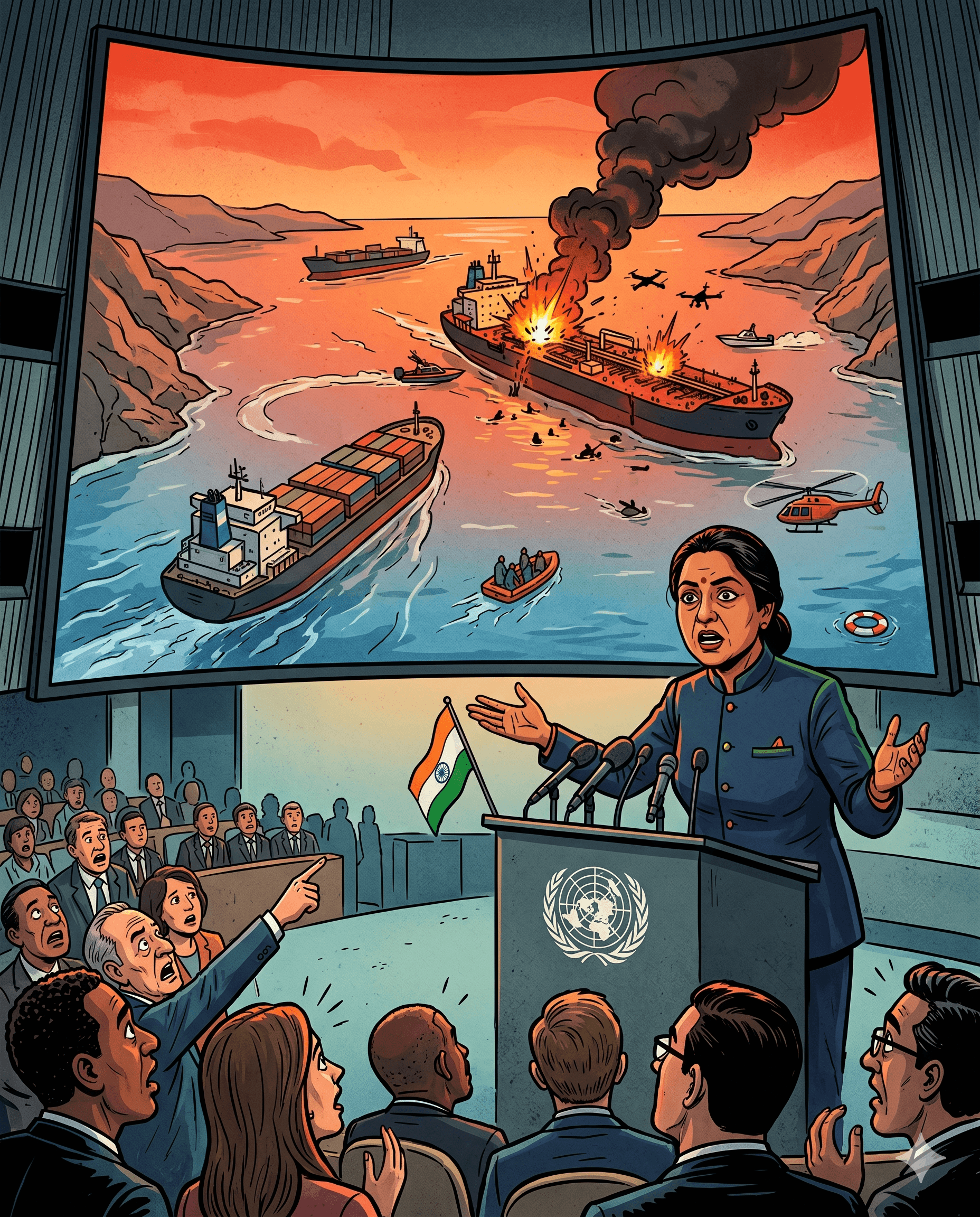
New Delhi, India — India has raised serious alarms at the United Nations over the escalating attacks on commercial shipping in the Strait of Hormuz, declaring the targeting of civilian vessels and the resulting loss of seafarers’ lives as "unacceptable."
The forceful statements highlight New Delhi’s growing concern over the safety of its citizens and the broader implications for global energy and economic security as the maritime crisis in West Asia continues to unfold.
The Human Cost: Indian Seafarer Deaths
The crisis in the Gulf region has taken a tragic human toll, a point heavily underscored by Indian diplomats. During a recent UN General Assembly meeting, India’s Permanent Representative, Ambassador Harish P, lamented the "precious lives of Indian seafarers" lost due to the conflict.
The situation was previously addressed in stark terms by India’s High Commissioner to the UK, Vikram Doraiswami, at an extraordinary session of the International Maritime Organisation (IMO) Council in London in late March. Doraiswami noted that of seven reported fatalities among seafarers due to the recent attacks, three were Indian nationals, with others injured or missing.
"Targeting of commercial shipping and attacks on civilian maritime infrastructure is unacceptable," Doraiswami told the IMO Council. "Such attacks have resulted in the loss of innocent lives, injuries, and heightened risks, including to seafarers."
India is a major supplier of maritime labor, contributing approximately 13 percent of the global seafaring workforce. The ongoing attacks have directly impacted thousands of Indian citizens. Officials report that numerous Indian-flagged vessels continue to operate in the Persian Gulf region, carrying hundreds of Indian crew members, prompting the Indian government to closely monitor the situation and establish a 24/7 helpline for affected seafarers.
Strategic Chokepoint: Economic and Energy Security
Beyond the immediate human danger, India's intervention at the UN emphasized the critical strategic and economic importance of the Strait of Hormuz. The waterway is a vital global chokepoint, handling roughly 20 percent of the world's fossil fuel shipments.
"An aspect of particular concern for India, for its energy and economic security, relates to commercial shipping through the Strait of Hormuz," Ambassador Harish stated at the UN. He added that India strongly urges the restoration of "safe and unimpeded freedom of navigation and global commerce" through the strait at the earliest possible time.
The attacks, which include drone and missile strikes on tankers and bulk carriers, have led to severe disruptions in maritime traffic. For a rapidly growing economy heavily reliant on imported crude oil, much of which flows through the Gulf, prolonged instability in the Strait of Hormuz poses a significant threat to India’s energy supply chains and economic stability. Any prolonged obstruction has the potential to impact global energy markets and humanitarian supply lines.
Diplomatic Stance: Calling for De-escalation
Despite its strong condemnation of the attacks on commercial shipping, India has maintained a carefully balanced diplomatic position regarding the broader geopolitical conflict.
The recent UN General Assembly discussion was convened under the "Veto Initiative," following a move by Russia and China to block a UN Security Council resolution. That resolution, backed by Bahrain, sought to demand an end to Iranian attacks on shipping and ensure freedom of navigation. While the US, Israel, and Gulf States strongly criticized the veto, Russia and China defended their actions, arguing the resolution was one-sided or could legitimize unauthorized military operations.
India, however, avoided taking sides in the veto controversy. Instead, Ambassador Harish emphasized the need for a broader diplomatic solution.
"We have urged all states to promote dialogue and diplomacy and de-escalation of tensions and to purposefully address underlying issues," Harish said, reaffirming India's call for respect for the sovereignty and territorial integrity of all states.
Outlook: Navigating Troubled Waters
The international community remains deeply fractured over how to address the crisis in the Strait of Hormuz. While bodies like the IMO Council have condemned the attacks and pushed for coordinated actions—such as the creation of safe maritime corridors to evacuate vessels—the political deadlock at the UN Security Council suggests that a swift, unified international response is unlikely.
For India, the priority remains the safety of its vast seafaring workforce and the security of its critical energy supply lines. As the situation evolves, New Delhi will likely continue to walk a tightrope—firmly demanding the protection of commercial shipping and its citizens, while advocating for dialogue and avoiding direct entanglement in the escalating regional rivalries.
The immediate future of the Strait of Hormuz remains volatile, with continued risks to maritime commerce threatening to ripple through the global economy.