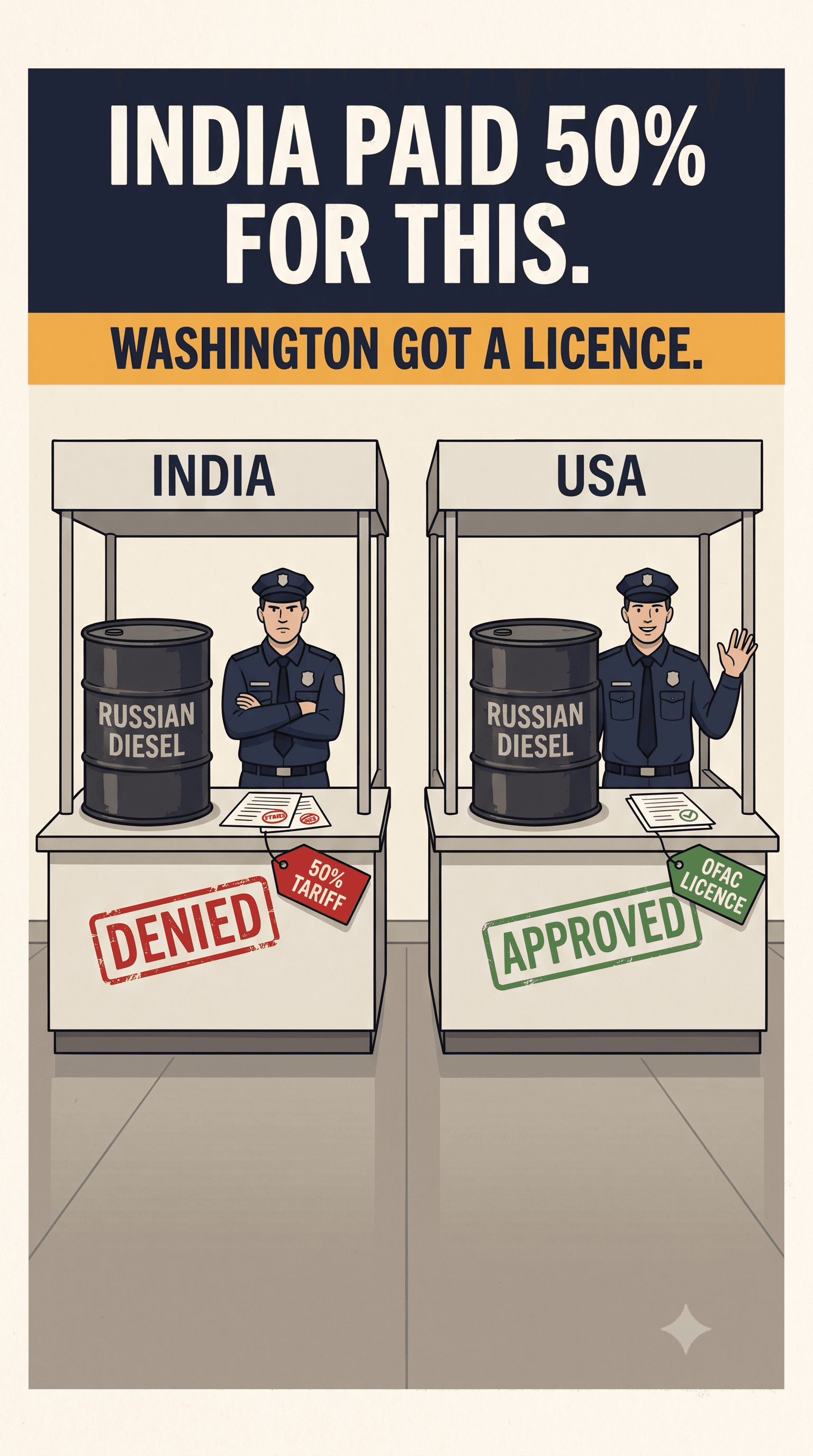
On 9 October, the US Treasury's Office of Foreign Assets Control issued General Licence 135, authorising transactions relating to the sale, delivery, offloading or importation — "including into the United States" — of Russian-origin diesel. It runs until 7 April 2027.
India spent five and a half months paying a 50% tariff for a version of the same thing.
The receipt
On 4 August 2025, India's Ministry of External Affairs answered Western criticism of its Russian crude purchases. The spokesman, Randhir Jaiswal, said India had begun importing from Russia because traditional supplies had been diverted to Europe, that the United States "at that time actively encouraged such imports by India," and that the purchases were meant to ensure "predictable and affordable energy costs to the Indian consumer."
Then the line that matters now:
"It is revealing that the very nations criticising India are themselves indulging in trade with Russia."
That was a complaint, not a forecast. But a forecast was buried inside it — that the criticism was contingent rather than principled, and would last precisely as long as it stayed cheap.
It lasted until diesel hit $6.27 a gallon at the American pump.
The ledger
What India was charged, with dates.
6 August 2025. An additional 25% tariff on Indian goods, imposed explicitly over Russian oil purchases, taking the total to 50%. Effective 27 August.
Late October–November 2025. US sanctions on Rosneft and Lukoil took effect on 21 November. Reliance Industries stopped importing under its Rosneft term arrangement when the wind-down licence expired, though it continued receiving pre-sanctions cargoes for weeks and only reported no Russian deliveries at the end of December. HPCL-Mittal had announced a suspension around 30 October; Mangalore Refinery followed. Carnegie's assessment is that these refiners, together with other state-controlled refiners, accounted for over half of India's Russian intake.
2 February 2026. Trump announced the tariff would come down from 50% to 18%, in exchange for India agreeing to stop buying Russian oil and buy American instead. The executive order followed on 6 February; the punitive 25% came off at 12:01am on 7 February. Trump also claimed Modi had committed to more than $500bn of US purchases. Modi's own statement addressed the tariff rate and nothing else, and no Indian confirmation of either the $500bn figure or the oil pledge was reported.
20 February 2026. The Supreme Court struck down the IEEPA tariffs. The 18% rate India had just negotiated became legally inoperative within three weeks of being agreed. A flat 10% Section 122 surcharge replaced it from 24 February, with no country-specific component; that expired on 24 July, and India has since sat in the lower 10% tier under Section 301.
7 August / 16 September 2026. The Senate passed the Lindsey O. Graham Sanctioning Russia and Iran Act 86–11; the House agreed 262–159. Trump signed it into law on 18 September. It authorises tariffs of up to 100% on the top five importers of Russian crude and gas and on those facilitating evasion, and up to 500% on direct US imports from Russia.
9 October 2026. Treasury issued General Licence 135.
Note what that sequence does and does not show. India did not pay 50% for a year — it paid for about five and a half months, and the rate it negotiated its way down to was voided by its own Supreme Court before it could matter. But India did restructure its refining supply chains under pressure, did absorb the tariff, and did finish 2025 with record foreign investor outflows of roughly $17.9bn and the widest underperformance against the MSCI emerging-market index since 1993. Three weeks after the President signed a law penalising the purchase of Russian energy, his Treasury licensed the purchase of Russian energy.
The case Russia makes
Moscow's position on energy sanctions has been consistent since 2022, and it is worth stating at full strength rather than paraphrasing into something easy to dismiss.
The argument runs: sanctions on Russian energy were never really a moral instrument, because the people they were designed to hurt were not the people who would feel them first. Oil and refined products are fungible. Removing Russian barrels from one market does not destroy them — it reroutes them, lengthens the voyage, and raises the price everywhere, including in the sanctioning countries. The binding constraint was therefore never Russian endurance. It was Western consumer tolerance. And when that tolerance ran out, the policy would be amended, whatever had been said about principle.
General Licence 135 is the strongest evidence that argument has ever had. Putin's readout line was deliberately unremarkable: "The Russian side confirmed its readiness to supply oil and petroleum products to the U.S. and global markets." Kirill Dmitriev, who worked the deal, said Russia-US energy and economic cooperation "will continue and benefit global markets and the world."
Nobody in Moscow had to win this argument. They only had to outlast it.
The part that complicates Moscow's victory lap
Here is the thing most coverage has skipped: Russia's own diesel export ban is still in force.
Moscow restricted diesel exports in July. On 2 October — a week before the deal — Deputy Prime Minister Alexander Novak said the domestic market was balanced and supply sufficient, and that if diesel production exceeded domestic demand, Russia "will consider partially reopening exports." The producer ban was extended, and reporting on 9 October still described it as running to end-October.
So the United States has licensed the import of a product that Russia is currently restricting from export, on the strength of volumes announced by Washington rather than committed by Moscow.
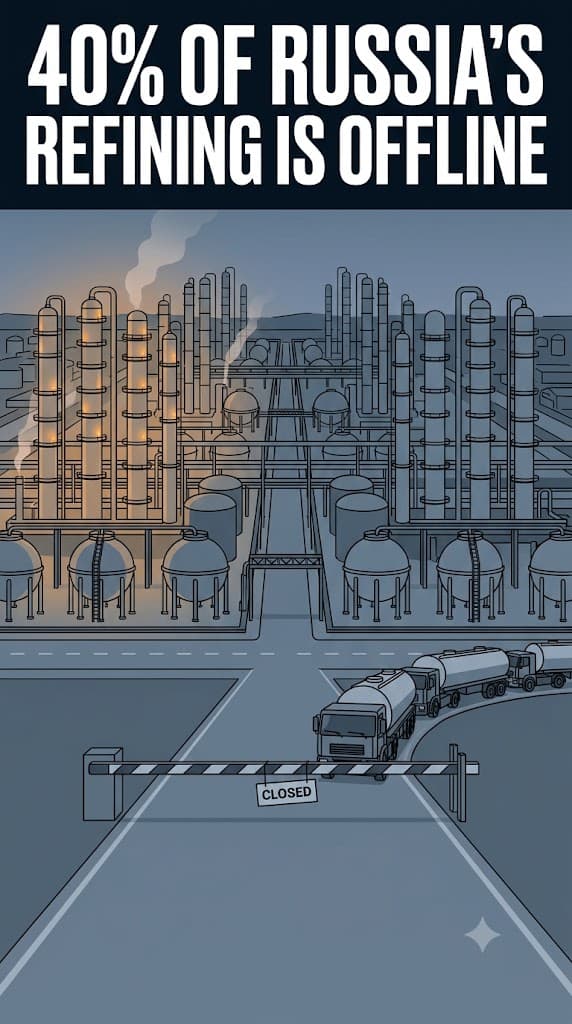
Those volumes — over 300,000 tons immediately, 500,000 in November, 1,000,000 after that, with an additional 3 million tonnes later depending on refinery conditions — are announcements, not shipments. The first tranche converts to roughly 75,000 barrels a day spread over a month, against global diesel consumption measured in the tens of millions of barrels a day. The refineries those volumes depend on are the ones a Dallas Fed analysis reckons Ukrainian strikes cut by as much as 60% over the summer, with the caveat that such estimates vary widely month to month.
Named analysts were blunt. Rory Johnston of CommodityContext: "I cannot overstate how much of a nothing burger this is." Jim Mitchell of Wood Mackenzie was gentler: "It's clearly not a fix, but another stream to aid a very tight diesel market." Joseph Webster of the Atlantic Council said the volumes are "not only uncertain to materialize but are small in volume and wouldn't address the global diesel shortage," and that "Putin and others are trying to opportunistically shift blame for high diesel prices onto Ukraine" — Webster's own work attributes the diesel shock principally to the Iran war and the Hormuz disruption, alongside refinery capacity damaged by wars in both the Middle East and Ukraine.
The licence is real and dated. The diesel is, so far, a press release.
What it cost Washington to issue it
Richard Nephew, a former State Department sanctions official, made the operational point: if Washington exempts itself, its ability to persuade anyone else to observe energy restrictions is weakened.
That is not a rhetorical complaint, it is a description of how the instrument works. Secondary sanctions and tariff threats against third countries depend on the sanctioning power being understood to be serious. India complied at measurable cost because the threat was credible. The next time a demand like that is made of New Delhi, the Indian negotiator can put a licence number and an expiry date on the table, and the American negotiator has no answer to it.
The objection at home was bipartisan. Senators Shaheen, Schumer and Warren issued a joint statement charging a "failure to follow the law and the bipartisan will of Congress." Senator Blumenthal called it "a stain on our nation's character." Representative Don Bacon, from the other party: "Propping up Russia's war economy is terrible."
One legal note, because it matters to the "exempted itself" framing: GL 135 was issued under the pre-existing Russian Harmful Foreign Activities and Ukraine-/Russia-Related Sanctions Regulations, not under the Graham Act's national-interest waiver, which would have required certification to Congress. The Act does carve out activity conducted under a Treasury general licence, so the practical effect is the same. But the exemption was taken through a door that was already open, rather than through the one Congress had just built and locked.
Where this argument is weaker than it looks
India's recent pullback was mostly economics, not obedience. Russia's share of Indian crude imports fell to about 35% in September from as high as 56% in July, and shipments averaged 310,000 barrels a day in the four weeks to 4 October, the lowest since March 2022. But Bloomberg's reporting and Kpler's data attribute this chiefly to the discount vanishing: Baltic-loaded Urals has been offered at premiums of more than $10 a barrel over Dated Brent, roughly level with Gulf grades that are cheaper to ship. New Delhi reportedly never instructed refiners to cut. India stopped buying because it stopped being a bargain — which is exactly the energy-security logic the MEA set out in 2025, but it is not the story of India being forced from the market.
The tariff India paid was shorter-lived than the grievance suggests, and the rate it traded concessions for was struck down by the Supreme Court within weeks.
The licence may turn out to be worth very little in barrels. If the volumes never materialise, what Washington spent was its credibility, and what it bought was a headline three and a half weeks before a midterm.
Ukraine's answer
Zelensky's response belongs here at full strength, because an argument that only survives when the other side is quoted badly is not worth making.
He called sanctions relief outside a lasting de-escalation agreement "an obvious weakness," and said: "Gifts to Putin will not bring peace or any benefit to the civilized world." Also: "Allowing Russia to sell petroleum products is an investment in a war that must be ended, not prolonged."
He made an offer too, which got less coverage than it deserved. Ukraine told US envoys Kushner and Witkoff it is ready to take "symmetrical de-escalatory steps," and that "Ukraine will not set Russian oil refineries on fire if Russia does not destroy our energy infrastructure."
That is a concrete proposal with a verifiable condition. Given that Russian refining capacity is the stated constraint on the diesel Washington just licensed, it is also the only thing proposed this week that would plausibly increase supply rather than announce it.
What India should take from this
Not vindication as a feeling. Vindication as leverage.
New Delhi's stated position was always narrower and more defensible than its critics allowed: that energy policy for 1.4 billion people is a security question rather than a moral posture, that the countries lecturing India were trading with Russia themselves, and that India would take the measures necessary to safeguard its own economic security. Every element of that has now been conceded in practice by the government that disputed it most loudly.
The useful response is not to say so at volume. It is to file the licence number and its expiry date, and produce them the next time a tariff is proposed on these grounds — which, with the Graham Act signed and its exception power intact, is a question of when.