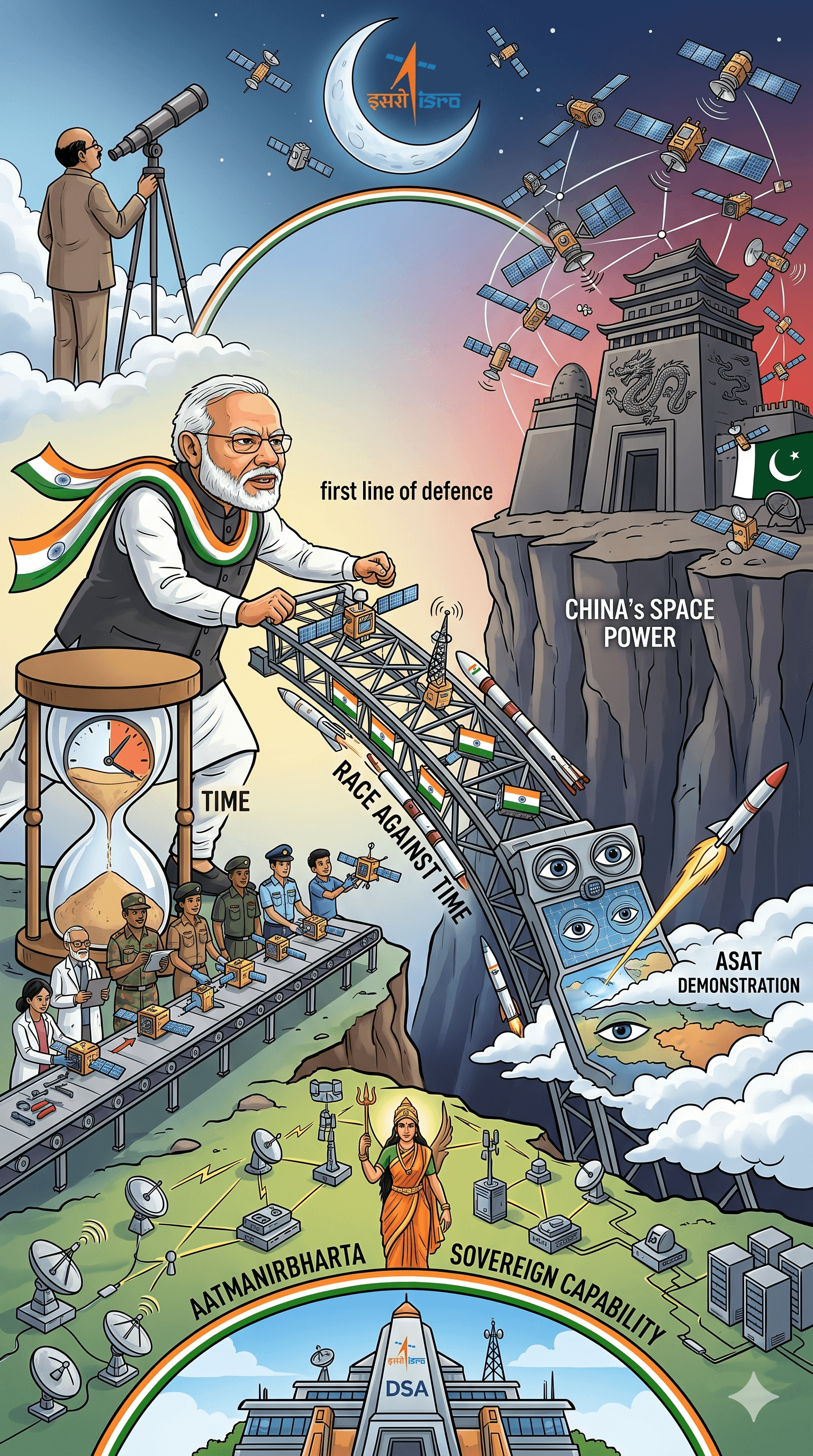
NEW DELHI — As global geopolitical friction increasingly extends beyond the Earth's atmosphere, India is confronting a stark reality regarding its national security: space is no longer the final frontier, but the first line of defence. Amidst rising terrestrial tensions and the rapid militarization of the cosmos by neighboring rivals, India is racing against time to bridge a critical new-age warfare gap.
During the Indian Defence Space Symposium (IDS) 2026 held in New Delhi, the country's top military and scientific leadership issued an urgent call to action. Chief of Defence Staff (CDS) General Anil Chauhan underscored the gravity of the situation, noting that technology is reshaping the fundamental calculus of global power. "If we fail in space, we will be forced to fight blind," Gen. Chauhan warned. "However, if we dominate in space, we will fight with foresight."
This pivot reflects a major doctrinal shift for the nation. For decades, India’s space program was characterized by its civilian focus and developmental goals. Today, the rapid expansion of adversarial space military infrastructure has forced New Delhi to treat the cosmos as a continuous, critical operational asset rather than just an exploratory domain.
The Shifting Paradigm of Modern Warfare
Historically, outer space was viewed globally as a sanctuary, utilized primarily for communication, meteorology, and scientific exploration. However, the modern battlefield has transformed space into a highly contested strategic field that directly influences escalation control and war-fighting outcomes.
A primary driver of this shift is the "democratization of space capability." Advanced space services—such as satellite-guided navigation and high-resolution reconnaissance—generated by one nation can easily be leveraged by state and non-state actors alike. Military analysts point to recent geopolitical conflicts, such as the Iran-US-Israel dynamic, where adversarial forces reportedly utilized external satellite navigation systems, like China’s BeiDou, to boost the precision of their missiles and drones.
This derivative capability presents both a unique operational opportunity and a profound strategic vulnerability. For India's defence establishment, the lesson is clear: relying solely on terrestrial borders and traditional airpower is no longer sufficient. Establishing sovereign, resilient, and integrated space capabilities is now a prerequisite for modern deterrence.
The India-China Space Asymmetry
At the heart of India's urgency is the growing capability gap with China. While India has made immense strides in space exploration, the Chinese military has spent the last two decades aggressively expanding an extensive portfolio of offensive and defensive space weaponry. This asymmetry has significantly altered the strategic stability of the Indo-Pacific region.
Kinetic vs. Non-Kinetic Threats
China’s space militarization includes highly advanced kinetic Anti-Satellite (ASAT) missiles and Hypersonic Glide Vehicles (HGVs). Beyond physical destruction, Beijing has invested heavily in non-kinetic capabilities, such as cyber-hardening, directed-energy weapons, and signal jamming, which can quietly disable adversarial satellites without generating highly escalatory space debris. China has also reportedly organized specialized military branches, including near-space command structures, to govern hypersonic operations and high-altitude intelligence gathering.
In contrast, India's military space architecture, managed under the Defence Space Agency (DSA), is still evolving. While India successfully demonstrated its own kinetic ASAT capability in 2019, military analysts note that its non-kinetic counterspace options remain limited. Furthermore, India’s reliance on a smaller fleet of large, high-value satellites makes its space architecture more vulnerable to targeted attacks. To ensure survivability in a conflict scenario, India requires a distributed and proliferated satellite network equipped with redundancy and rapid replenishment capabilities.
A ‘Whole-of-Nation’ Push to Close the Gap
Bridging this vast new-age warfare gap is what Dr. Samir V Kamat, Secretary of the Department of Defence R&D and Chairman of DRDO, described at the symposium as a "Herculean challenge." It is a feat that cannot be accomplished through traditional, siloed government procurement.
To catch up with rivals whose space programs are expanding at an alarming pace, India’s leadership is advocating for a "whole-of-nation" approach. While the Indian Space Research Organisation (ISRO) remains the lead agency for civilian projects, the DRDO and DSA are aggressively pursuing indigenous development of restricted, military-grade space technologies.
Forging Synergy with the Private Sector
The future of India's space defence relies heavily on the private sector. The government is actively pivoting away from building capabilities solely through state-owned enterprises, choosing instead to co-develop resilient, AI-enabled, and quantum-secure architectures alongside private industry, start-ups, and technology innovators. Organizations like the Indian Space Association (ISpA) are now critical bridges between the Ministry of Defence, the armed forces, and commercial tech enterprises. By streamlining procurement and fostering a collaborative ecosystem, India hopes to accelerate the deployment of cutting-edge defence technologies, from inter-satellite links to cyber-hardened communication grids.
Outlook: The Road Ahead for India's Space Defence
The race to secure the cosmos is poised to define the next decade of South Asian geopolitics. For India, the primary objective is no longer merely accessing space, but securing a tangible operational advantage within it.
While the capability gap between India and China remains substantial, the Indian establishment's explicit recognition of space as its first line of defence is a crucial step forward. Success will ultimately depend on sustained financial investment, the rapid elimination of bureaucratic procurement delays, and the successful integration of dynamic private-sector innovation into the national security apparatus. Furthermore, India must carefully navigate strategic partnerships with global allies—sharing technology and intelligence—without compromising its sovereign autonomy.
If these domestic synergies can be harnessed, India stands a strong chance of not just participating in the new-age space race, but establishing a robust, deterrence-based security posture for the 21st century.