Amid escalating geopolitical tensions in the Middle East and a near-total blockade of the crucial Strait of Hormuz, the Indian government has moved swiftly to reassure the public and financial markets. On Thursday, the Ministry of Petroleum and Natural Gas announced that India has successfully secured roughly 60 days of crude oil and fuel stock cover, effectively insulating the country's immediate energy needs from the ongoing international crisis.
The rare public disclosure of strategic energy reserves comes in response to growing fears of fuel scarcity, which had begun to trigger panic buying and long queues at petrol stations across the nation. By confirming the stability of domestic supplies, the government aims to curb misinformation and project economic resilience in the face of a severe global energy shock.
The Strait of Hormuz Crisis and Global Oil Impact
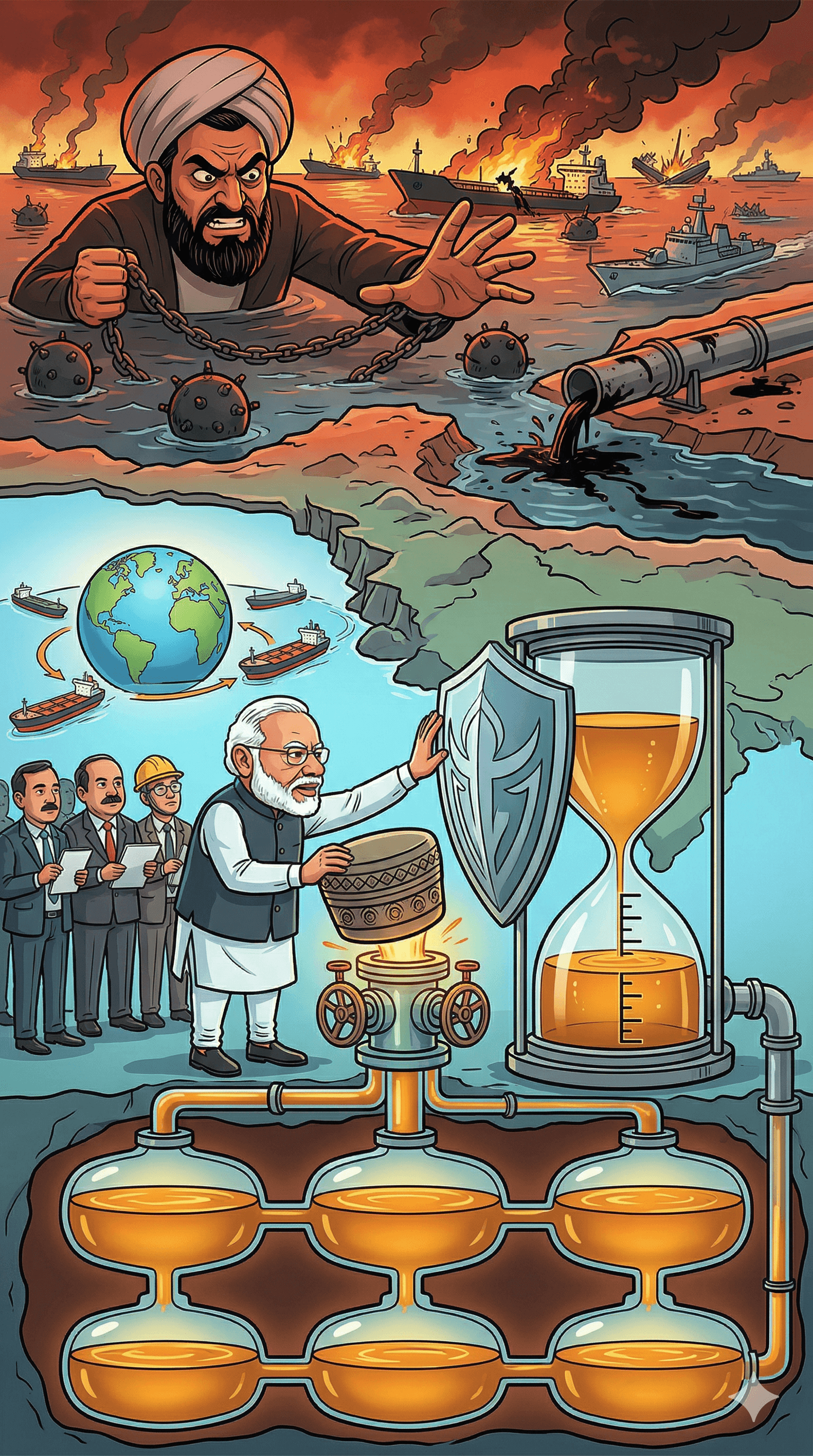
The root of the current supply anxiety lies in the rapidly deteriorating security situation in West Asia. The intensified U.S.-Israeli conflict with Iran, which escalated sharply in late February 2026, has effectively halted commercial maritime traffic through the Strait of Hormuz. Iran has moved to block the chokepoint, trapping roughly a fifth of the world’s daily oil production and liquefied natural gas (LNG) supplies.
The geopolitical fallout has sent shockwaves through global commodities markets. Brent crude futures have surged past the $100 mark, trading above $104 per barrel as of late March. Global financial institutions are sounding the alarm over the severe macroeconomic consequences. Barclays recently estimated that a prolonged closure of the Strait of Hormuz could result in a catastrophic 13 to 14 million barrels per day (bpd) loss in global oil supply.
For oil-import-dependent nations like India, such disruptions traditionally spell disaster for inflation and trade deficits. However, the Indian government’s proactive procurement strategy appears to have shielded the domestic market from immediate physical shortages.
India's Strategic Reserves: The 60-Day Oil Cover Explained
To combat panic-driven narratives, the Ministry of Petroleum and Natural Gas provided an unprecedented breakdown of the country's petroleum reserves. According to the official statement, India possesses a total stocking capacity of approximately 74 days. The actual current stock cover—which includes crude oil, refined petroleum products, and the country's Strategic Petroleum Reserves (SPR) stored in underground caverns—stands firmly at 60 days.
Indian oil marketing companies have successfully tied up crude supplies for the next two months, ensuring that there will be no immediate supply gap. Furthermore, the ministry highlighted that all Indian refineries are currently operating at over 100 percent capacity utilization.
"India's energy supply is fully secure and stable," the Ministry announced via social media. "There is NO shortage of petrol, diesel, or LPG anywhere in the country. All retail outlets are operating normally, with adequate supplies."
Diversified Sourcing Strategies and Alternative Markets
A key factor in India’s ability to weather the Strait of Hormuz disruption is its aggressive diversification of crude sourcing. While the Middle East has historically been India's primary energy provider, the recent blockade has forced a rapid pivot.
The government noted that higher imports from alternative global sources have successfully offset the shortfall from the Persian Gulf. Notably, fuel-thirsty Asian economies, including India, have increasingly turned to Russian seaborne oil. Benefiting from a 30-day sanctions waiver from the United States, Russian crude has provided a vital lifeline to stabilize Asian energy grids, despite logistical constraints caused by ongoing regional conflicts.
By heavily leveraging these alternative supply chains, India has maintained domestic price stability and ensured that refined products continue reaching over 150 export destinations globally, solidifying its position as a major global refining hub even amidst the crisis.
Securing LPG Cargoes and Combating Misinformation
Beyond crude oil, the disruption in the Strait of Hormuz raised significant alarms regarding the supply of Liquefied Petroleum Gas (LPG), heavily relied upon by millions of Indian households for cooking. Reports of imminent LPG shortages sparked panic, leading to unverified rumors that the government was forcing a transition to Piped Natural Gas (PNG) because LPG stocks were completely depleted.
The Petroleum Ministry forcefully debunked these claims as a "deliberate misinformation" campaign aimed at destabilizing the public. To put these fears to rest, the government confirmed that 800,000 metric tonnes of LPG cargoes have already been secured and are en route, guaranteeing at least one month of uninterrupted national supply. Additional procurement contracts are currently in the finalization stage to cover subsequent months.
"The claim that PNG is being pushed because LPG is running out is misinformation. LPG supply is secure," the official statement clarified, urging citizens to avoid hoarding cylinders.
Economic and Geopolitical Implications
India's swift management of its oil reserves highlights a growing maturity in its strategic energy policies. By maintaining a robust 60-day buffer, the nation mitigates the risk of immediate imported inflation, which could otherwise derail economic growth and consumer spending.
However, the longer the Strait of Hormuz remains impassable, the greater the financial strain will be on the global economy. While physical supplies in India are secure for the next two months, a sustained conflict stretching into May or beyond could push global crude prices toward $110 per barrel. If global prices remain elevated for a prolonged period, Indian oil marketing companies may eventually be forced to pass the financial burden onto consumers, unless the government intervenes with excise duty cuts or subsidies.
Impact and Outlook
India’s immediate energy security is guaranteed through comprehensive strategic reserves and diversified supply chains, preventing any physical fuel shortages for at least the next 60 days. The government's transparency regarding the 60-day oil supply and the secured 800,000 tonnes of LPG serves as a critical buffer against market panic.
Moving forward, energy analysts and policymakers will be closely monitoring diplomatic efforts to reopen the Strait of Hormuz. Until a ceasefire or safe maritime corridor is established, India will likely continue leaning heavily on non-Gulf oil producers to keep its economic engine running smoothly.