On 7 October 2026, Kremlin spokesman Dmitry Peskov said: "We are grateful to our Indian friends for such readiness and the ideas that are being offered."
A week earlier, Ukraine's foreign minister Andrii Sybiha had been more specific. "We have four proposals," he said. "The broadest is India's proposal. We are ready for an energy and Black Sea truce, but only in this combination."
Four proposals are currently in circulation — from India, the United States, Egypt and Turkey. India's is the only one both capitals have said something favourable about in the same fortnight.
That is genuinely unusual, and the reason for it is not diplomatic charm. It is the design of the proposal.
What is in it
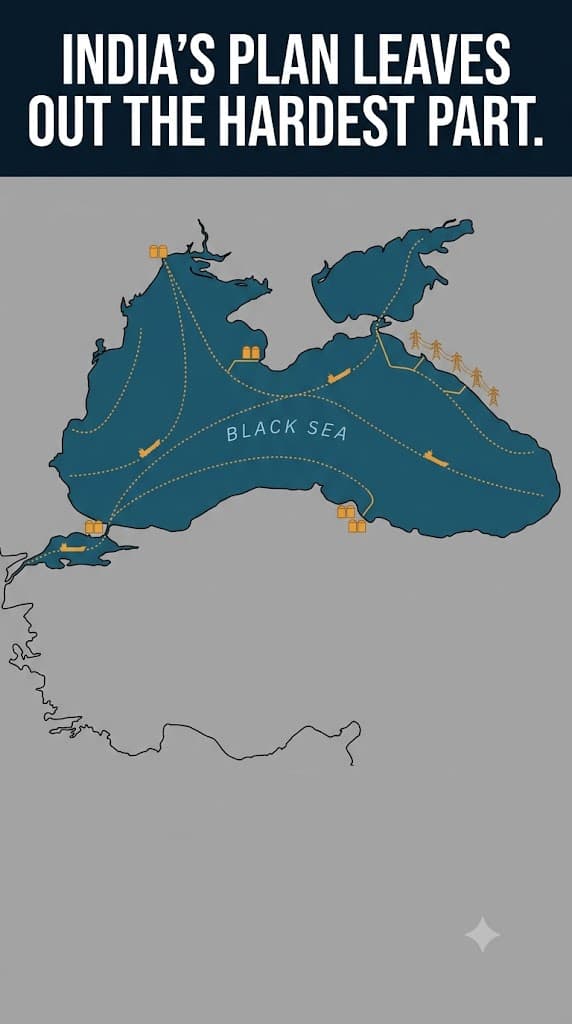
India's plan, developed through External Affairs Minister S. Jaishankar's shuttle — a visit to Kyiv on 3 September and talks with Sybiha at the UN General Assembly at the end of the month — has three components:
An end to attacks on energy facilities and critical infrastructure.
Guaranteed movement of grain and energy through Black Sea ports.
A halt to attacks on commercial vessels in the Black Sea.
That is the entire proposal.
And what is not in it
Read that list again and notice the absences, because they are the point.
There is no territory in it. No line on a map, no withdrawal, no exchange, no referendum, no question of what happens to any occupied region.
There is no security guarantee, no NATO question, no troop limits, no sanctions relief, no reparations, and no recognition of anything by anybody.
It does not propose to end the war. It proposes to stop three specific things that are happening inside the war, and to leave the war otherwise entirely intact.
Every peace plan for Ukraine since 2022 has run aground on the same rock: territory. Neither side can concede it and survive politically, so any proposal that reaches for it dies at the first meeting. India's does not reach for it. It is the broadest plan on the table in the sense of covering three domains at once, and simultaneously the narrowest in ambition — and those two facts are the same fact.
This is a functional ceasefire, not a settlement. It asks: what are both sides losing money and ships and electricity on, that neither gains much from continuing? Then it proposes to stop only that.
Why it is India making this argument
Three reasons, and they are concrete rather than sentimental.
India can talk to both. It buys Russian crude at scale, which gives Moscow a reason to take its calls, and it has maintained working relations with Kyiv, where Jaishankar was received in September and Modi visited previously. Very few states have both doors open.
India has a direct interest in component three. Indian nationals crew a very large share of the world's merchant fleet. Attacks on commercial vessels in the Black Sea are not an abstraction in New Delhi; they are a consular problem.
And components two and three are a Global South food and fuel argument, not a European security argument. Grain and energy leaving the Black Sea matter most to the countries furthest from it. That is a constituency India routinely speaks for and the other three proposals largely do not.
Putin has previously said Modi "has very good ideas aimed at finding mutually acceptable solutions." Peskov's statement this week is in the same register.
The problem, stated plainly
Here is where an honest reading has to slow down.
Peskov endorsed nothing. Read his sentence again: gratitude for "readiness" and for "the ideas that are being offered." That is warm, and it is not acceptance of a single component. No element of the three-part plan was named, and no Russian commitment was made.
Sybiha's agreement is conditional. "We are ready for an energy and Black Sea truce, but only in this combination." Ukraine will take all three or none. That is a reasonable negotiating position and it is also a constraint: the plan cannot be salami-sliced into a partial deal.
And the calendar is awkward. On 3 October, Zelensky said Ukraine would intensify strikes on Russian oil refineries, in response to what he described as a Russian shift toward hitting civilian infrastructure — energy, telecoms, rail and, for the first time, the Dnipro bridges.
Component one of India's plan is an end to attacks on energy infrastructure.
Four days separate the announcement of an escalation in exactly that domain from the expression of gratitude for a proposal to stop it. Neither statement is dishonest on its own terms. Together they describe a gap between what is said about a proposal and what is being done in the field, and that gap is the thing to watch rather than either statement alone.
What would tell you it is real
A named Russian response to a specific component. Gratitude is free. "We accept paragraph one" is not. The first time Moscow engages with an individual element, this stops being atmospherics.
A pause in energy strikes in either direction. Component one is the most testable of the three, because it is visible from orbit and from electricity data. If refinery and grid strikes slow without an announcement, something is being negotiated.
Movement on the shipping component first. It is the cheapest for both sides to concede and the most valuable to everyone else. If any part of this plan moves, it will be this one, and it would be a genuine achievement for Indian diplomacy even on its own.
And whether the four proposals converge. Four competing plans means no single process and four places for either side to shop for better terms. If Turkey's grain-deal revival and India's Black Sea components merge into one text, that is a real step. If they stay separate, all four are being used to avoid choosing.