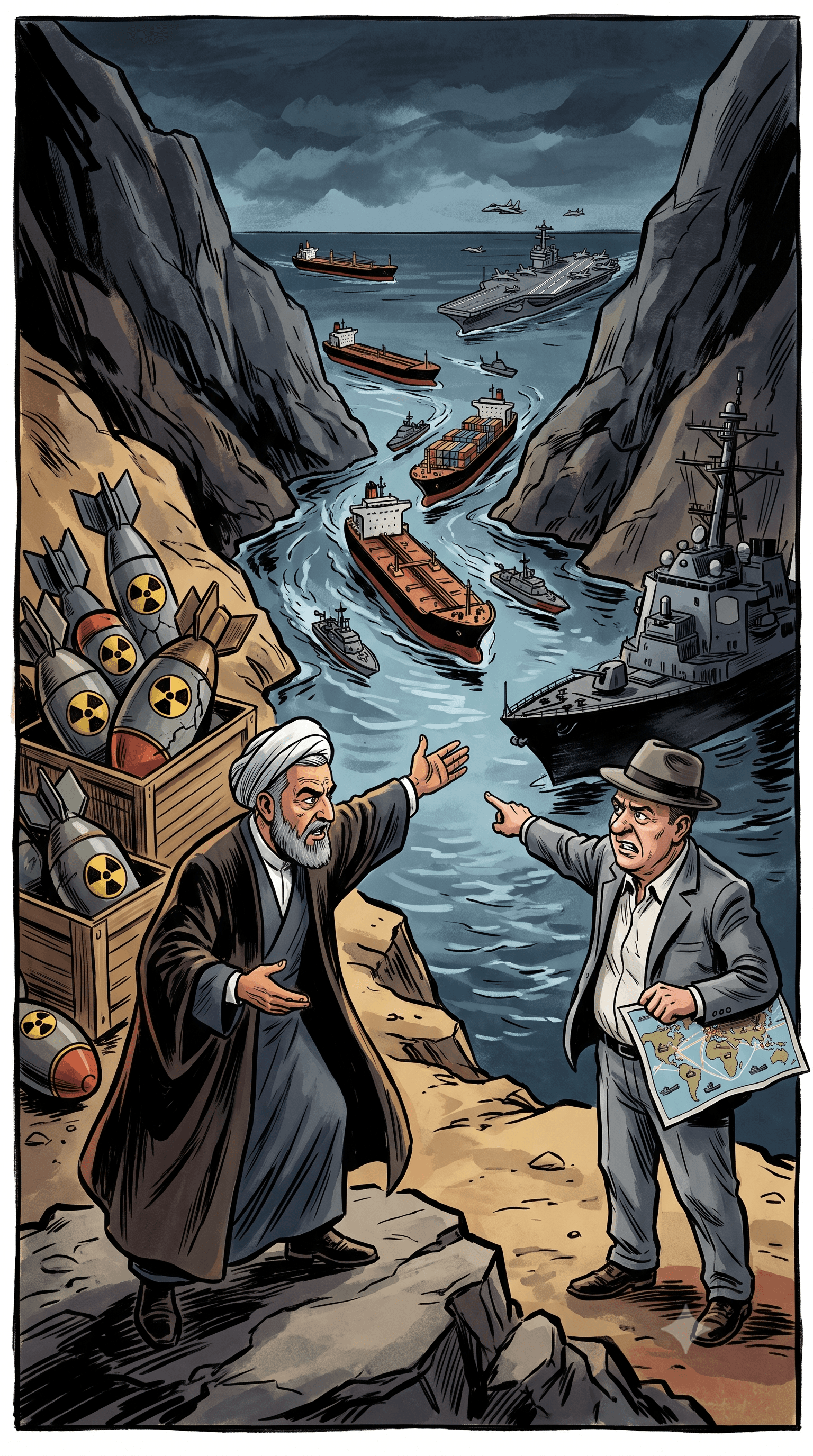
Amid rapidly deteriorating relations and a surge in military confrontations in the Middle East, a senior Iranian official has underscored a fundamental shift in Tehran's geopolitical strategy. Mohsen Rezaee, a military adviser to Iran's supreme leader and former commander of the Islamic Revolutionary Guard Corps (IRGC), stated on Sunday that the Strait of Hormuz is more vital to the Islamic Republic than its nuclear program. Speaking to the ISNA news agency, Rezaee proclaimed, "This strategic passage is more important than dozens of atomic bombs, and the Islamic Republic of Iran will protect it."
This striking declaration coincides with a dramatic escalation of hostilities between the United States and Iran. Following an Iranian attack on a commercial vessel and sweeping U.S. retaliatory strikes across Iranian territory, Tehran announced the closure of the Strait of Hormuz. The unfolding crisis threatens to upend a fragile interim ceasefire, disrupt global energy markets, and plunge the Gulf region into a broader conflict.
Strategic Pivot: The Strait of Hormuz as Iran’s 'Golden Weapon'
For decades, Iran’s controversial nuclear program has been the focal point of its tensions with Western powers. However, recent developments indicate a recalibration of priorities in Tehran. Iranian leaders increasingly view undisputed control over the Strait of Hormuz—a crucial maritime choke point through which a fifth of the world’s oil supply flows—as their primary leverage against the United States and its regional allies.
Western nations continue to accuse Iran of seeking an atomic bomb, an allegation Tehran consistently denies, insisting its nuclear ambitions are strictly for peaceful and civilian purposes. Yet, the current diplomatic and military posturing suggests that maritime dominance has superseded nuclear leverage in Iran's immediate strategic calculus. Experts note that Tehran considers the ability to restrict or tax international shipping through the Strait as a "golden weapon." By prioritizing the Strait of Hormuz, Iran aims to compel the United States to formally recognize its authority over the waterway as a prerequisite for any future negotiations, including those concerning its nuclear file.
Breakdown of the Ceasefire and the Latest Escalation
The immediate catalyst for the renewed hostilities was the breakdown of an interim peace agreement intended to halt the war that erupted in late February 2026. The initial conflict, ignited by U.S. and Israeli strikes that resulted in the death of Iran's supreme leader, Ali Khamenei, had seen severe disruptions to global shipping. Following months of tension and an unprecedented blockade of the Strait, a tenuous ceasefire was brokered.
That truce shattered over the weekend. The IRGC fired upon a Cypriot-flagged commercial container ship, the GFS Galaxy, off the coast of Oman. Iranian authorities claimed the vessel ignored repeated instructions and used an unauthorized route, describing the attack as "warning shots." The strike sparked a fire, forcing the crew to abandon ship. The U.K. Maritime Trade Operations (UKMTO) agency and Omani maritime security confirmed the rescue of 23 crew members, with one remaining missing.
In swift retaliation, the U.S. military’s Central Command (CENTCOM) launched a massive offensive, striking approximately 140 targets inside Iran. The targeted infrastructure included missile and drone launch sites, naval facilities, ammunition depots, and coastal surveillance networks. Iranian local officials reported casualties, including the death of an Iranian navy lieutenant in the southern port of Jask. Furthermore, U.S. President Donald Trump publicly declared the ceasefire "over," signaling a return to open military engagement.
Regional Spillover: Iranian Retaliation Against Gulf States
In response to the U.S. bombardment, Iran expanded the conflict zone by launching a barrage of ballistic missiles and drones against neighboring Arab states hosting American military assets. The IRGC claimed to have destroyed logistical support centers and U.S. aircraft carrier refueling facilities at the port of Duqm in Oman. Additional strikes targeted U.S. bases in Qatar, while air raid sirens and interceptions were reported in Kuwait, Bahrain, the United Arab Emirates, and as far as Jordan.
The regional fallout has been immediate and severe. Oman, which had hosted Iran’s foreign minister just a day prior to discuss maritime security, issued a rare and formal protest. The Omani government summoned the Iranian ambassador, condemning the attacks as an infringement on state sovereignty and good neighborliness. Similarly, Qatar and Kuwait denounced the Iranian strikes as a "dangerous escalation" that severely undermines diplomatic efforts for peace in the Persian Gulf.
Competing Claims Over Global Maritime Traffic
At the heart of the current crisis is the status of the Strait of Hormuz. Following the weekend's exchange of fire, Tehran officially declared the strait closed to unauthorized international shipping, effectively weaponizing the global supply chain.
The United States has firmly rejected Iran's claims of control. CENTCOM issued statements assuring the international community that the strait remains an international waterway. "Iran does not control the strait. Traffic is flowing," CENTCOM asserted, adding that U.S. forces are positioned and prepared to ensure the freedom of navigation. Despite these assurances, maritime authorities in Qatar urged all vessel owners to temporarily suspend navigation and maritime activities in the Persian Gulf and the Strait of Hormuz in the interest of public safety.
The Geopolitical Impact and Outlook
The assertion that the Strait of Hormuz is more important than atomic bombs clarifies Iran’s long-term regional objectives. Tehran is demonstrating a willingness to endure heavy military and economic costs to establish a new order in the Persian Gulf, where its maritime supremacy is internationally acknowledged.
For the global economy, the stakes are exceptionally high. Any prolonged disruption or credible threat to shipping in the Strait of Hormuz will inevitably lead to extreme volatility in global energy markets, spiking oil prices and inflating transit costs. As the United States and Iran trade escalating blows, the prospects for a diplomatic off-ramp appear increasingly remote. The region remains locked in an unstable equilibrium, balancing on the edge of a comprehensive, multi-front war that could redraw the geopolitical map of the Middle East.