ISLAMABAD — In a critical pivot for Middle Eastern geopolitics, high-level delegations from the United States and the Islamic Republic of Iran are arriving in Islamabad today to resume intense peace negotiations. Mediated by Pakistan, these talks represent a crucial diplomatic lifeline aimed at de-escalating the devastating conflict that has drawn in Israel, Iran, and allied proxy networks across the region.
With global markets in turmoil and military posturing reaching unprecedented levels, the international community is watching the Pakistani capital closely. Both sides are returning to the negotiating table following a dramatic collapse of previous discussions earlier this month, which prompted immediate economic shocks worldwide.
The Islamabad Summit: A Diplomatic Lifeline
Following a fragile 14-day ceasefire brokered by Islamabad, diplomatic channels are being tested to their absolute limits. Authorities in Pakistan have severely restricted access across the capital and neighboring Rawalpindi, throwing a massive security blanket over the diplomatic enclave and the Serena Hotel, the designated venue for the talks.
Armed guards, barricades, and heavy traffic diversions reflect the intense security protocol required for this trilateral engagement. Pakistan’s Prime Minister Shehbaz Sharif has publicly described these ongoing mediation efforts as a “make or break” moment for the region. After earlier negotiations stalled, bringing both global adversaries back to the same physical location is being hailed as a significant, albeit fragile, diplomatic achievement.
Who is at the Negotiating Table?
The seniority of the officials present in Islamabad underscores the immense political capital invested in finding a resolution.
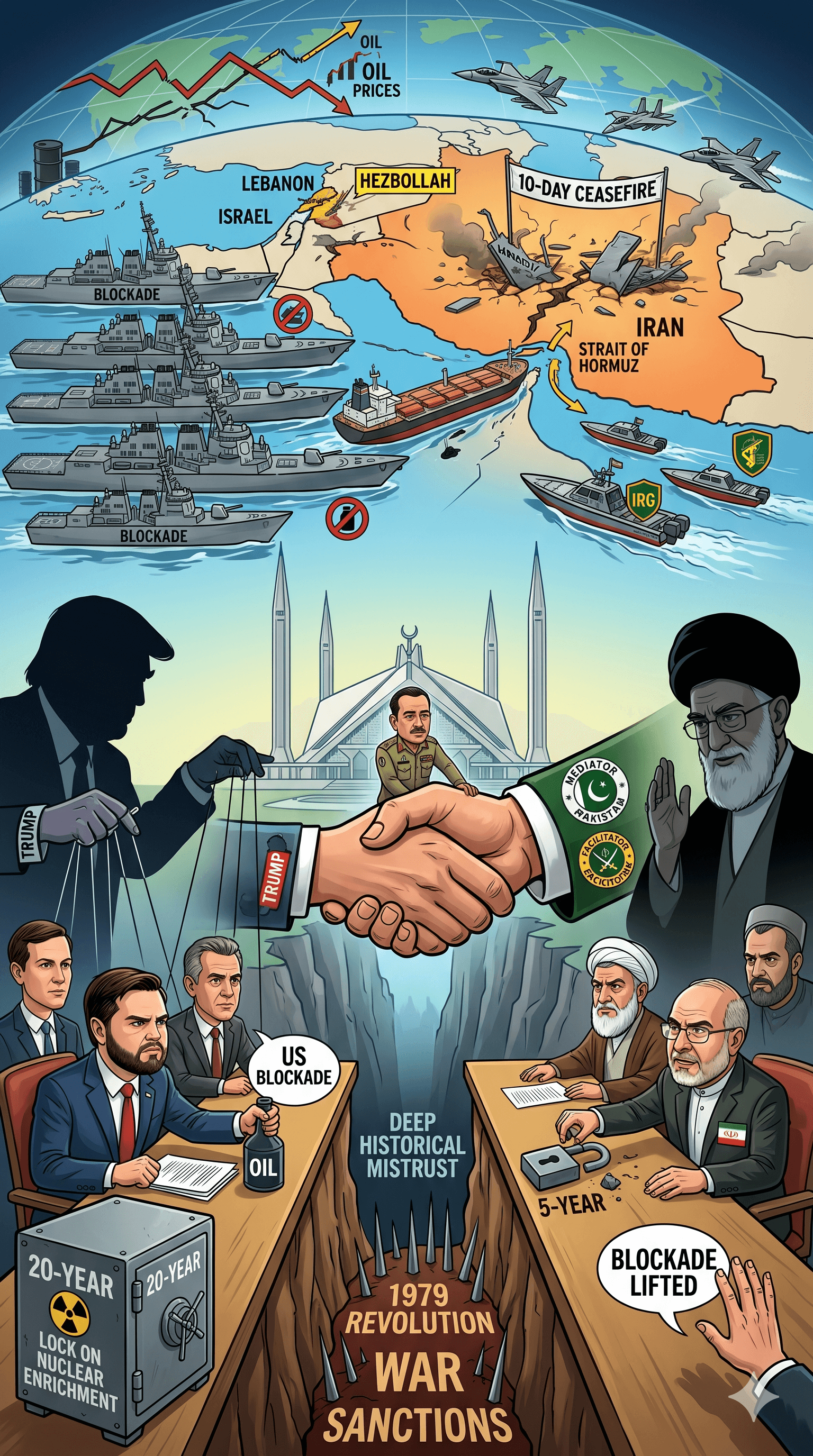
The United States delegation is being led by Vice President J.D. Vance, representing a direct mandate from the Trump administration. He is accompanied by key diplomatic figures, including Special Envoy Steve Witkoff and Jared Kushner, bringing deep experience in Middle Eastern deal-making.
On the opposing side, the Iranian delegation arrives with equal institutional weight. Foreign Minister Abbas Araghchi and Parliamentary Speaker Mohammad Bagher Ghalibaf are leading the negotiations for Tehran. The presence of these top-tier officials indicates that both Washington and Tehran recognize the severe consequences of further military escalation, even as they navigate deeply entrenched historical mistrust.
Why Did the First Round of Talks Collapse?
The return to Islamabad comes just over a week after an initial, grueling 21-hour marathon session broke down without a comprehensive agreement. Despite exchanging written texts and engaging in expert-level committee discussions, the first round of talks faltered over seemingly insurmountable red lines.
According to diplomatic sources, the sticking points remain strictly defined. The United States is reportedly pushing for rigid, long-term limitations on Iran’s nuclear program, demanding absolute guarantees against nuclear enrichment.
Conversely, Iran approached the initial talks with complete distrust, outlining strict preconditions. Tehran’s primary demands include the immediate unfreezing of deeply restricted Iranian state assets, a complete lifting of economic sanctions, and a guaranteed, comprehensive ceasefire in Lebanon, where Israeli forces have continued to target Hezbollah infrastructure. When neither side would budge on their core “maximalist” demands, the negotiations crumbled, ending the temporary truce.
The Economic Fallout: Blockades and Surging Oil Prices
The immediate consequence of the previous diplomatic breakdown was swift and severe. Following the collapse of the initial talks, the United States Central Command (CENTCOM) announced an impartial naval blockade of all Iranian ports and coastal areas along the Arabian Gulf and the Gulf of Oman.
More critically, the blockade threatened transit through the Strait of Hormuz—the world’s most vital maritime energy corridor, responsible for handling roughly 20% of the globe’s daily oil supply. In response to the US military maneuvering, Iran's Revolutionary Guard Navy issued stern warnings, placing its coastal defense forces on high alert.
The mere announcement of the blockade sent shockwaves through the global economy. International oil prices instantly spiked, bouncing back above the $100-a-barrel threshold. Global energy markets remain incredibly volatile today, with analysts warning that a permanent closure or a direct naval confrontation in the Strait of Hormuz could trigger massive supply chain disruptions and a paralyzing global recession.
Pakistan's Role as a Regional Mediator
Pakistan’s emergence as the primary mediator in the Iran-Israel-US conflict highlights a complex balancing act. Prime Minister Shehbaz Sharif, alongside Chief of Army Staff Field Marshal Asim Munir, has worked aggressively to keep the communication lines open between Washington and Tehran.
Sharing a long, porous border with Iran while simultaneously maintaining deep historical, military, and economic ties with the United States, Pakistan is uniquely positioned to host these talks. The Pakistani leadership is acutely aware that a full-scale regional war would not only destabilize the Middle East but would inevitably spill over into South Asia, creating disastrous refugee and economic crises for Islamabad.
Global Outlook: "Make or Break" for Middle East Peace
As the U.S. and Iranian delegations unpack their briefcases in Islamabad once again, the window for a peaceful resolution is rapidly closing. The stakes have never been higher.
If this second round of negotiations yields a framework for a lasting ceasefire, it could pave the way for the gradual lifting of the US naval blockade, a stabilization of global energy markets, and a halt to the devastating airstrikes in Lebanon and Israel.
However, if these talks fail, the trajectory points toward a terrifying escalation. Reports already indicate that the US administration is weighing limited military strikes if the diplomatic stalemate persists, while Iran maintains that its finger remains "on the trigger" to retaliate against any perceived violations of its sovereignty.
The world now waits on the closed-door discussions at the Serena Hotel. Over the next 48 hours, the decisions made in Islamabad will likely determine whether the Middle East steps back from the brink of total war or plunges into an unprecedented era of conflict.