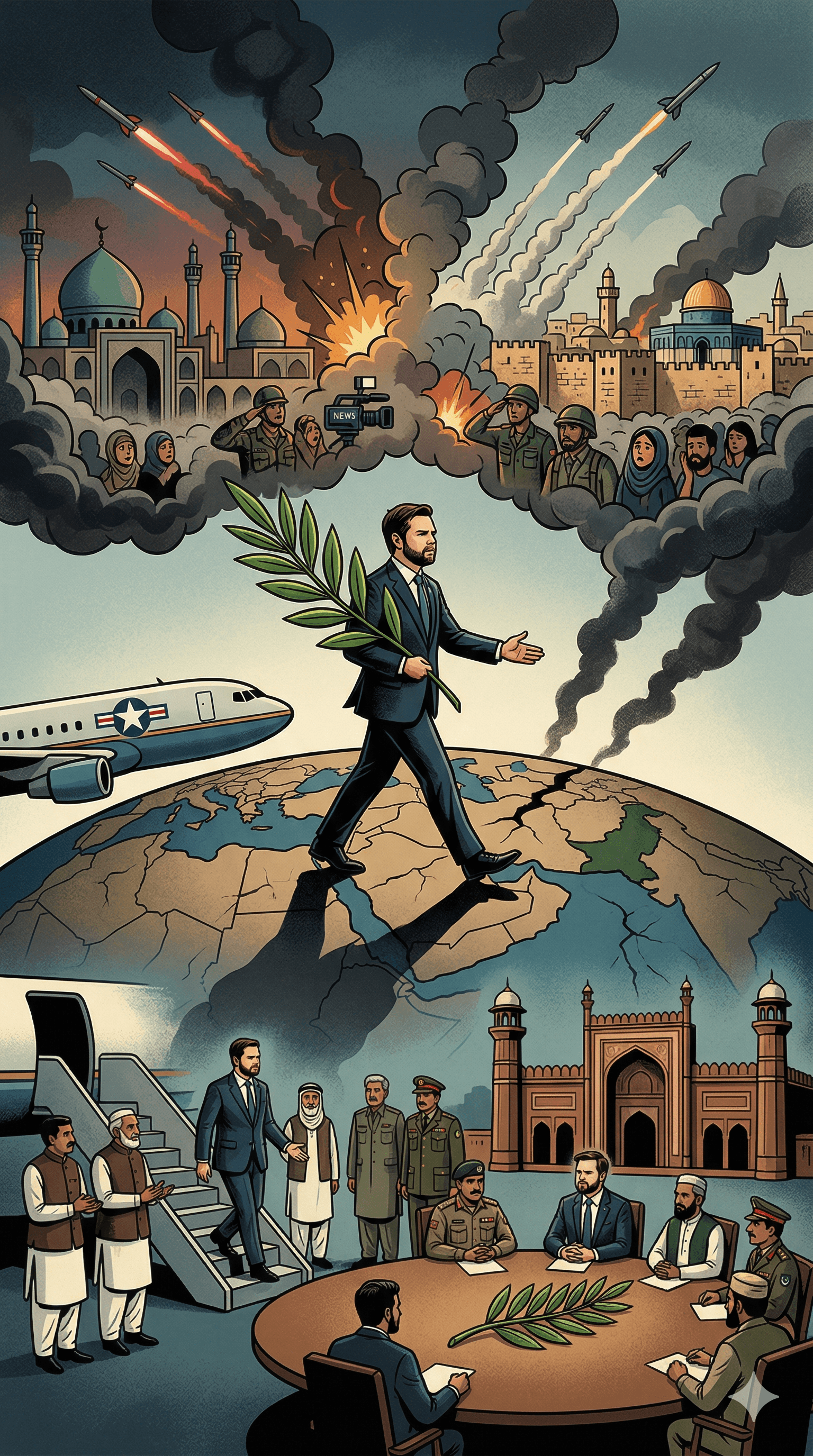
ISLAMABAD — In a critical diplomatic maneuver aimed at preventing the Iran-Israel war from spiraling into a broader regional conflict, United States Vice President JD Vance departed on Friday for Islamabad, Pakistan. Vance is set to lead a high-level American delegation in high-stakes, US-backed peace negotiations with Iranian representatives. The historic meeting takes place under the shadow of a highly fragile ceasefire that has momentarily paused direct military confrontations in the Middle East.
Speaking to reporters on Friday before boarding Air Force Two, Vice President Vance projected a stance of cautious optimism mixed with stern warnings. The negotiations represent a significant test of the Trump administration’s foreign policy approach toward Tehran, focusing on de-escalation while maintaining a hardened military posture.
Vance Outlines US Strategy: 'Good Faith' vs. Hard Lines
Vice President Vance’s departure remarks underscored a dual-track approach to the impending dialogue. While emphasizing a desire for diplomatic progress, he made it abundantly clear that Washington is prepared to walk away if Tehran does not approach the table constructively.
"We're looking forward to the negotiation," Vance stated, adding that he expects the dialogue to be "positive." However, he quickly tempered his optimism with a direct warning to the Iranian leadership.
“If the Iranians are willing to negotiate in good faith and extend an open hand, that's one thing,” Vance told the press. “If they're going to try to play us, they're going to find that the negotiating team is not that receptive.”
Vance further confirmed that the US delegation is operating under strict and “clear guidelines” directly from US President Donald Trump. While the exact parameters of these guidelines remain classified, the White House’s objective is clear: solidify the current ceasefire, address regional security threats, and prevent the disruption of international trade routes.
Islamabad on Lockdown: High Security for Historic Talks
Pakistan finds itself thrust into the center of the global geopolitical arena, serving as the mediator for these critical talks. Anticipating the arrival of both American and Iranian delegations, the Pakistani capital of Islamabad has been placed under maximum security.
A US Air Force transport aircraft marked “Charleston” was reportedly seen approaching Nur Khan Airbase on Friday, signaling the arrival of advance American officials. In preparation for the main delegations, local authorities have locked down the city.
The talks are scheduled to take place at the Serena Hotel, situated within Islamabad's heavily fortified Red Zone. The luxury hotel has been entirely vacated of regular guests to accommodate the diplomatic teams. The Pakistani government has declared a two-day public holiday, sealing off major avenues leading to key government ministries and deploying a highly visible military presence with multiple checkpoints across the capital.
The Ceasefire Confusion: The Lebanon Complication
The urgency of the Islamabad peace talks is magnified by the rapidly deteriorating state of the recently agreed-upon ceasefire. The truce, which initially brought a sigh of relief to global markets, is already facing severe stress fractures due to conflicting interpretations of its scope.
A major diplomatic crisis emerged earlier in the week when Pakistani mediators announced that the ceasefire applied to all fronts, including Lebanon. However, Vice President Vance publicly corrected this, stating that Iranian negotiators may have misunderstood the agreement. Washington clarified that while the ceasefire applied to direct Iran-US/Israel exchanges, it did not extend to Hezbollah strongholds in Lebanon.
Hours after this clarification, Israeli military forces carried out targeted airstrikes in Lebanon. This miscommunication has infuriated Tehran, raised questions about Pakistan’s efficacy as a mediator, and left the broader Middle East on edge. Iran's Khatam al-Anbiya Central Headquarters subsequently issued a warning that its armed forces still have a "finger on the trigger," vowing a "crushing" response to continued attacks on Hezbollah.
Economic Flashpoint: Threats to the Strait of Hormuz
Beyond the immediate exchange of missiles, the economic implications of the Iran-Israel war will dominate the negotiating table in Pakistan. The free flow of global energy is under direct threat, making the Strait of Hormuz a critical focal point for Vice President Vance's delegation.
Recent days have seen severe rhetoric from Tehran regarding international shipping. Iranian senior lawmaker Ebrahim Azizi recently revealed a parliamentary proposal that would permanently bar oil tankers linked to the United States and Israel from navigating the Strait of Hormuz. Furthermore, reports have surfaced indicating that Iran is attempting to impose "toll fees" on commercial vessels passing through the vital maritime chokepoint.
President Donald Trump issued a fierce warning on Thursday regarding these alleged fees, indicating that the US military is prepared to ensure freedom of navigation. British Prime Minister Keir Starmer also weighed in, noting that allied nations are evaluating the "logistics of actually moving vessels through the Strait" should Iran attempt a blockade. For Vance, securing guarantees from Iran regarding the unhindered passage of global oil supplies will be a primary objective.
Outlook and Global Implications
The peace talks in Islamabad represent a watershed moment for the Middle East and global economic stability in 2026. If Vice President JD Vance and the Iranian delegation can formalize a lasting truce, it could pull the region back from the brink of a catastrophic, multi-front war. It would also stabilize global energy markets, which have been deeply rattled by the threats to the Strait of Hormuz.
However, the path to a diplomatic breakthrough is incredibly narrow. Deep-seated mistrust, the recent Israeli strikes in Lebanon, and hardline posturing from both Washington and Tehran threaten to derail the negotiations before they even begin. If the talks collapse, analysts warn that the resumption of hostilities between Iran and Israel could rapidly draw in broader international forces, severely disrupting global trade and plunging the region into unprecedented conflict.
The world now watches Islamabad, waiting to see if diplomacy can outpace the drums of war.