A U.S. Army helicopter is at the bottom of the sea. The pilots are safe. The deal is "two or three days away." Again.
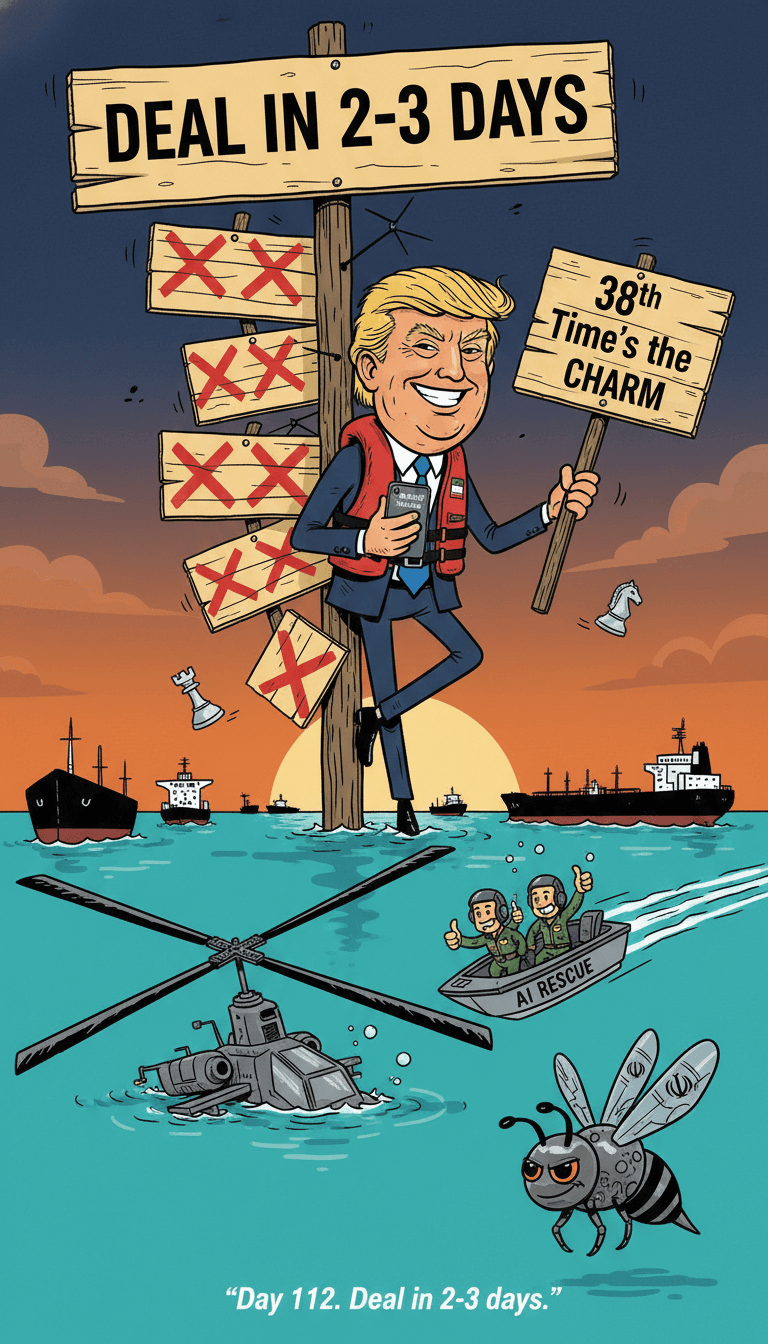
On the morning of June 9, 2026, a U.S. Army AH-64 Apache helicopter went down into the waters off the coast of Oman — in the Strait of Hormuz, the narrow chokepoint through which roughly 20% of the world's oil supply normally flows. Both crew members survived, rescued in history's first-ever unmanned drone boat rescue at sea. But within hours, President Donald Trump took to Truth Social to declare that Iran had shot it down — and that the United States "must, of necessity, respond to this attack."
The incident marks the first confirmed Apache loss since the United States began its aerial campaign against Iranian targets in March 2026 — and it arrived on the same day Trump announced that a peace deal with Iran was "two or three days away." It was at least the 37th time since late March that Trump had publicly declared a deal was imminent.
A Strait on Fire
The Strait of Hormuz has been a battleground since Iran closed it to foreign shipping in late February 2026, following U.S. and Israeli airstrikes on Iranian military infrastructure — a campaign that also resulted in the assassination of Supreme Leader Ali Khamenei. Since then, the United States has maintained a naval blockade of Iranian crude oil, operated a continuous aerial patrol over the waterway, and partnered with the UAE to intercept Iranian drones.
Apache helicopters have been central to that operation — enforcing the blockade, escorting vessels, and serving as mobile firepower against Iranian drone swarms in the Gulf. Their loss, even of a single aircraft, carries outsized symbolic weight.
According to two U.S. officials who spoke to CBS News, early indications suggest an Iranian drone brought down the Apache. However, those same officials noted it was not yet clear whether the drone deliberately targeted the helicopter or whether the shootdown was intentional. The cause remains officially unconfirmed. The Jerusalem Post noted the Apache may have experienced mechanical failure — an alternative that the Pentagon had not ruled out as of Tuesday afternoon.
Iran's parliament speaker and chief nuclear negotiator, Mohammad-Bagher Ghalibaf, offered his own framing of the broader context. Speaking Monday — the day before the crash — Ghalibaf accused the United States of committing "blatant violations" of the April ceasefire through its naval blockade and alleged breaches of negotiating terms. From Tehran's perspective, the U.S. is not a ceasefire partner — it is an occupying naval force.
The 37th "Final Throes"
Trump's declaration that a deal was imminent has become something of a running geopolitical dark comedy. Since late March 2026, he has made at least 37 public statements claiming the U.S. and Iran were on the verge of an agreement — variously describing the deal as "days away," "almost done," or in its "final throes." Each prediction has been followed by new escalation, new violations, and new rounds of talks.
On Tuesday, even as he promised retaliation for the Apache shootdown, Trump expressed "renewed optimism" about the negotiations — saying the U.S. had "a good chance" of signing a deal within two to three days. He offered no specific details on why he believed a breakthrough was near.
The pattern raises a fundamental question: Is the deal perpetually close because diplomacy is genuinely progressing, or because "deal imminent" has become a rhetorical tool — a pressure valve that manages public expectations while the actual military and economic campaign continues?
Iran's position, as conveyed by Ghalibaf, suggests the gap remains significant. Tehran has pushed back against Washington's demand for immediate denuclearization. U.S. negotiators have reportedly softened that position — moving toward a framework where denuclearization is addressed in a later phase — but key differences remain unresolved.
A Rescue for the History Books
Amid the geopolitical chaos, one genuinely unprecedented moment emerged: the first-ever sea drone rescue in U.S. military history. After the Apache went down, the two crew members spent approximately two hours in the water before a 7.3-meter unmanned surface vessel called the Corsair — manufactured by Saronic Technologies and assigned to the Navy's Task Force 59 — located them and brought them to shore. They were then hoisted to a helicopter for further transport.
Task Force 59, established in 2021, is the Navy's first uncrewed and AI-focused maritime security unit, operating across the Middle East including the Strait of Hormuz and the Suez Canal. The Corsair rescue is a milestone for autonomous military operations — and a signal of how deeply AI and drone technology have been integrated into the U.S. military posture in the Gulf.
What Comes Next
Trump's vow to "respond" to the Apache shootdown puts the fragile ceasefire under new pressure. On the Israeli front, the situation is equally tense: Israel and Iran agreed to halt their exchange of airstrikes following a major escalation over the weekend, but Israel has continued operations against Hezbollah in southern Lebanon, drawing warnings from Tehran that further attacks would be met with a "severe response."
The Strait of Hormuz remains effectively closed to normal commercial shipping. The global energy market continues to absorb the shock. And the world waits — again — to see whether the 38th announcement of a deal imminent will be different from the 37 that came before it.
Somewhere in the Persian Gulf, a drone boat is already back on patrol.