Tensions escalated dramatically in the Persian Gulf this week as the United States launched military operations to secure shipping lanes in the strategically vital Strait of Hormuz, prompting forceful retaliation from Iran. For the first time since an April 8 ceasefire was implemented between the U.S., Israel, and Iran, the United Arab Emirates (UAE) came under direct attack from Iranian missiles and drones, raising global alarms that the delicate truce may be on the verge of collapsing.
This resurgence of violence centers around control of the Strait of Hormuz, a critical global choke point for energy supplies, and highlights the fragile state of negotiations to end the broader conflict that erupted in late February.
The Launch of “Project Freedom”
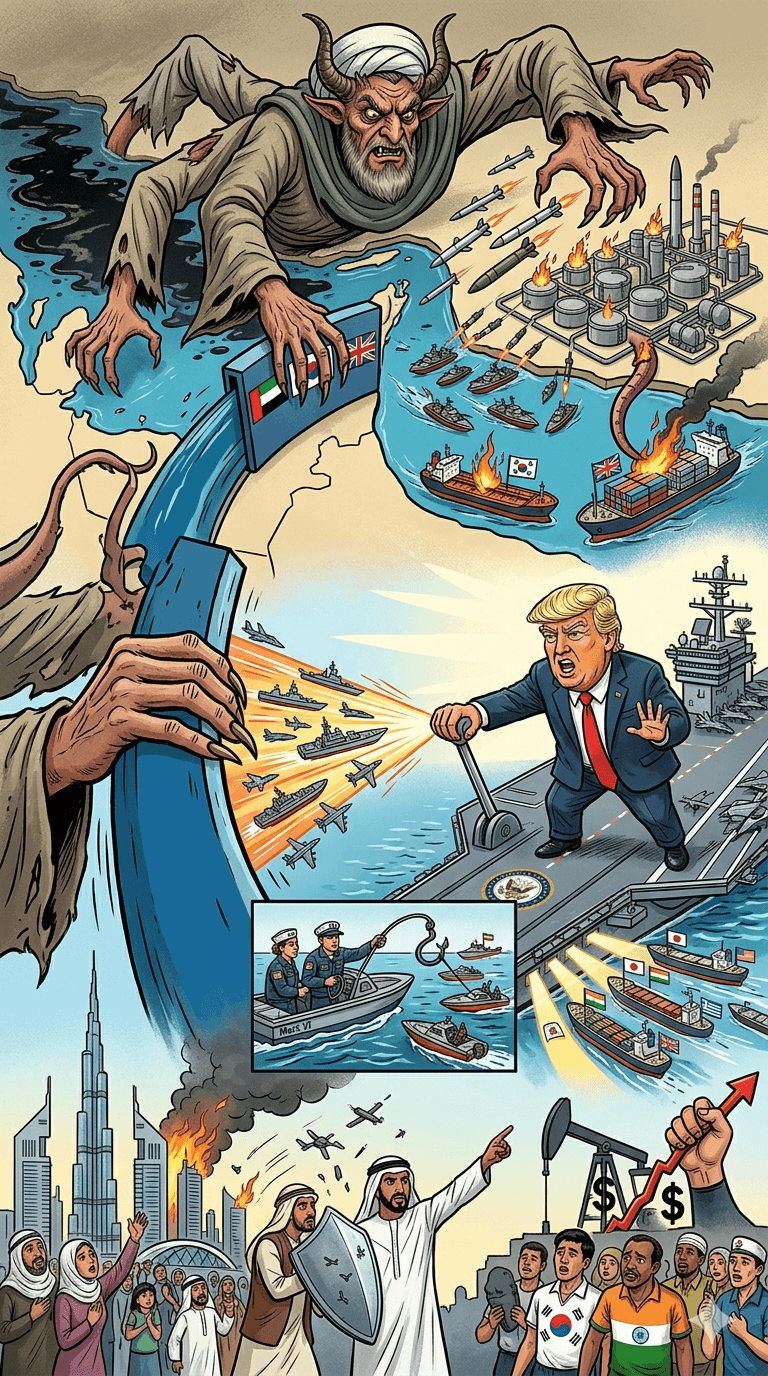
The renewed hostilities were triggered by an initiative dubbed "Project Freedom," announced by U.S. President Donald Trump on May 3, 2026. The operation aims to restore freedom of navigation and guide hundreds of commercial vessels that have been trapped in the Persian Gulf since the conflict began out of the contested waterway.
According to the U.S. Central Command (CENTCOM), the operation involves guided-missile destroyers, over 100 military aircraft, unmanned platforms, and approximately 15,000 service members. The primary objective is to clear a safe path—primarily through Omani territorial waters—and provide defensive cover for commercial shipping.
On Monday, CENTCOM reported early success, stating that two U.S.-flagged merchant vessels successfully transited the Strait while two U.S. Navy guided-missile destroyers, the USS Truxtun and USS Mason, entered the Gulf. However, the transit was not without peril. Defense officials confirmed that the U.S. warships had to navigate a "sustained barrage" of Iranian small boats, missiles, and drones. In the ensuing clash, the U.S. military destroyed six Iranian fast-attack boats that attempted to interfere with the operation.
Iran’s Islamic Revolutionary Guard Corps (IRGC) denied that any commercial vessels had crossed the strait and dismissed U.S. claims that Iranian vessels had been sunk. Iranian officials maintained that any unapproved transit, particularly by the U.S. military, constitutes a violation of the ceasefire.
Iran Escalates by Targeting the UAE
In direct response to the U.S. naval push, Iran expanded its targets beyond the immediate vicinity of the Strait. On Monday, the UAE faced a barrage of ballistic missiles, cruise missiles, and drones originating from Iran.
The UAE Ministry of Defense reported that its air defense systems successfully engaged 12 ballistic missiles, three cruise missiles, and four drones. However, the attacks were not entirely repelled. A suspected Iranian drone strike sparked a fire at the crucial Fujairah Oil Industry Zone. Fujairah is strategically significant as it lies outside the Strait of Hormuz, providing an alternative oil export route for the UAE.
Local authorities reported that three Indian nationals were injured in the Fujairah attack. India's Ministry of External Affairs quickly condemned the incident as "unacceptable," calling for an immediate cessation of hostilities targeting civilian infrastructure. The UAE Foreign Ministry echoed this sentiment, condemning the strikes as a "dangerous escalation" and asserting the country's right to respond. The UAE has since ordered schools to transition to remote learning for the remainder of the week.
Adding to the regional chaos, the UAE state oil company, ADNOC, reported that an empty tanker affiliated with them was struck by drones. Meanwhile, the British military’s United Kingdom Maritime Trade Operations (UKMTO) center reported multiple incidents involving commercial vessels in the Gulf, including fires aboard two cargo ships.
The Diplomatic Stalemate
The military escalation is unfolding against the backdrop of stalled diplomatic negotiations. Iran effectively closed the Strait of Hormuz following the outbreak of the war in late February, slowing maritime transit to a trickle and demanding tolls. The U.S. countered with a naval blockade of Iranian ports.
Recent efforts to secure a lasting peace have hit a wall. Over the weekend, Iran submitted a 14-point counter-proposal to the U.S. via Pakistani intermediaries. Tehran’s plan insists on resolving all issues and ending the war within 30 days, rejecting the U.S. proposal for a two-month ceasefire extension.
Crucially, the Iranian proposal demands the lifting of U.S. sanctions and the naval blockade, the unfreezing of Iranian assets, and the withdrawal of U.S. forces from the surrounding region. It also pointedly separates the current conflict from its nuclear program, stating that nuclear negotiations would only resume after the war ends.
President Trump expressed strong skepticism regarding the Iranian proposal, stating he is likely to reject it because Tehran has "not yet paid a big enough price." Conversely, Iranian Foreign Ministry spokesman Esmaeil Baghaei described the U.S. response to their proposal as "difficult to review," citing Washington's history of "making unreasonable demands."
Economic Impact and Global Outlook
The escalating violence in the Strait of Hormuz—a waterway that previously handled roughly 20 percent of global oil shipments—has immediate economic repercussions. Oil prices surged by over 5% following reports of the Iranian attacks on the UAE and commercial vessels.
While the U.S. operation seeks to unblock the vital artery, analysts remain cautious about its short-term success. Major shipping companies have indicated they are likely to wait for a definitive end to hostilities before risking the transit. The threat of naval mines and continued IRGC harassment presents a formidable economic and physical risk to commercial fleets.
If diplomacy continues to fail and the U.S. relies heavily on military force to push ships through, the region risks returning to full-scale war. The coming days will be critical in determining whether "Project Freedom" successfully breaks the Iranian blockade or merely serves as the catalyst for a broader, more devastating conflict in the Middle East.