The Middle East conflict has reached a perilous new threshold. Iran’s military has explicitly warned that the Strait of Hormuz could be "completely" closed if the United States follows through on threats to bomb Iranian power plants. The stark warning from Tehran comes directly on the heels of a 48-hour ultimatum issued by US President Donald Trump, demanding the unconditional reopening of the crucial maritime chokepoint. With global oil prices surging and international markets bracing for a potential crash, the standoff threatens to plunge the region into a broader, devastating war involving critical energy infrastructure across the Gulf.
Trump’s 48-Hour Ultimatum to Iran
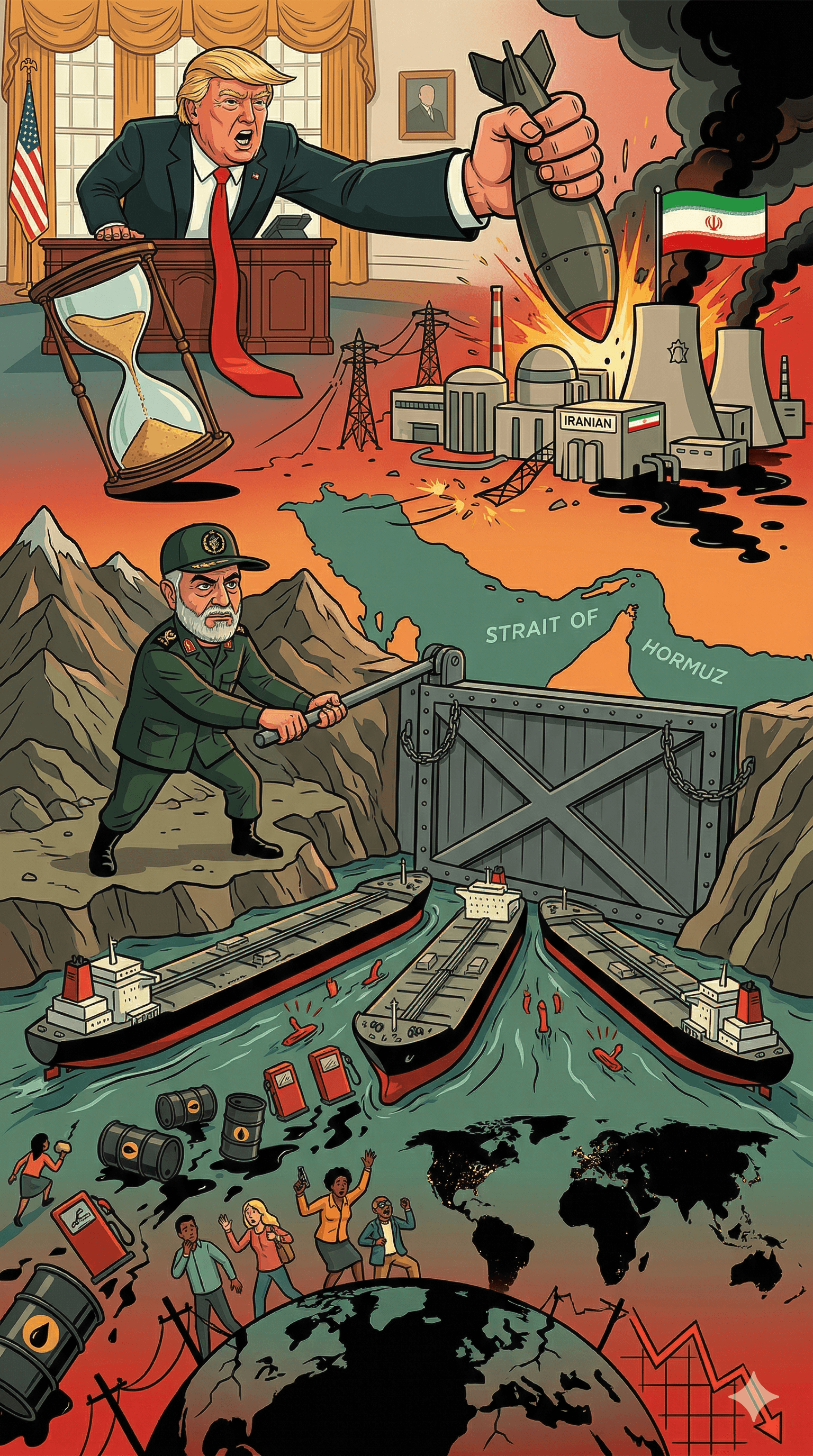
The immediate catalyst for the renewed tensions was a social media post by US President Donald Trump late Saturday. Frustrated by the prolonged disruption to global shipping and soaring energy costs, Trump issued a strict deadline to Tehran. He demanded that Iran must "fully open, without threat, the Strait of Hormuz" within 48 hours.
Should Iran fail to comply, the US President warned that the American military would "hit and obliterate their various power plants, starting with the biggest one first." The deadline is set to expire shortly before midnight GMT on Monday. Trump's rhetoric marks a sharp escalation in the conflict, pivoting the focus from military installations to vital civilian and national energy infrastructure. The threat comes despite recent remarks from the President suggesting he was considering winding down military operations in the region, sending mixed signals to both allies and financial markets.
Iran’s Military Vows "Irreversible Destruction" of Regional Infrastructure
Tehran’s response was swift and uncompromising. In a statement broadcast by state media, the Islamic Revolutionary Guard Corps (IRGC) and the Khatam al-Anbiya Central Headquarters warned that any strike on Iran’s fuel and energy sector would trigger a massive, disproportionate retaliation. The Iranian military explicitly stated that if the US bombs power plants, the Strait of Hormuz will be completely closed to all maritime traffic, and regional energy assets will be heavily targeted.
Iranian Parliament Speaker Mohammad Bagher Ghalibaf reinforced this posture, warning that any attack on Iranian soil would render critical infrastructure across the Middle East "legitimate targets." According to military spokespersons, this retaliatory perimeter would include not just oil facilities, but also vital desalination plants and information technology systems belonging to the United States and its regional allies.
This expands the threat matrix to Gulf nations hosting US military bases, such as Saudi Arabia, the United Arab Emirates, and Qatar. Iranian President Masoud Pezeshkian dismissed the US ultimatum, stating that "threats and terror" only strengthen Iranian unity, calling the prospect of erasing Iran's infrastructure an illusion born of desperation.
The Strait of Hormuz Blockade and Global Economic Impact
At the heart of this geopolitical standoff is the Strait of Hormuz, a narrow waterway connecting the Persian Gulf to the open ocean. Approximately 20% of the world’s crude oil and liquefied natural gas (LNG) supplies transit through this chokepoint. Since the outbreak of the current US-Israel-Iran war on February 28, Iran has severely restricted access to the strait.
Ali Mousavi, Iran’s representative to the International Maritime Organization, clarified on Sunday that the strait remains technically open, but only to vessels that are not linked to "Iran’s enemies." Tehran has reportedly instituted a new "sovereign regime," charging a $2 million fee for transit while entirely blocking ships bound for the US, Israel, or allied nations.
The economic fallout has been immediate and severe. International benchmark Brent crude futures have surged past $112 a barrel—the highest level in almost four years. European gas prices jumped by 35% last week alone. Financial analysts are warning of a looming "Black Monday" for global equity markets if the 48-hour ultimatum expires without a diplomatic off-ramp. The destruction of Gulf energy facilities would trigger an unprecedented energy supply shock, cementing long-term inflationary pressure worldwide.
A Rapidly Expanding Multi-Front War
The escalating rhetoric over power plants and shipping lanes is playing out against a backdrop of intense, active combat. The conflict, now entering its fourth week, has seen a dangerous expansion in military engagements. Over the weekend, Iran launched long-range ballistic missiles targeting two southern Israeli towns, Arad and Dimona, injuring dozens of civilians and damaging residential areas. In an unprecedented show of reach, the Iranian military also fired missiles toward the joint US-UK military base at Diego Garcia in the Indian Ocean.
In retaliation, the Israel Defense Forces (IDF) initiated a fresh wave of strikes on the Iranian capital of Tehran early Sunday morning. The US military, commanded by CENTCOM, has also been active, deploying 5,000-pound bunker-buster bombs to degrade Iranian underground facilities storing anti-ship cruise missiles along the coast. Furthermore, the Pentagon is reportedly positioning thousands of US Marines and heavy landing craft closer to the Middle East to maintain "maximum optionality" should a ground invasion or further escalation be required.
Outlook: The Ticking Clock on Geopolitical Stability
As the 48-hour window narrows, the Middle East stands on the precipice of a full-scale regional infrastructure war. If the United States follows through on its threat to bomb Iranian power plants, and Iran retaliates against Gulf desalination and oil facilities, the humanitarian and economic consequences will be catastrophic. The World Health Organization has already declared the conflict to be at a "perilous stage," urging immediate restraint. Without an emergency diplomatic intervention to de-escalate the standoff over the Strait of Hormuz, the global economy and regional security architecture face irreversible damage in the days ahead.