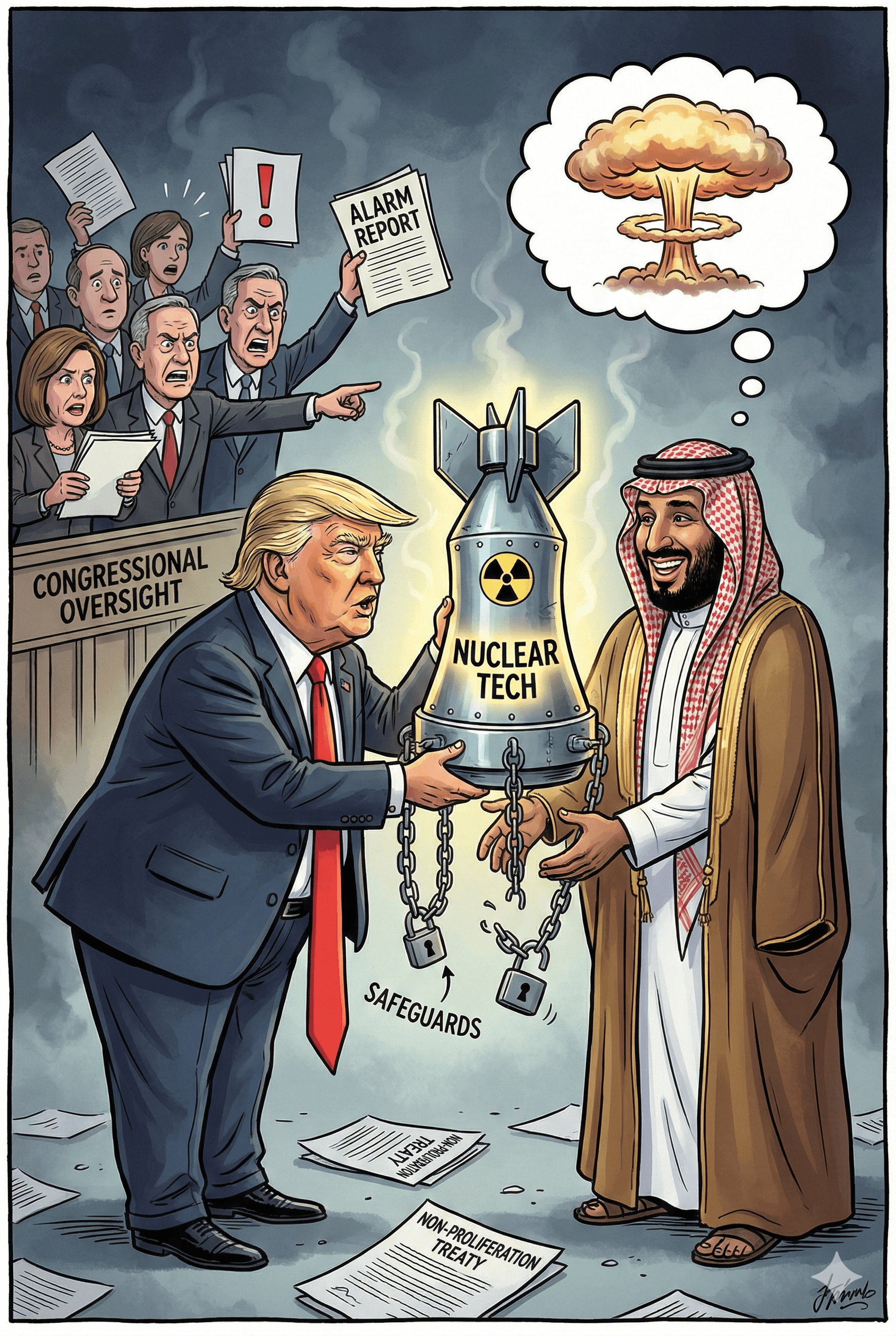
WASHINGTON — A proposed civilian nuclear cooperation agreement between the United States and Saudi Arabia is facing intense scrutiny after newly disclosed congressional documents revealed that the pact may lack critical nonproliferation safeguards. Arms control experts and lawmakers are raising alarms that the deal, currently being pushed by the US administration, could inadvertently pave the way for Saudi Arabia to develop a nuclear weapon by allowing domestic uranium enrichment.
As the geopolitical rivalry in the Middle East intensifies, the revelation has sparked a fierce debate over the balance between American economic interests and the severe risks of sparking a regional nuclear arms race.
The Core Controversy: Bypassing the Nuclear "Gold Standard"
Central to the controversy is the legal framework governing US nuclear exports, known as a "123 Agreement" under the Atomic Energy Act. Historically, a bipartisan coalition in Washington has insisted that any nuclear deal with Saudi Arabia must include the "Gold Standard." This stringent standard requires the partner nation to legally commit to forgoing uranium enrichment and the reprocessing of spent nuclear fuel—the two primary technical pathways to acquiring weapon-grade fissile material.
Furthermore, the Gold Standard traditionally mandates the adoption of the International Atomic Energy Agency's (IAEA) "Additional Protocol," which grants UN inspectors broad authority to conduct intrusive, short-notice inspections at both declared and undeclared nuclear sites to ensure compliance.
However, a recent report submitted to congressional committees and obtained by the Washington-based Arms Control Association (ACA) indicates that the proposed US-Saudi pact does not insist on these requirements. Instead, the agreement reportedly opens the door for Saudi Arabia to acquire some form of uranium enrichment technology, relying merely on a baseline "Bilateral Safeguards Agreement" rather than the rigorous oversight of the Additional Protocol.
Kelsey Davenport, the director for nonproliferation policy at the ACA, warned that while nuclear cooperation can uphold transparency, "the devil is in the details." The documents suggest that once bilateral safeguards are established, Riyadh will have a sanctioned pathway to uranium enrichment capabilities, raising severe global proliferation concerns.
The Regional Tinderbox: Iran and the Threat of an Arms Race
The prospect of spinning centrifuges on Saudi soil is particularly alarming to the international community given the kingdom's explicit geopolitical posture. Saudi Crown Prince Mohammed bin Salman, the kingdom's de facto ruler, has been unambiguous about his strategic red lines. He has publicly stated on multiple occasions that if regional archrival Iran successfully obtains a nuclear weapon, Saudi Arabia "will have to get one" as well.
Enrichment technology is inherently dual-use. While low-enriched uranium is used to fuel civilian power reactors, the exact same centrifuge technology, if spun longer and arranged in cascades, can produce highly enriched uranium suitable for nuclear warheads.
Nonproliferation experts fear that providing Saudi Arabia with a sanctioned pathway to enrich uranium provides the kingdom with a "nuclear hedge." If the atomic standoff between the West and Iran deteriorates, or if Tehran crosses the nuclear threshold, Riyadh would already possess the latent infrastructure and technical know-how to rapidly weaponize its civilian energy program.
Geopolitics and Commerce: Why the US is Taking the Risk
If the proliferation risks are so severe, why is the US administration pursuing this deal? The answers lie in a complex mix of great power competition and lucrative economic incentives.
The congressional documents outline a strategic rationale: if the United States does not partner with Saudi Arabia to build its nascent nuclear energy sector, strategic competitors like China, Russia, or France will gladly fill the void. These nations often do not attach the same stringent nonproliferation strings to their nuclear exports. By securing the agreement, the US administration argues it will prevent strategic competitors from seizing an opportunity to undermine American national security interests for decades to come.
Economically, the stakes are staggering. The administration aims to secure a "decades-long multi-billion-dollar nuclear energy partnership." Securing the Saudi market is viewed as a vital lifeline for the domestic American nuclear industry, potentially bringing massive investments and job creation while reestablishing US leadership in the global civilian nuclear energy market. Furthermore, framing the deal as a geopolitical necessity ties Saudi energy security directly to US influence in the region.
Bipartisan Pushback on Capitol Hill
Despite the economic and strategic arguments, the proposed circumvention of the Gold Standard has triggered immediate bipartisan pushback in Congress. Lawmakers have long been wary of Saudi Arabia's nuclear ambitions, further complicated by concerns over the kingdom's human rights record.
Prominent figures, including Democratic Representative Joaquin Castro and Senator Ed Markey, alongside several Republican counterparts, have consistently urged the application of the highest nonproliferation standards. They argue that exporting nuclear technology without the strongest possible safeguards is a "recipe for disaster" that could fundamentally destabilize the Middle East.
Under US law, once a formalized Nuclear Proliferation Assessment Statement (NPAS) and the final 123 Agreement text are submitted, Congress has 90 days of continuous session to review the pact. If lawmakers determine that the proliferation risks are too high, they have the legislative authority to pass a joint resolution of disapproval to block the agreement or mandate additional, stricter obligations.
Outlook: A Critical Juncture for Global Nonproliferation
The coming months will be a defining test for the global nonproliferation regime. The US government must weigh the commercial benefits of a multibillion-dollar nuclear partnership and the strategic imperative of sidelining China against the terrifying prospect of fueling a nuclear arms race in the Middle East. If the US-Saudi deal proceeds without the Gold Standard or the IAEA's Additional Protocol, it risks setting a dangerous precedent. Other nations seeking US nuclear technology may demand the same lenient terms, potentially unraveling decades of international efforts to contain the spread of nuclear weapons. Congress now stands as the final arbiter, holding the power to either approve the new strategic alignment or hit the brakes on a highly volatile atomic gamble.
#USSaudiDeal #NuclearProliferation #MiddleEastPolitics #Geopolitics #SaudiArabia #NuclearEnergy #ArmsControl #USForeignPolicy #GlobalSecurity #EnergyMarket #Diplomacy