The Middle East has been thrust into unprecedented volatility following the launch of "Operation Epic Fury," a joint military campaign by the United States and Israel against Iran. Initiated in late February 2026, the sweeping offensive has already resulted in the death of Iranian Supreme Leader Ayatollah Ali Khamenei and widespread destruction of Iranian military infrastructure. However, as the conflict expands across multiple countries and proxy networks, military analysts and defense experts are raising alarms over a critical strategic vulnerability: the rapid depletion of the U.S. military's precision-guided munitions and interceptor stockpiles. The defining question on the global stage is whether the US possesses the necessary missile depth to sustain a prolonged war against Tehran.
The Scale of Operation Epic Fury
Since the commencement of hostilities on February 28, 2026, U.S. Central Command (CENTCOM) has deployed a staggering array of firepower to dismantle Iran's ballistic missile production facilities, naval assets, and air defense networks. Operating across land, sea, and air domains, the U.S. has utilized more than 20 advanced weapon systems. This includes B-2 stealth bombers dropping 2,000-pound munitions, F-35 Lightning II fighters, and the combat debut of Low-Cost Unmanned Combat Attack System (LUCAS) drones.
Central to the initial "shock and awe" phase was the U.S. Navy's reliance on Tomahawk Land Attack Missiles (TLAMs). Launched from guided-missile destroyers and submarines stationed in the Persian Gulf and Arabian Sea, these cruise missiles played a pivotal role in neutralizing Iran's early warning systems. However, the sheer volume of munitions expended in the campaign's opening days has sparked acute concerns within the Pentagon about the sustainability of the U.S. arsenal.
Depleting the Arsenal: Tomahawks, THAAD, and Patriots
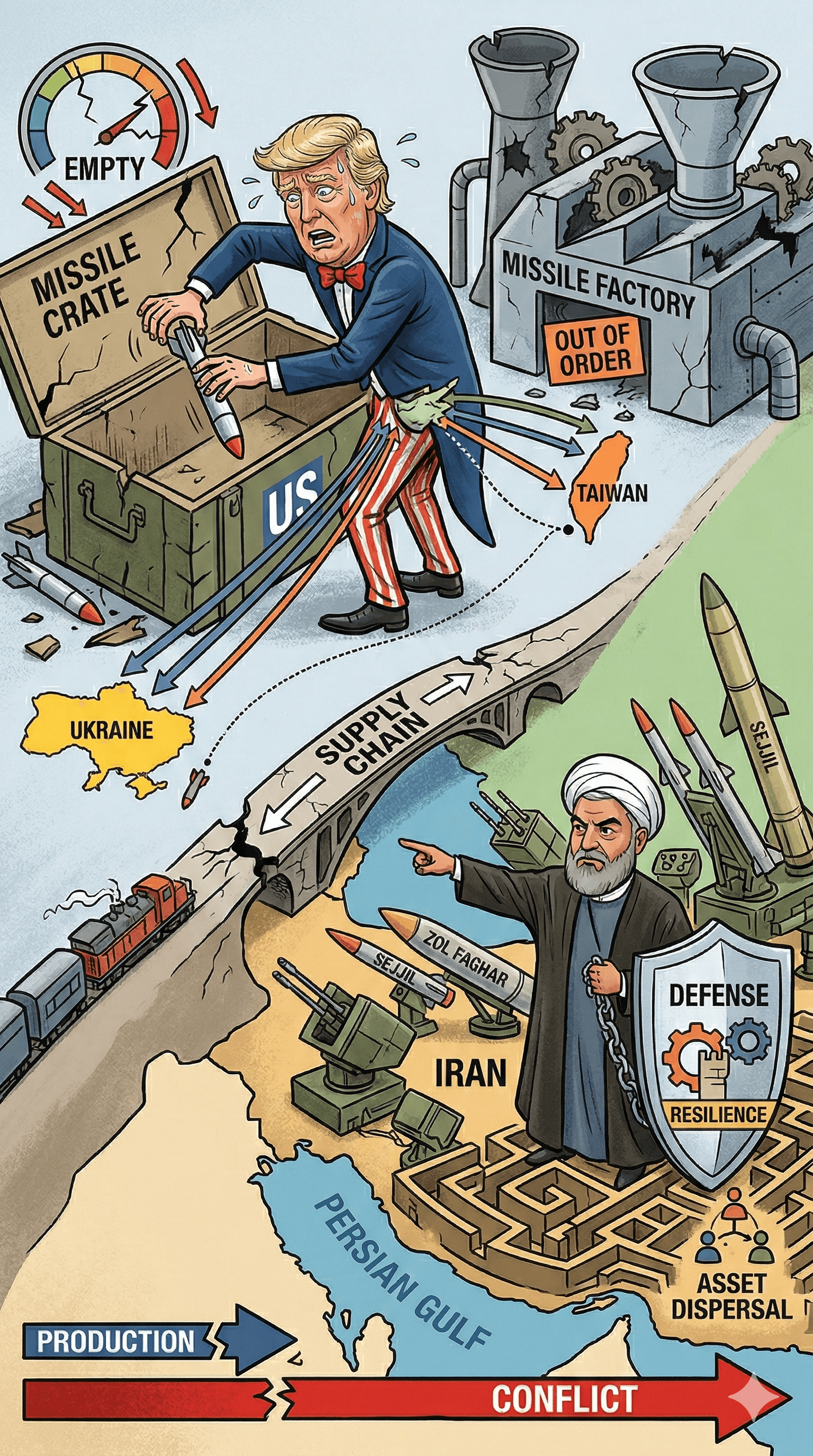
The United States' arms and ammunition stockpiles were already stretched thin by years of sustained military support for Ukraine and Israel. The current Iranian theater is now pushing these reserves to their absolute limits.According to military analysts, the U.S. Navy fired approximately 400 Tomahawk missiles within the first 72 hours of Operation Epic Fury. At the current peacetime production rate of roughly 90 units per year, this consumption represents nearly five years' worth of manufacturing. This aggressive expenditure rate creates what defense insiders refer to as an "Empty Rack" crisis.
Beyond offensive cruise missiles, the defensive calculus is equally grim. Iran has heavily retaliated with waves of drone and ballistic missile strikes targeting Israel and U.S. bases in allied Gulf states, including facilities in Dubai and Riyadh. To counter these barrages, the U.S. and its allies rely on advanced interceptors, such as the Terminal High Altitude Area Defense (THAAD) system, Patriot missiles, and ship-borne Standard Missile-3 (SM-3) interceptors. During previous clashes in 2025, the U.S. expended roughly 150 THAAD interceptors—amounting to 25% of its total global stockpile—in just 12 days, illustrating how quickly these vital assets can evaporate.
The Economics of Attrition: Multimillion-Dollar Missiles vs. Cheap Drones
The ongoing war is heavily defined by an asymmetric economic battle. High-end U.S. missile defense systems are explicitly designed to counter limited, high-intensity threats from major state actors—not to sustain prolonged engagements against endless barrages of cheap loitering munitions.
Intercepting an incoming drone often costs five times more than the drone itself. Firing a multimillion-dollar SM-3 or Patriot interceptor to down an Iranian Shahed-style drone, which costs only a few thousand dollars to produce, is an economically and strategically unsustainable strategy over the long term. Kelly Grieco, a strategic analyst at the Stimson Center, noted that the U.S. and its regional allies are "burning through" inventories rapidly. This dynamic of "death by a thousand cuts" may soon force commanders into making incredibly difficult decisions regarding which regional assets to protect and which to abandon.
The Official Stance vs. Supply Chain Realities
Publicly, the U.S. administration has downplayed the severity of the U.S. missile shortage. President Donald Trump recently stated that the U.S. possesses a "virtually unlimited supply" of medium-grade munitions and could fight "forever." However, contradictory actions suggest a different logistical reality. The President also acknowledged to the media that U.S. defense contractors have been placed under "emergency orders" to rapidly accelerate weapons production.
Surging production, however, is severely hindered by deep supply chain bottlenecks. Advanced missiles require highly specialized components, including solid rocket motors and precision electronics, sourced from a consolidated and fragile supplier base. "Cold" production lines cannot be instantaneously expanded; manufacturing a single Tomahawk missile can take up to 24 months from order to delivery.
Strategic Implications: A Vulnerable Indo-Pacific
The rapid expenditure of finite resources in the Middle East imposes a severe opportunity cost globally, particularly in the Indo-Pacific theater. Defense officials worry that the diversion of interceptors and long-range strike capabilities to combat Iran severely weakens the U.S. deterrent posture elsewhere.
If a major contingency were to arise in the Taiwan Strait, the U.S. Navy could find its magazines dangerously low. Analysts warn that the aggressive consumption of Tomahawks and SM-6 missiles in Operation Epic Fury could delay vital weapon deliveries to crucial Pacific allies like Japan and Australia, fundamentally altering the global balance of power and signaling vulnerability to geopolitical rivals.
Global Impact and Outlook
The ultimate trajectory of the Middle East war may be decided by a grueling race of attrition: whether Iran runs out of offensive launchers before the U.S. and Israel run out of defensive interceptors. If air defense stockpiles hit critical lows, the U.S. might be pressured into scaling back offensive operations to seek a negotiated diplomatic settlement.
The economic shockwaves are already being felt across the globe. With the Strait of Hormuz—a crucial maritime chokepoint for the global oil trade—plunged into crisis, international shipping giants like MSC, CMA CGM, and Hapag-Lloyd have ordered their vessels to seek safe shelter or reroute entirely. Over 170 containerships are reportedly stuck inside the strait, sparking fears of prolonged supply chain disruptions and skyrocketing global freight costs. As the conflict grinds on, the U.S. defense industrial base will face an unprecedented test of its capacity to rearm a superpower engaged in an expanding geopolitical crisis.
#News #Geopolitics #MiddleEastCrisis #USMilitary #IranWar #OperationEpicFury #DefenseIndustry #GlobalEconomy #MissileShortage #WorldNews