On 17 October, tens of thousands marched in Paris. The CGT claimed more than 500,000 nationwide — its own figure, with no independent count behind it. Protests ran in Marseille, Lyon, Rennes, Toulouse and Angers. The Interior Ministry reported 272 arrests by 3pm and attributed the unrest to the "ultra-left." Riot police used tear gas, stun grenades and water cannon. In Marseille, demonstrators breached the town hall.
The arithmetic nobody wants to do
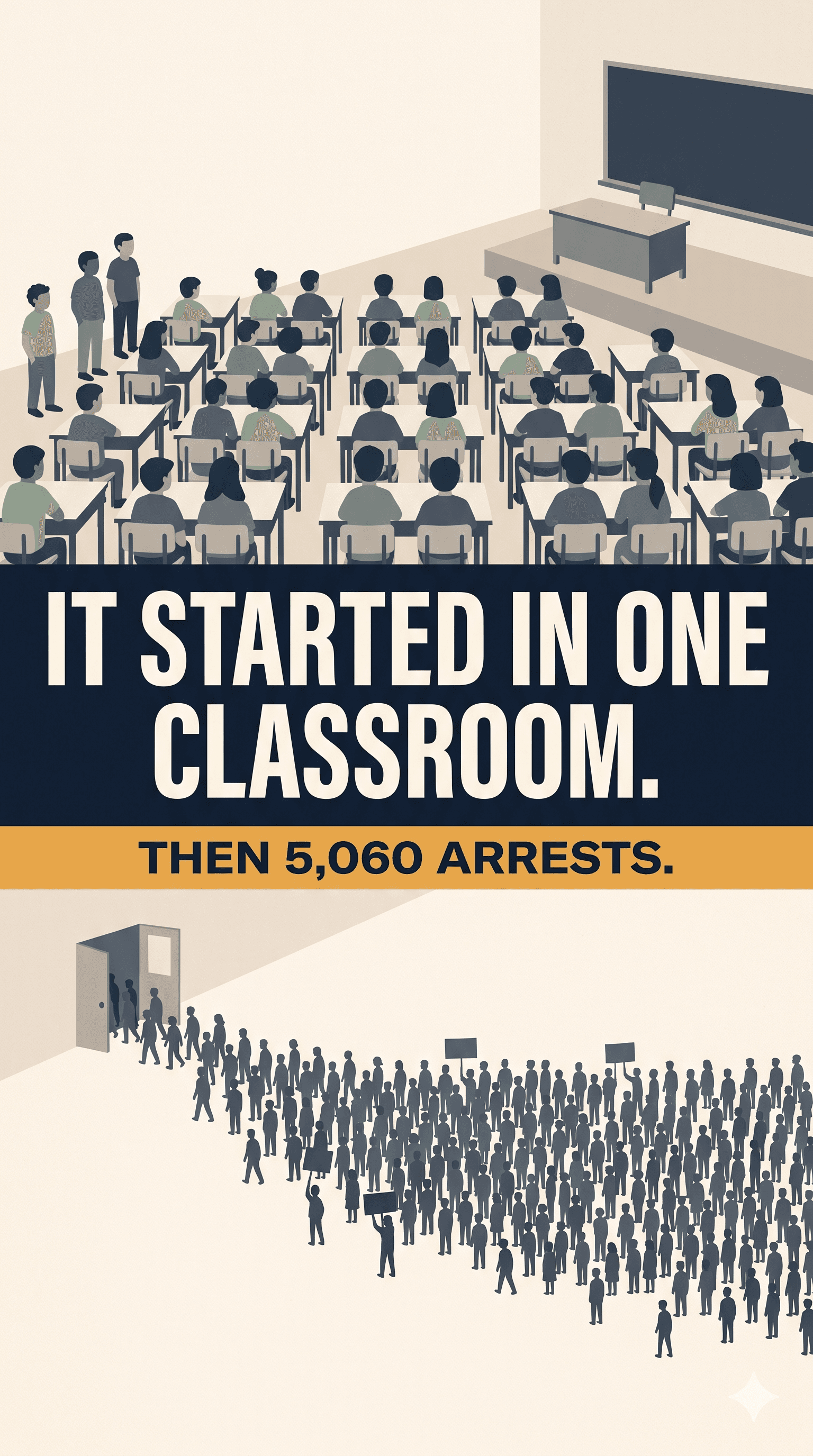
5,060 arrests. 87% minors. That is roughly 4,400 children detained in nineteen days over a dispute about class sizes.
That number can be read two ways and both are true at once, which is why it belongs in the piece rather than in a headline.
It is a statement about who is protesting: this started in schools, so the people in the street are schoolchildren, and a state facing blockaded lycées will encounter minors by definition.
It is also a statement about how a state responds when the people inconveniencing it are fourteen. France chose mass detention as its instrument. Justice Minister Gérald Darmanin sought to make parents civilly liable for damage and asked prosecutors for a firm penal response. By 5 October the police inspectorate had opened around ten internal investigations. One 14-year-old was reported with a fractured jaw.
A government can be right that blockades must end and still be making a generational political error in the way it ends them. The pupils arrested in September will be voting in a few years.
How a staffing shortfall became a general strike
The mechanism here is the interesting part, and it is not "anger spreads."
The original grievance was small, specific and universally legible. Not an abstraction about neoliberalism — a missing teacher and a room with too few chairs. Everyone who has been to school understands it instantly, including people who have never attended a demonstration.
That legibility is what let it scale. Within three weeks the movement had been joined by teachers, the CGT, nurses, firefighters, human-rights lawyers, parents and the remnants of the gilets jaunes. The CGT's demands are now "higher wages and pensions, lower prices and the protection of public services" — which is to say, the schools dispute became the carrier for a cost-of-living dispute that was already there, waiting for a vehicle.
This is the ordinary life cycle of French protest, and the state knows it. What is unusual is the starting point. Movements of this size normally begin with a government action — a pension reform, a fuel tax. This one began with a government inaction: posts that were never filled.
It is much harder to defuse a protest about absence than one about a policy. There is nothing to withdraw.
It crossed borders, but less than the headlines suggest
Protests reached Liège, in Belgium, on 1 October, with pupils at five schools; by 5 October they had reached Mons, Charleroi and Brussels, and there were riots in Liège on the 7th. Belgian pupils chanted against their own education minister. That is documented direct spread, in a neighbouring francophone school system with comparable complaints.
Beyond that, be careful. Copycat demonstrations have been reported in Albania and Greece. Students in Argentina have marched against President Milei's education cuts. Albania's protests are substantially about a proposed sale of southern coastline to a luxury resort development — related in mood and generation, but a different grievance.
"Four countries" is defensible. "Europe is rising" is not, and the distinction is the difference between analysis and cheerleading.
The fight over who owns it
The French government blamed the far left. Intelligence services reportedly described the movement as an operation organised by La France Insoumise. LFI rejected that and called it spontaneous.
A Figaro poll found 62% of respondents thought the protests were justified and 78% thought LFI was exploiting them.
Both at once. That is not a contradiction; it is an accurate description of how most people hold political events — the grievance is real and the party rushing to the front of it is opportunistic. Any account of this that reports only one of those two numbers is doing something other than journalism.
The ending that writes itself
On 6 October, Prime Minister Sébastien Lecornu asked his ministers for proposals by the end of the month on three subjects: replacing absent teachers, the length of the school day, and repairs to old buildings.
Those are, almost precisely, the three things the pupils of Créteil walked out about on 18 September.
Five thousand arrests and nineteen days later, the French state's formal position is that the children had a point.
What to watch
The end-of-October proposals. Whether they contain funded commitments or a review. A review will restart this.
Whether the arrest figures keep climbing, and whether the police inspectorate investigations produce anything. The detention of several thousand minors is a story that will outlive the protests.
Whether Belgium's protests outlast France's. If they do, this stopped being a French dispute.
Whether the CGT keeps the coalition together. The schools grievance is specific and solvable; the cost-of-living grievance is neither. Movements that broaden this fast usually dissolve when the original complaint is addressed — unless the broader one has become the point.
Sources and tiers
Official French government figures: all school and arrest counts, including the Justice Ministry's 5,060 arrests at 87% minors (6 October), Interior Minister Laurent Nuñez's 30 September figures, and the Interior Ministry's 272 arrests on 17 October.
Contemporaneous reporting: the Créteil origin, the class-size and unfilled-post complaints, the seven-months-without-a-teacher account, the spread to Belgium, and today's scenes in Paris and Marseille.
One party's own claim, not independently counted: the CGT's figure of more than 500,000 nationwide on 17 October.
Reported as copycat, not as direct spread: Albania and Greece.
Related in mood, separate grievance — not folded in: Argentina's marches against Milei's education cuts, and the Albanian coastline dispute.
Contested, with all sides given: who organised the movement. The government and intelligence services point at LFI; LFI denies it; the Figaro poll suggests the public believes both that the protests are justified and that LFI is exploiting them.
A date that needs care: the teachers' strike was 17 September and the pupils' walkout followed on the 18th, but some accounts date the wider mobilisation to the 21st. We have used 18 September for the school walkout, which is the best-supported.