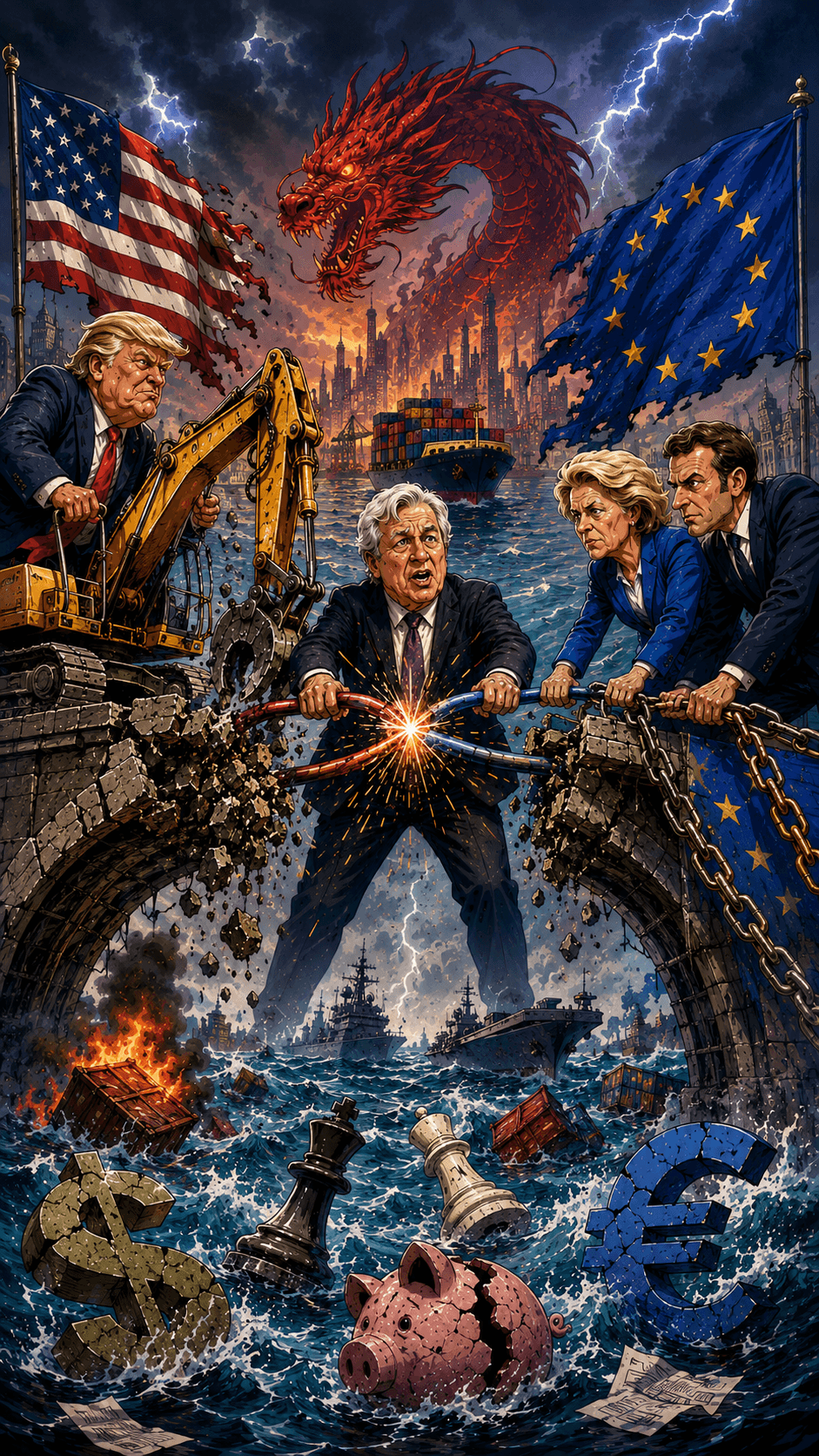
JPMorgan Chase CEO Jamie Dimon used a high-profile appearance at his bank's annual Global Markets Conference in Paris to issue a clear message to Washington: the United States' primary economic goal with Europe should be making it stronger — and unresolved, avoidable trade disputes are standing in the way of growth on both sides of the Atlantic.
Speaking in a Bloomberg Television interview on Tuesday, May 12, 2026, from Paris, Dimon pulled no punches. "If you asked me what the goal should be for our economic relationship with Europe, it should be having a stronger Europe," he said. "Both economies would grow better." He also called on the US and Europe to resolve what he bluntly described as "stupid" trade disputes — preventable frictions that he argued are undermining the broader transatlantic partnership at a moment of global uncertainty.
Dimon's Paris Remarks: What He Said and Why It Matters
At JPMorgan's annual Global Markets Conference — one of the most closely watched events on the international financial calendar — Dimon argued that strengthening Europe must be reframed as an American strategic interest, not merely a European problem. His comments arrived amid ongoing tensions between Washington and Brussels over tariffs, trade imbalances, and defense spending.
Dimon said the US would benefit from a stronger NATO in addition to a more economically robust Europe, reinforcing his long-held position that transatlantic unity is inseparable from American prosperity and security. The conference setting in Paris gave the remarks additional symbolic weight, with European business leaders and policymakers in the audience.
The JPMorgan CEO has consistently characterized petty trade disputes between the US and EU as self-inflicted wounds. By labeling them "stupid," Dimon was not dismissing the complexity of transatlantic trade — rather, he was signaling that many of these frictions are political rather than structural, and therefore fixable.
A Consistent and Escalating Warning on Europe's Decline
Tuesday's comments are the latest in a sustained campaign by Dimon to sound the alarm about Europe's economic trajectory — and to push Washington toward a more constructive posture.
At the Reagan National Defense Forum in December 2025, Dimon warned bluntly that "Europe has a real problem," saying that heavy regulation, slow bureaucracy, and policy uncertainty had "driven business out, driven investment out, driven innovation out." He added his now-frequently cited warning: "If Europe goes down, we all go down."
Just weeks later, at the World Economic Forum in Davos in January 2026, Dimon doubled down, declaring himself a "globalist" and stating: "I want a stronger NATO, a stronger Europe. Some of the things Trump has done are causing that. Some are not. I'm not a tariff guy." He acknowledged that the US had become "less reliable" in the eyes of some European partners — a pointed critique of the Trump administration's geopolitical posture.
At a conference hosted by Norway's sovereign wealth fund (Norges Bank Investment Management) in April 2026, Dimon laid out the stark numbers: Europe's GDP has fallen from approximately 90% to 70% of US levels over the past 25 years — a structural decline he called deeply concerning. He described the EU as "one of the greatest accomplishments of mankind" that "never got finished," pointing to gaps in a common capital markets union, harmonized bankruptcy laws, and cross-border banking frameworks.
The Economic Stakes: Why a Weak Europe Threatens the US
Dimon's call for a stronger Europe is rooted in hard economic logic. US-EU trade exceeds $1.3 trillion annually, making the European Union America's largest collective trading partner. Any weakening of European growth, stability, or institutional coherence would ripple directly through US export markets, financial systems, and corporate earnings.
Dimon has specifically cited the 2024 Draghi competitiveness report — authored by former Italian Prime Minister and European Central Bank President Mario Draghi — as a blueprint for European reform. The report offered some 300 recommendations to boost EU competitiveness. Dimon noted that only seven or eight of those recommendations had been implemented — a pace he described as dangerously inadequate given the competitive rise of China and the US.
He has also framed Europe's fragmentation as a geopolitical risk to the Western alliance itself. "The worst thing we can do is fragment it," he said at the Norway conference in April. "What we should be doing is trying to make sure we keep the Western world together. Fragmentation would be the reason that a book is written one day: 'How the West Was Lost.'"
Context: Dimon's Complex Relationship With the Trump Administration
Dimon's remarks place him in a nuanced and sometimes tense relationship with the Trump White House. While he has supported aspects of Trump's trade-imbalance agenda, he has consistently opposed broad-based tariffs and pushed back against policies that strain transatlantic relationships.
In his widely read annual letter to JPMorgan shareholders, Dimon wrote that "our country's goal should be to help make European nations stronger and keep them close," and warned: "If Europe's economic weakness leads to fragmentation, the landscape will look a lot like the world before World War II." He added: "America First is fine, as long as it doesn't end up being America alone."
The Trump administration's national security strategy, by contrast, has directed US interests primarily toward the Western Hemisphere and homeland protection, with some officials dismissing European concerns. This divergence has put Dimon at odds with key elements of the current US foreign economic policy framework.
Despite this tension, Dimon has maintained access to the White House. He was credited by some observers as a key voice in the administration's decision to pause the "Liberation Day" tariffs in April 2025 for 90 days, a pause he appeared to support behind the scenes.
Implications for US-Europe Trade Policy
The timing of Dimon's Paris remarks is significant. US-EU trade negotiations have been fragile amid ongoing disputes over digital services taxes, steel and aluminum tariffs, and agricultural market access. The tariff pause initiated in 2025 has given negotiators a window — but that window is seen as narrowing.
Dimon's call to resolve "stupid" trade disputes aligns with a broader chorus from the global business community urging Washington and Brussels to prioritize a comprehensive trade framework. Failure to do so, in Dimon's view, leaves both sides economically weaker and geopolitically more vulnerable — particularly as China continues to build economic leverage in third markets.
Outlook: Can Washington Hear Dimon's Call?
Jamie Dimon is not a typical business commentator. As chairman and CEO of JPMorgan Chase — the largest bank in the United States with over $3.9 trillion in assets — his views carry significant weight in both financial markets and policy circles. His repeated, escalating calls for a stronger Europe and the resolution of avoidable trade disputes represent a consistent strategic vision that cuts across political cycles.
Whether Washington acts on that vision remains to be seen. The Trump administration has shown little appetite for the kind of multilateral trade engagement Dimon envisions. But with European growth stagnating, geopolitical risks intensifying, and transatlantic institutions under strain, Dimon's message from Paris carries urgency that markets and policymakers would be unwise to dismiss.
As he put it simply in Paris: both economies would grow better. The question is whether the political will exists to make it happen.