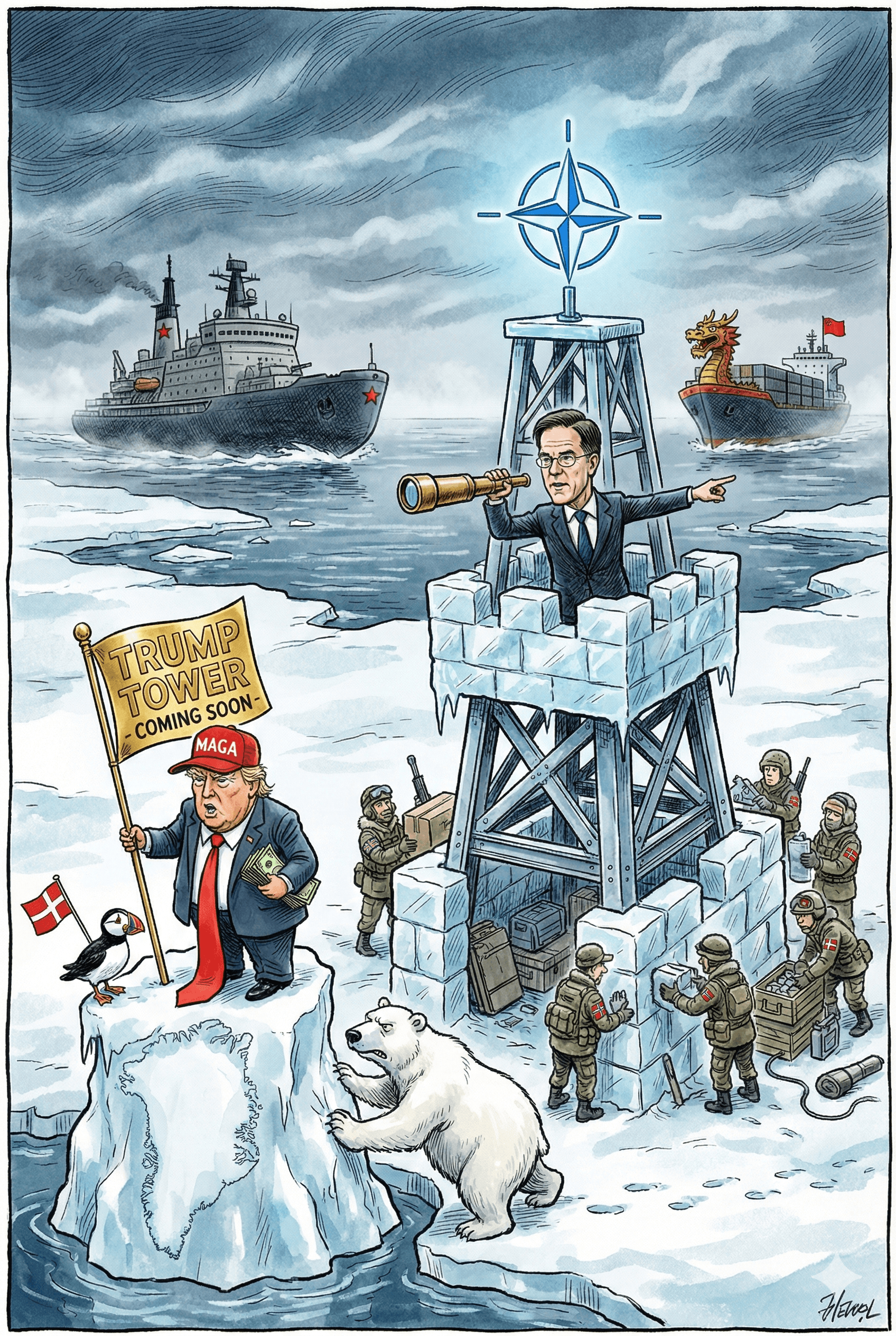
BRUSSELS — NATO officially launched its new "Arctic Sentry" mission on Wednesday, a sweeping initiative designed to unify allied military activities in the High North. The move comes as a critical diplomatic reset following months of strained relations between the United States and Denmark over the future of Greenland.
The initiative, formally activated by NATO Supreme Allied Commander Europe (SACEUR) General Alexus Grynkewich, marks a significant shift in the alliance’s strategy. For the first time, disparate national military exercises and surveillance operations across the Arctic will be coordinated under a single NATO banner, led by Joint Force Command Norfolk.
While the alliance frames the mission as a necessary response to increasing Russian and Chinese activity in the polar region, analysts view the launch as a vital political maneuver to heal internal fractures. Tensions had reached a boiling point earlier this year following renewed pressure from U.S. President Donald Trump regarding the status of Greenland.
A Strategic Pivot to the High North
"Arctic Sentry underscores the Alliance's commitment to safeguard its members and maintain stability in one of the world's most strategically significant and environmentally challenging areas," Gen. Grynkewich said in a statement released from Mons, Belgium.
The mission acts as an umbrella for major national exercises, including Denmark’s ongoing "Arctic Endurance" and Norway’s upcoming "Cold Response." By integrating these under NATO command, the alliance aims to close surveillance gaps in the Greenland-Iceland-UK (GIUK) gap and present a unified front against competitors.
NATO Secretary-General Mark Rutte, speaking at a press conference in Brussels, emphasized that the mission is about efficiency and collective security. "We will not only leverage all that we are doing, we will also see what gaps there are and we will fill them," Rutte said. "We do this because we have a clear sense that the Russians and the Chinese are becoming more active there."
The operational details include:
Centralized Command: All Nordic and Arctic operations will now report through JFC Norfolk in Virginia, the alliance’s bridge between North America and Europe.
Increased Troop Presence: The United Kingdom announced plans to double its troop deployment to Norway from 1,000 to 2,000 personnel over the next three years.
Enhanced Surveillance: Germany and France have committed naval and air assets to improve situational awareness in the polar seas, where melting ice is opening new potential trade and naval routes.
Easing Transatlantic Tensions
The launch of Arctic Sentry is widely interpreted as the direct result of a "diplomatic bargain" struck last month in Davos, Switzerland.
In January, the alliance faced one of its most severe internal crises in years after President Trump ramped up rhetoric regarding the acquisition of Greenland, a semi-autonomous territory within the Kingdom of Denmark. The dispute escalated when the White House threatened tariffs on European allies and did not rule out other measures to secure American interests on the island, citing threats from rival powers.
The standoff rattled European capitals, with Danish officials firmly rejecting any transfer of sovereignty. The impasse threatened to overshadow the alliance's focus on the eastern flank and support for Ukraine.
However, a pivotal meeting between President Trump and Secretary-General Rutte in Davos appears to have provided the off-ramp. Diplomatic sources indicate that Arctic Sentry was the compromise: a robust, NATO-branded commitment to Arctic security that addresses U.S. concerns about vulnerability in the High North without requiring a change in Greenland’s sovereignty.
"In many ways, this is burden-sharing in action," said a senior European diplomat speaking on condition of anonymity. "Arctic Sentry demonstrates that Europe is capable of securing the northern flank, effectively neutralizing the argument that the U.S. must take unilateral control of Greenland to ensure its safety."
Geopolitical Implications
The mission signals that the Arctic is no longer a peripheral concern for NATO but a central theater of operation.
Russia has steadily rebuilt its Soviet-era Arctic military infrastructure, refurbishing airfields and expanding its Northern Fleet capabilities. Simultaneously, China has declared itself a "near-Arctic state," showing growing interest in polar shipping routes and resource extraction.
"The Arctic is heating up, both climatically and geopolitically," notes Dr. Elena Ivy, a security analyst at the Center for European Policy Analysis. "With Sweden and Finland now fully integrated into NATO, the alliance has the geography to effectively check Russian expansion. Arctic Sentry is the operational software to match that geographic hardware."
For the residents of Nuuk and the wider Arctic region, the mission brings a mix of reassurance and wariness. While it solidifies the security guarantee under Article 5, it also promises an uptick in military traffic and exercises in an ecosystem already under pressure from climate change.
Outlook: A Fragile Unity?
As the first reports flow into JFC Norfolk, NATO leaders are hopeful that Arctic Sentry will serve as a stabilizing force. The immediate crisis over Greenland appears to have abated, replaced by a structured military framework that satisfies Washington’s demand for toughness while preserving Danish sovereignty.
However, the long-term success of the mission—and the durability of this diplomatic reset—remains to be seen. With the U.S. administration continuing to prioritize "America First" foreign policy, European allies know that their commitment to the High North must remain visible, tangible, and well-funded to prevent future disputes from emerging.
For now, the alliance has managed to turn a moment of potential fracture into a demonstration of collective resolve, keeping the peace in the north by preparing for conflict.
#NATO #ArcticSentry #Greenland #Geopolitics #DefenseNews #ArcticSecurity #USForeignPolicy #Denmark #MilitaryStrategy #HighNorth #AllianceStrong #GlobalSecurity