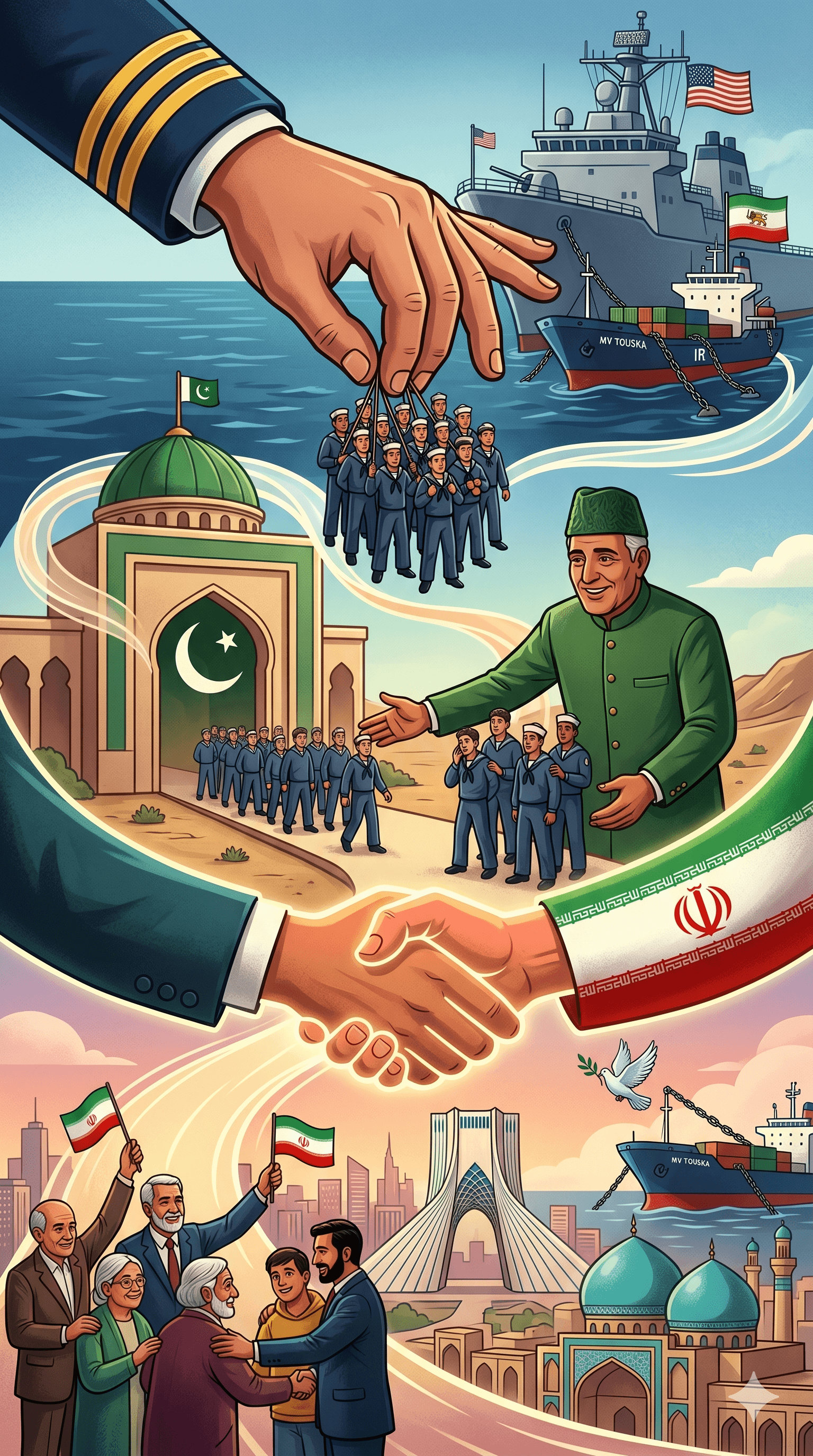
ISLAMABAD — In a significant development for Middle Eastern maritime security, the United States has transferred 22 crew members of a seized Iranian-flagged vessel to Pakistan. The move, described by officials in Islamabad as a "confidence-building measure" (CBM), marks a rare moment of diplomatic coordination amidst a period of intense regional friction and naval blockades.
The transfer of the sailors, who were aboard the container ship MV Touska, is being viewed by analysts as a calculated gesture by Washington to lower the temperature in the Gulf of Oman. As Pakistan continues its role as a primary mediator between the United States and Iran, this humanitarian handover could provide the necessary momentum for stalled peace negotiations in the region.
The Seizure of MV Touska: A Flashpoint in the Gulf
The saga of the MV Touska began on April 19, 2026, when the vessel was intercepted and boarded by US naval forces near the Iranian port of Chabahar. According to US Central Command (CENTCOM), the ship—owned by the Islamic Republic of Iran Shipping Lines (IRISL)—had repeatedly ignored warnings to stay clear of a US-imposed naval blockade on Iranian ports.
Captain Tim Hawkins, a spokesperson for CENTCOM, stated that the vessel was seized after a six-hour standoff during which the crew failed to comply with international maritime directives issued by the blockade task force. The IRISL has been a long-standing target of US sanctions, and the seizure was framed as an enforcement action to prevent the flow of sanctioned goods and military hardware.
Tehran initially condemned the boarding as an act of "piracy" and a violation of international law. However, following weeks of quiet diplomacy facilitated by Pakistani officials, the narrative has shifted from confrontation toward a structured repatriation process.
Pakistan’s Role as a Diplomatic Bridge
Pakistan’s Ministry of Foreign Affairs confirmed on Monday, May 4, 2026, that the 22 crew members had been flown to a military airbase in Pakistan on Sunday night. Following medical evaluations and processing, the sailors are scheduled to be handed over to Iranian authorities at a border crossing today.
"As a confidence-building measure by the United States of America, twenty-two crew members held aboard the seized Iranian container ship, MV Touska, have been evacuated to Pakistan," said Tahir Andrabi, a spokesperson for the Pakistani Foreign Office.
The facilitation of this transfer underscores Islamabad's growing influence as a neutral arbiter. With the "US-Israeli war on Iran" reaching a fragile ceasefire four weeks ago, Pakistan has emerged as the most viable venue for indirect communication between Washington and Tehran. The Pakistani government has also confirmed that the MV Touska itself will be moved to Pakistani territorial waters for "necessary repairs" before being returned to its original owners, further signaling a de-escalatory path.
Geopolitical Context: A Fragile Regional Ceasefire
The release of the MV Touska crew does not occur in a vacuum. The broader Middle East remains on a knife-edge following the military confrontations that began in February 2026. While large-scale kinetic operations have slowed, the naval theater remains the primary arena for "gray zone" warfare, where ship seizures and blockade enforcement are used as leverage in diplomatic bargaining.
For the United States, the decision to release the crew through a third party like Pakistan allows for a humanitarian gesture without appearing to compromise on its sanctions regime or blockade policy. For Iran, the return of its citizens is a domestic victory that allows the leadership to engage in further rounds of the "14-point proposal" for a permanent peace deal currently under review in Washington.
Economic analysts suggest that these small "trust exercises" are vital for stabilizing global energy markets. The Strait of Hormuz and the Gulf of Oman remain the world's most sensitive chokepoints; any reduction in naval hostility directly correlates to a stabilization of oil prices, which have seen extreme volatility throughout early 2026.
Maritime Security and Global Trade Implications
The seizure of commercial vessels like the MV Touska has raised alarm bells for global shipping companies. The use of naval blockades as a tool of modern warfare has forced a redirection of cargo routes, significantly increasing insurance premiums and shipping costs for Asian and European markets.
The decision to involve Pakistan in the repatriation of the crew and the repair of the vessel provides a blueprint for how future maritime disputes might be resolved without escalating into full-scale naval battles. By utilizing Pakistani ports and diplomatic channels, both the US and Iran are utilizing a "safety valve" to prevent accidental escalation.
However, the "confidence-building" nature of this move remains tested. While the crew is returning home, the core issues—ranging from Iran's nuclear program to the presence of US naval assets in the Persian Gulf—remain unresolved.
Economic Outlook and Energy Markets
Markets responded with cautious optimism to the news. Brent Crude, which had spiked following the April seizure of the Touska, saw a slight cooling as traders interpreted the crew transfer as a sign that neither side is looking for an immediate return to open hostilities.
For the Pakistani economy, acting as a regional hub for diplomacy and maritime repair provides both political prestige and a potential boost to its port services sector. If the MV Touska is successfully repaired and returned through Pakistani waters, it could cement the country’s role as the "Geneva of the East" for maritime conflict resolution.
Conclusion: A Step Toward Stability?
The repatriation of the 22 Iranian sailors is a small but essential gear in the complex machinery of Middle Eastern diplomacy. While it does not signal an end to the sanctions or the naval blockade, it demonstrates a willingness by the US and Iran to utilize professional, third-party channels to manage the human cost of their confrontation.
The next few weeks will be telling. If this CBM leads to a second round of high-level talks in Islamabad, the MV Touska incident may be remembered not as a seizure, but as the catalyst for a more robust diplomatic framework. For now, the sailors' return to Iran offers a rare moment of relief in a region that has seen little of it this year.
Impact and Outlook
The immediate impact is a reduction in naval tensions in the Gulf of Oman, likely preventing retaliatory seizures by Iranian forces in the short term. However, the long-term outlook remains dependent on the success of the broader peace proposals. Until a formal agreement is reached regarding the Strait of Hormuz, commercial shipping will likely continue to operate under high-risk protocols.