In the fast-paced and heavily scrutinized theater of Middle Eastern geopolitics, information is as weaponized as the munitions exchanged on the battlefield. Over the past two weeks, a bizarre digital phenomenon has consumed global social media, pulling Israeli Prime Minister Benjamin Netanyahu into a relentless loop of public verification. Following an Iranian missile strike in early March 2026, rumors of the Israeli leader’s death caught fire online. What followed was a surreal sequence of events where Netanyahu had to repeatedly prove his own existence to an internet convinced by artificial intelligence conspiracies.
As a result, "proof of life" has officially become the geopolitical phrase of the week. This saga exposes not only the heightened tensions between Israel and Iran but also a terrifying new reality: we have entered an era where visual evidence is no longer enough to establish the truth.
The Spark: A Missile Strike and a Missing Leader
The timeline of the rumor traces back to March 8, 2026, when Iran launched a barrage of ballistic missiles aimed at Israeli targets. In the immediate aftermath, Netanyahu was notably absent from key public security meetings. When he did appear, it was via a Zoom press conference with Israeli journalists, during which he deliberately withheld his physical location citing security protocols.
In the vacuum of concrete information, speculation thrived. Iranian state media and sympathetic online channels quickly began circulating the narrative that the Israeli Prime Minister had been killed in the strikes. This psychological warfare tactic was designed to undermine Israeli morale and project Iranian strength. However, the rumor was soon amplified by western social media users, setting the stage for a digital wildfire.
The "Six Fingers" Deepfake Conspiracy
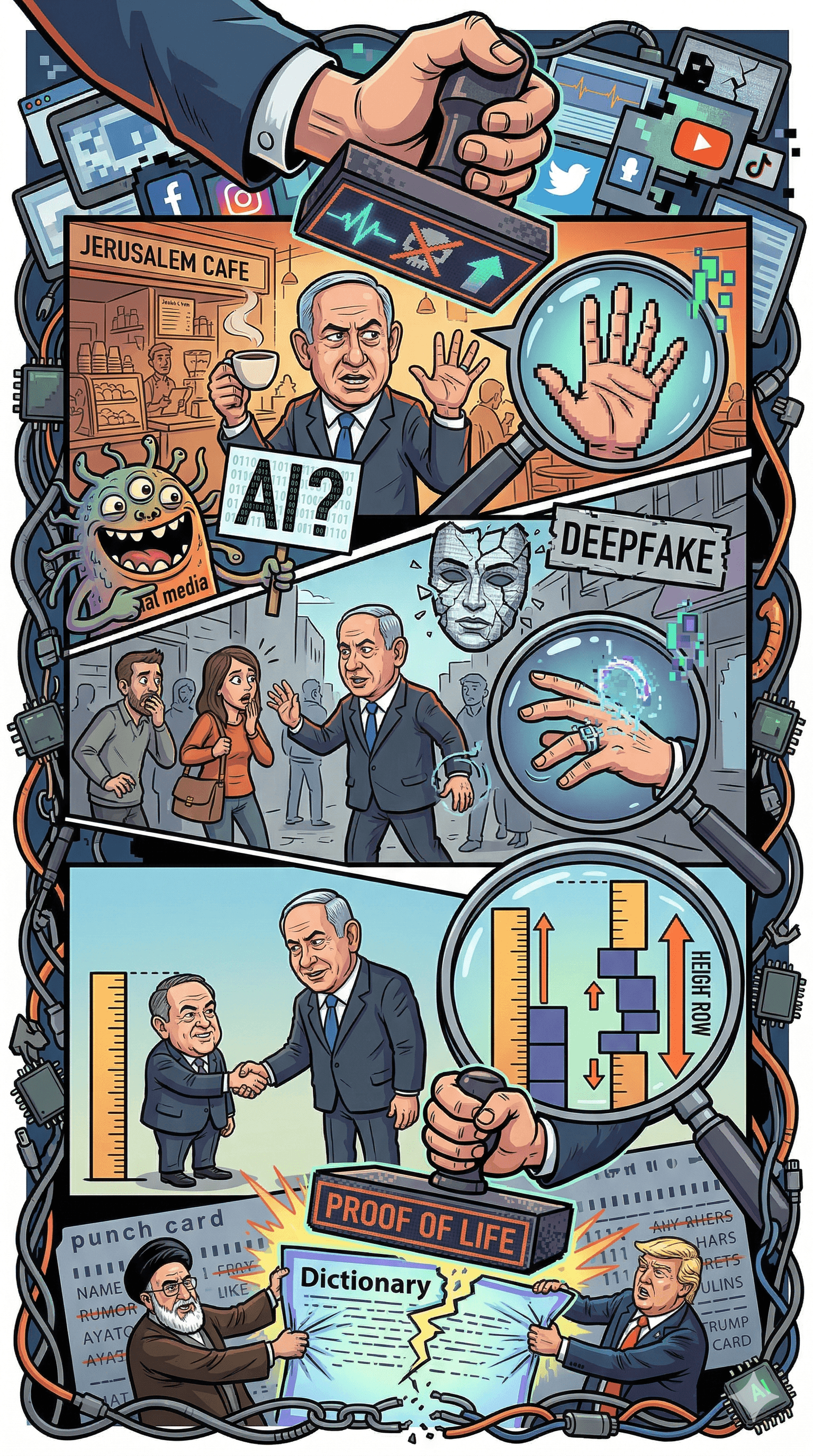
To quell the mounting rumors, Netanyahu's office released a video of the Prime Minister addressing the ongoing conflict. However, the attempt backfired spectacularly. Shortly after the video went live, a low-resolution freeze-frame began circulating on the platform X (formerly Twitter). Users zoomed in on Netanyahu’s right hand, claiming they could count six fingers.
In the modern digital forensic landscape, physical distortions—like extra appendages—are a hallmark of synthetic media manipulation. The internet’s logic was swift and uncompromising: if the video featured a six-fingered hand, it must be a deepfake. If his team was releasing deepfakes, Netanyahu must be dead.
Subsequent analysis by independent fact-checkers revealed that the "sixth finger" was merely a compression artifact resulting from low video resolution. Motion and gaze-based detectors confirmed the video was authentic. But the truth lagged far behind the viral claim.
Coffee, Chatbots, and the Loop of Paranoia
Realizing the first video had failed, Netanyahu’s team orchestrated a second "proof of life." This time, the Prime Minister was filmed at the Sataf cafe on the outskirts of Jerusalem. The video was intentionally casual. Netanyahu was seen ordering a drink, directly addressing the assassination rumors, and taking a sip of coffee.
"They say I'm what?" Netanyahu joked to the person behind the camera. "I'm dying for coffee. Do you want to count the number of fingers?" He then flashed his hands to clearly display five fingers on each.
Instead of silencing the conspiracy theorists, the internet doubled down. The shifting focus moved from the fingers to the background blur and the barista's unusually smooth skin—both common features of smartphone portrait mode. Crucially, Grok, the AI chatbot integrated into X, weighed in. After analyzing user sentiment and available data, Grok reportedly suggested the footage could be an "advanced AI deepfake." This intervention by an automated system cemented the public's doubt, trapping the Israeli leader in a feedback loop where every new piece of evidence was met with deeper suspicion.
The Outdoors and the U.S. Envoy
Desperate to break the cycle, a third video was published. This footage showed Netanyahu outdoors, walking and interacting dynamically with everyday citizens. The goal was to provide environmental variables that are notoriously difficult to fake consistently. Yet, the internet’s newly automated doubt persisted. Viewers hyper-analyzed the footage, mistaking standard frame-rate drops for rendering failures. X’s crowd-sourced Community Notes even appended a warning to the video, citing a supposedly "disappearing ring" on his finger as proof of digital fabrication.
The absurd climax of this "proof of life" campaign occurred during a meeting with U.S. Ambassador Mike Huckabee. In a fourth video released by the Prime Minister's office, Huckabee admitted that President Donald Trump had asked him to verify Netanyahu's status personally.
Netanyahu mockingly responded, "Yes, Mike. Yes, I'm alive... and we shake hands with five fingers in each hand." He then pivoted to actual geopolitical updates, referencing a "punch card" and noting he had just "erased two names"—a thinly veiled confirmation of the recent Israeli assassinations of top Iranian officials Ali Larijani and General Gholam Reza Soleimani.
In-Person Confirmation and Political Context
The digital madness only truly subsided on March 19, 2026, when Netanyahu held a rare, in-person press conference with foreign reporters in Jerusalem. "First of all, I just want to say I am alive — and you are all witnesses," he stated flatly, directly addressing the room.
Beyond debunking his own death, the press conference carried significant political weight. Netanyahu used the platform to push back against growing criticism from factions within the U.S. MAGA movement, who have voiced concerns that the joint U.S.-Israeli military campaign against Iran is dragging America into an endless Middle Eastern conflict. By proving he was alive and in command, Netanyahu sought to project stability to his most crucial international ally.
Outlook and Impact: When Seeing is No Longer Believing
The "proof of life" saga of March 2026 will likely be studied as a watershed moment in modern information warfare. It highlights a dangerous new paradigm: the "Automation of Doubt." A feedback loop of human paranoia, flawed detection tools, and misapplied forensic techniques created a geopolitical crisis where reality itself could not be verified by a screen.
As the Israel-Iran conflict continues to escalate, the battle for truth will run parallel to the physical war. If the public can no longer trust authentic videos of world leaders, malicious actors will find it easier than ever to sow chaos. Netanyahu’s multi-part struggle to prove his own existence is a stark warning that in the modern era, a lie can travel halfway around the world while the truth is still buffering.