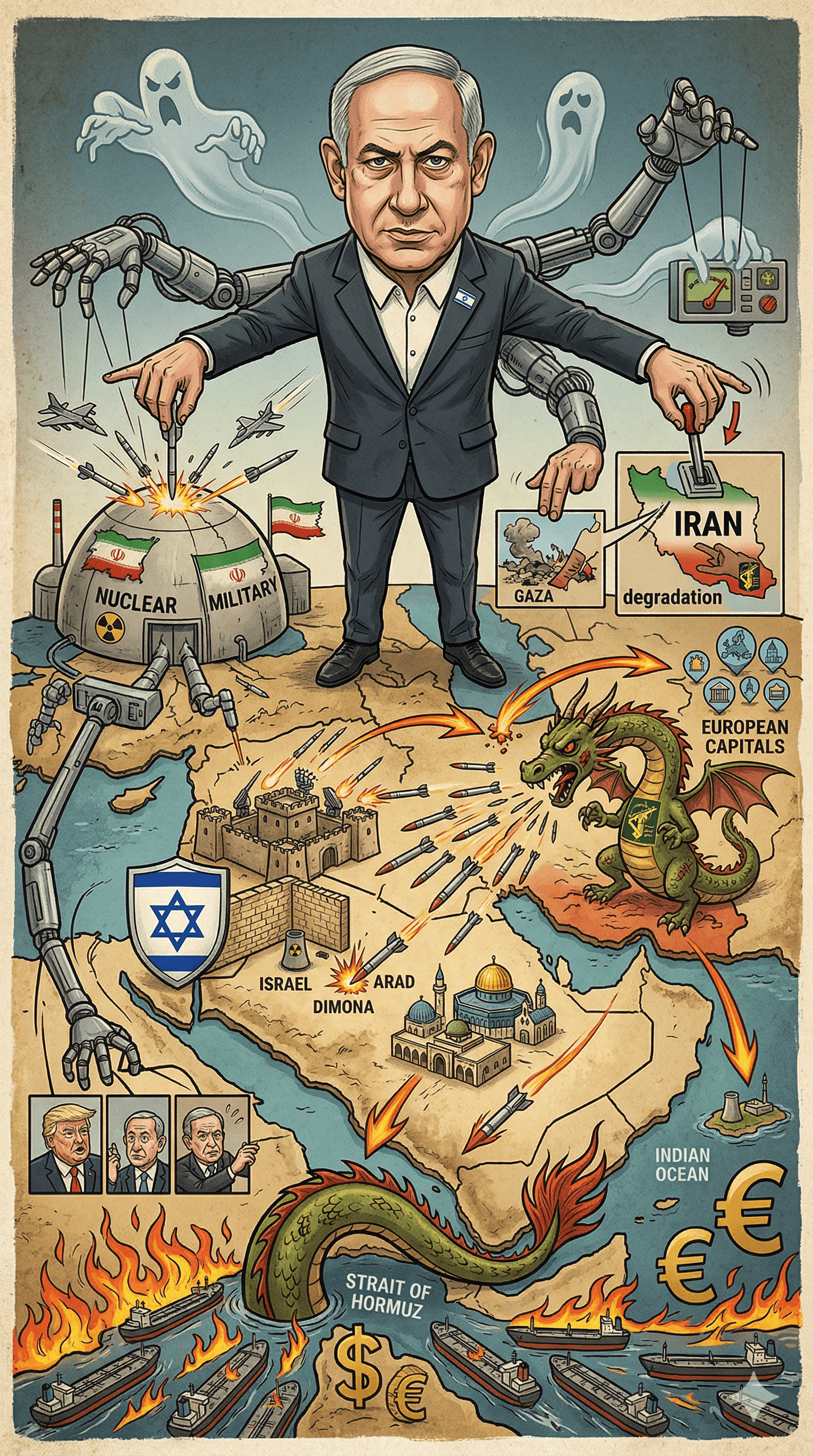
Jerusalem — As the 2026 Iran War enters its fourth week, Israeli Prime Minister Benjamin Netanyahu’s handling of the conflict is projecting a calculated strategy of strength and operational control. Following the initiation of joint US-Israeli military strikes on February 28, 2026, the geopolitical landscape of the Middle East has shifted dramatically.
In a sweeping national address on March 19, Netanyahu outlined the extent of Israel’s military achievements, asserting that Iran’s strategic capabilities have been systematically dismantled. By dictating the pace of the conflict, demonstrating the willingness to act unilaterally when necessary, and maintaining a tight—albeit occasionally tense—alliance with the United States, Netanyahu’s war strategy underscores a firm grip on both the battlefield and the broader geopolitical narrative.
Dismantling Iran’s Nuclear and Ballistic Missile Capabilities
The cornerstone of Netanyahu’s Iran war strategy has long been the neutralization of Tehran’s nuclear ambitions and its expansive ballistic missile program. According to the Prime Minister’s recent briefing, that decades-long objective is now being realized. Netanyahu confidently stated that Iran "no longer has the capacity to enrich uranium or manufacture ballistic missiles," pointing to the systemic destruction of critical infrastructure during the ongoing military campaign.
The joint US-Israeli offensive has reportedly targeted major uranium enrichment sites, including Fordow and Natanz, as well as factories producing missile components. US Defense Secretary Pete Hegseth recently corroborated these assessments, noting in reports that the strikes have "functionally defeated" Iran's ballistic missile production. Netanyahu emphasized that without this decisive intervention, Iran was mere months away from moving its nuclear and missile assets into impenetrable underground bunkers. By executing these pre-emptive and sustained strikes, Netanyahu has demonstrated a strategy of overwhelming strength, neutralizing the immediate threat and degrading the Iranian military apparatus to what he described as its "weakest point."
The South Pars Strike: Unilateral Action and the US Alliance
A key indicator of Netanyahu's control over the conflict's trajectory is his willingness to take calculated risks, even if they momentarily diverge from Washington's preferences. This dynamic was vividly illustrated by Israel’s unilateral strike on Iran’s South Pars gas field—a critical node in the country’s energy network.
The attack initially triggered concerns in the Gulf and prompted retaliatory Iranian strikes on regional energy infrastructure. US President Donald Trump publicly revealed that the United States "knew nothing" about the South Pars strike in advance and urged Netanyahu to hold off on further attacks targeting energy infrastructure to prevent severe global economic fallout.
Rather than appearing fractured, Netanyahu used the episode to project autonomy and control. He openly acknowledged that Israel "acted alone" in the South Pars strike, reinforcing Israel's sovereign right to defend its interests. However, he quickly demonstrated strategic restraint by confirming that Israel would honor Trump’s request to pause further attacks on energy sites. This delicate balancing act—flexing independent military strength while ultimately preserving the "exceptionally close" coordination with the White House—highlights Netanyahu’s ability to manage complex alliance dynamics without compromising Israel's core security objectives.
Calming Markets and Setting the Timeline
One of the most significant challenges of the 2026 Iran War has been its global economic impact. The conflict has disrupted supply chains, with Iran restricting tanker movements through the vital Strait of Hormuz, leading to spikes in global oil and gas prices. An uncontrolled escalation could plunge the global economy into a severe energy crisis.
However, Netanyahu’s strategy appears heavily focused on controlling the war's timeline and mitigating long-term economic damage. During his March 19 address, he surprised many analysts by predicting that the conflict may end "a lot faster than people think." This statement, coupled with Israel's efforts to help reopen the Strait of Hormuz, immediately shifted market sentiment and offered relief to global oil prices. By projecting that the military objectives are nearly complete and signaling an end in sight, Netanyahu has exerted control over not just the military theater, but the global economic anxieties tied to the war.
Domestic Politics and Strategic Motivations
Netanyahu’s approach to the Iran conflict cannot be fully decoupled from his domestic political reality in Israel. Since the Hamas-led attacks of October 7, 2023, the Prime Minister has faced immense domestic pressure and scrutiny. The long, grueling wars on multiple fronts took a toll on his public standing.
For Netanyahu, the direct confrontation with Iran presents an opportunity to rehabilitate his image and solidify his political legacy. By taking decisive action to eliminate what Israelis broadly view as an existential threat, he is leaning into a narrative of uncompromising strength. While early polling suggests that the Israeli public remains divided on broader goals like Iranian regime change, there is overwhelming consensus and support for the destruction of Iran's nuclear and missile threats. Netanyahu is leveraging this consensus to project steadfast leadership during a period of unprecedented regional volatility.
Outlook and Regional Impact
Looking ahead, Netanyahu’s Iran war strategy has fundamentally altered the balance of power in the Middle East. If his military assessments hold true, Iran emerges from this conflict severely weakened, stripped of the military industries it spent decades building, and isolated on the world stage. While the total collapse of the Iranian regime remains uncertain—Netanyahu himself noted that Israel is "working to create the conditions for it to collapse, but it may survive"—the immediate existential threat to Israel has been dramatically curtailed.
As the military campaign transitions toward its next phases, the international community will be closely watching how Israel and the United States manage the geopolitical fallout. However, for the time being, Benjamin Netanyahu’s execution of the 2026 Iran War stands as a stark demonstration of military strength, strategic autonomy, and tight control over one of the most consequential geopolitical conflicts of the 21st century.