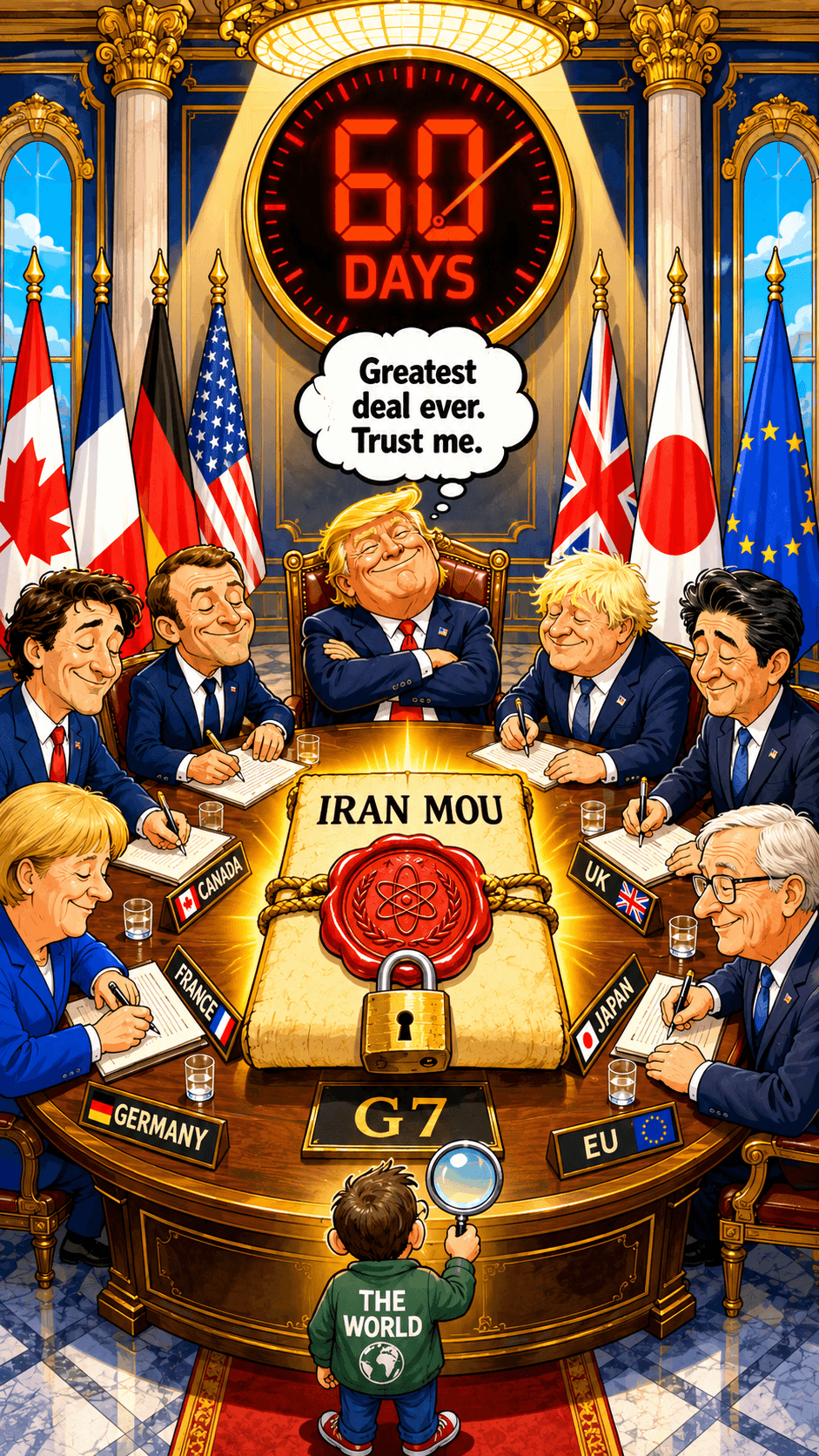
Trump's Iran Deal: A 60-Day Clock, a Sealed Envelope, and a World Holding Its Breath
In what may be one of the most consequential — and most opaque — diplomatic moments of the decade, the United States and Iran have signed a Memorandum of Understanding to end 15 weeks of active warfare. But as of June 17, 2026, the world has still not seen the full text of the agreement. Presidents, prime ministers, and G7 leaders have endorsed a deal whose details remain locked behind diplomatic protocol. And the clock is already ticking.
Background: From Ultimatum to MOU
The road to this agreement began in early April 2026, when President Donald Trump issued a stark ultimatum to Tehran: reopen the Strait of Hormuz — through which roughly 20% of global oil passes — or face the full force of US military action. Hours before a threatened 8 PM bombing campaign, a ceasefire was brokered with Pakistani Prime Minister Shehbaz Sharif and Field Marshal Asim Munir credited as key intermediaries. Iran's Foreign Minister Abbas Araghchi confirmed the terms: halt attacks on Iran, and Tehran would coordinate safe passage through the Strait.
That two-week ceasefire has since been extended through weeks of intensive back-channel diplomacy. On June 15, 2026, Trump arrived in Évian-les-Bains, France, for the G7 summit and announced that "the deal's all signed" — a 60-day Memorandum of Understanding, digitally signed by both Trump and Vice President JD Vance on behalf of Washington.
What We Know About the Deal
According to senior US administration officials and partial disclosures, the MOU contains several key pillars. First, a 60-day ceasefire across all active fronts, with the Strait of Hormuz to remain toll-free for all maritime traffic during this window. Second, Iran is expected to assist in clearing sea mines and begin negotiations over its enriched uranium stockpiles — though Trump has firmly denied reports that the US would pay Iran $300 million as part of any arrangement. Vice President Vance, however, acknowledged that Iran could gain access to a $300 billion reconstruction fund contingent on compliance with deal terms.
Third, a Lebanon ceasefire is referenced within the agreement. Iranian officials stated this as a condition. Israel's defense minister responded that Israeli forces have no plans to withdraw from southern Lebanon, and a senior US official confirmed that Israeli withdrawal was "not a condition of the deal." The MOU stipulates that if Iran cannot restrain Hezbollah and attacks on Israel resume, Israel retains the right to self-defense.
The formal signing ceremony is expected to take place in Geneva, Switzerland, on Friday, June 20, with the full text to be released publicly shortly afterward.
Global Reaction
Markets responded swiftly and positively. The S&P 500 rose 1.9% on the announcement, and oil prices dropped nearly 5% — a sign that financial markets had priced in worst-case scenarios for weeks. The G7 leaders issued a joint declaration calling the deal a "historic opportunity to prevent Iran from acquiring any nuclear weapon and tackling threats related to its regional and ballistic activities." They also voiced readiness to contribute to the deal's implementation and called for a "robust and comprehensive diplomatic follow-on agreement."
In Israel, the reaction has been far more guarded. Prime Minister Benjamin Netanyahu, who held his first meeting with newly appointed Mossad chief Roman Gofman on the same day as Trump's G7 press conference, has not publicly endorsed the MOU. Likud, his political party, reportedly scrapped a campaign emphasizing Netanyahu's close ties to Trump — a visible signal of the friction between Jerusalem and Washington over the Iran framework.
Trump, for his part, was unambiguous in his defense of the deal. Speaking at his closing G7 press conference, he argued that continued bombing would have caused an "economic catastrophe," adding that critics who oppose the deal are "the tough guys that would drive the country right down the tubes."
What Remains Unresolved
Despite the optimism surrounding the announcement, critical questions remain. The full terms of the MOU are still undisclosed. Iran's nuclear enrichment program, which was significantly damaged during US strikes, will require complex negotiations around verification, stockpile removal, and long-term monitoring. The Lebanon front remains a flashpoint. And with only a 60-day window before terms expire, the pressure on diplomats to forge a permanent agreement is immense.
Iran's Supreme National Security Council has described the deal as the product of "a difficult and intensive period of negotiations lasting several months," framing it as a victory on Iranian terms. Washington sees it differently. The gap in narratives — combined with the mystery of the still-unreleased text — means this story is far from over.
Outlook
The Geneva signing on Friday will be the next pivotal moment. If the text holds few surprises, markets and allies will stabilize. If it reveals concessions that either side finds unacceptable, the 60-day clock could collapse. For now, the world is operating on trust — and the word of a president who says the deal is the best thing that's ever happened, and a regime that says it never lost.