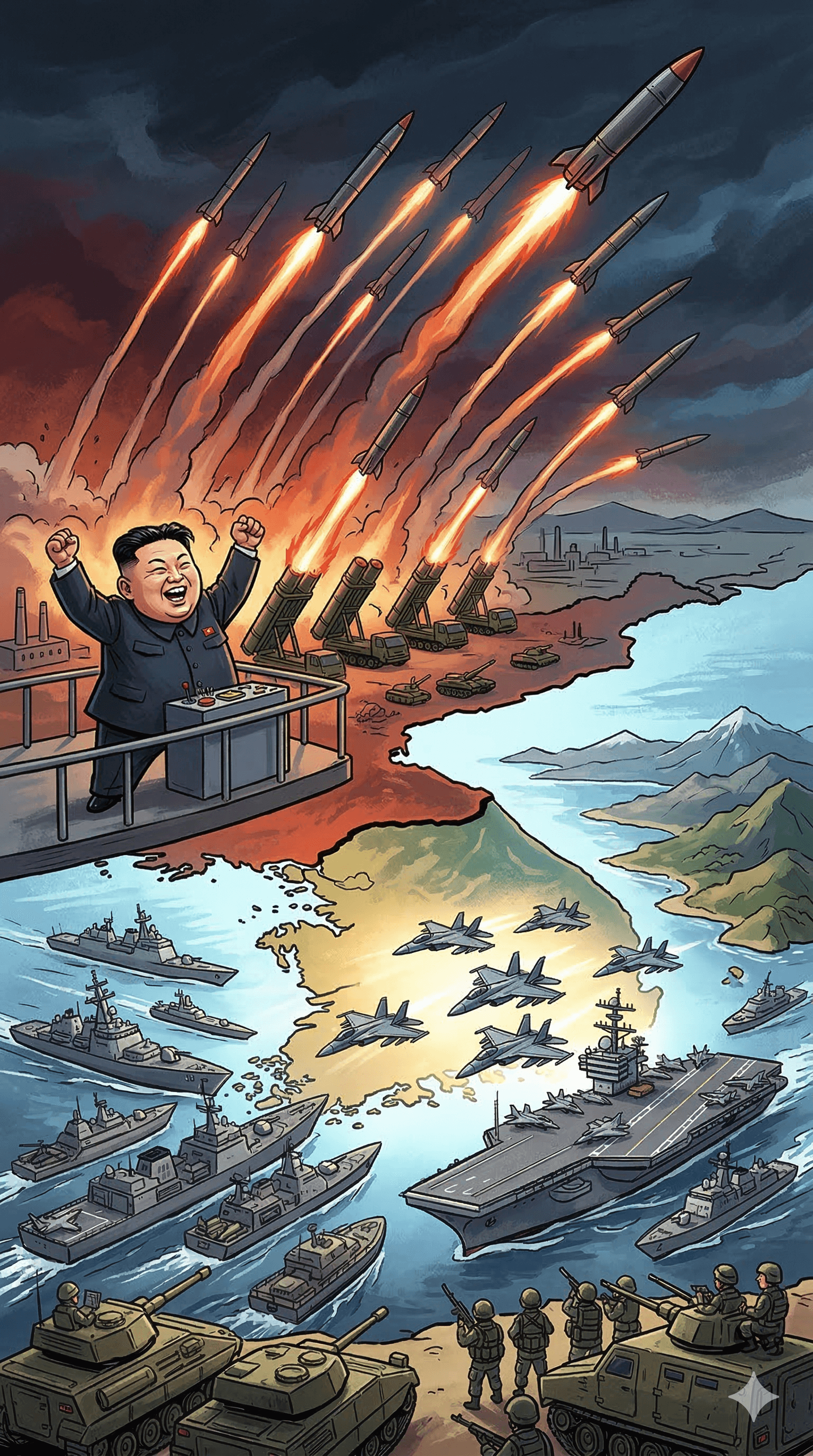
In a dramatic and highly calculated show of force, North Korea launched a barrage of approximately 10 short-range ballistic missiles toward the Sea of Japan (East Sea) on Saturday. The aggressive military demonstration coincides with the ongoing joint US-South Korea military exercises and arrives at a moment of intense global geopolitical vulnerability, as the United States navigates an escalating conflict in the Middle East.
The simultaneous launch of multiple ballistic missiles highlights a growing tactical shift in Pyongyang’s military strategy, raising immediate alarms in Seoul, Tokyo, and Washington as global security dynamics become increasingly strained.
Breaking Down the Missile Launch: From Sunan to the Sea of Japan
According to South Korea’s Joint Chiefs of Staff (JCS), the salvo of ballistic missiles was fired at approximately 1:20 p.m. local time on Saturday. The launch originated from the Sunan area, located near the international airport in the North Korean capital of Pyongyang.
Military radar tracked the projectiles as they flew approximately 350 kilometers (220 miles) before splashing down into the sea. Japanese Defense Minister Shinjiro Koizumi confirmed that the weapons landed safely outside of Japan’s Exclusive Economic Zone (EEZ), and no damage to maritime vessels or aircraft was reported.
In an immediate response to the provocation, the South Korean military elevated its alert status. "Our military is fully prepared and is sharing information related to North Korean ballistic missiles in real-time with the United States and Japan," the JCS noted in a statement. Additional intelligence assets have been deployed to closely monitor Pyongyang for any subsequent launches.
'Freedom Shield' Drills: The Catalyst for Pyongyang’s Retaliation
The timing of the North Korean missile launch is intrinsically linked to the 11-day "Freedom Shield" military exercises currently being conducted by the United States and South Korea. Set to run through March 19, Freedom Shield is a massive, largely computer-simulated command post exercise designed to test the joint operational capabilities of the allied forces against evolving security threats.
The simulated drills are accompanied by "Warrior Shield," an extensive field training program. Just hours before the missile launches, hundreds of US and South Korean troops conducted a joint river-crossing exercise on the Imjin River, utilizing armored combat vehicles and tanks under the supervision of combined forces commanders.
North Korea has historically condemned these annual joint military drills, labeling them as "dress rehearsals" for an unprovoked invasion. This year, the rhetoric has been exceptionally fierce. Earlier in the week, Kim Yo Jong, the powerful sister of North Korean leader Kim Jong Un, issued a stark warning. She criticized Washington and Seoul for proceeding with the drills at a perilous moment for global security, cautioning that any challenge to North Korea’s sovereignty would result in "terrible consequences."
The Geopolitical Shadow: The Middle East Conflict and Defense Speculations
Analysts suggest that Saturday’s 10-missile barrage is not just a protest against local military drills, but a calculated move exploiting the current global security landscape. The Donald Trump administration is currently engaged in an escalating war in the Middle East against Iran and its allied "Axis of Resistance."
Without directly naming the Middle East conflict, Kim Yo Jong recently pointed out that the global security structure is "collapsing rapidly," leading to wars breaking out across different regions. Concurrently, North Korea’s Foreign Ministry has issued statements condemning joint US-Israeli military actions and explicitly expressing support for Tehran’s new Supreme Leader, Mojtaba Khamenei.
This dual-theater dynamic has sparked deep anxieties within South Korea. Local media, citing security camera footage, recently speculated that the United States might be actively relocating vital missile defense assets—such as Patriot batteries and Terminal High Altitude Area Defense (THAAD) interceptors—from the Korean Peninsula to the Middle East to counter Iranian threats.
When questioned about these potential security gaps, South Korean President Lee Jae Myung’s office declined to confirm specifics regarding US military operations. However, the office firmly stated that any potential relocation of US assets would not compromise the allies' robust defense posture against a nuclear-armed North Korea, pointing to South Korea's formidable conventional military strength as a deterrent. By launching 10 missiles simultaneously, military analysts suspect Kim Jong Un is testing his "saturation strike" capabilities, aiming to prove that North Korea can overwhelm any remaining air defense umbrellas.
Dashed Hopes for Renewed Diplomacy
The ballistic missile launches have cast a heavy shadow over recent, fragile attempts to reopen diplomatic channels. Just hours before the missiles were fired, South Korean Prime Minister Kim Min-seok—Seoul’s second-highest official—met with US President Donald Trump in Washington. Following the meeting, Kim expressed optimism regarding the potential for renewed diplomacy between Washington and Pyongyang.
President Lee Jae Myung has made improved inter-Korean relations a cornerstone of his administration, and top officials had hoped that Trump's upcoming diplomatic trips might create an opening for dialogue with Kim Jong Un. However, Saturday's defiant show of force appears to have firmly shut that window.
Pyongyang has spent the last several months hardening its stance against Seoul and has repeatedly demanded that Washington drop its insistence on denuclearization as a precondition for any future summits. Since the high-profile collapse of the 2019 Hanoi summit during Trump’s first term, North Korea has aggressively expanded its ballistic and nuclear programs, facing multiple UN Security Council sanctions while rejecting all calls for disarmament.
Regional Impact and Future Outlook
The immediate aftermath of the missile tests has left the Indo-Pacific region on high alert. The US Indo-Pacific Command swiftly condemned the launches, reiterating that North Korea’s illicit weapons programs have a severely destabilizing impact on the region.
As the "Freedom Shield" exercises continue into the coming week, global observers are bracing for potential secondary provocations. With the United States actively managing a hot war in the Middle East, North Korea's aggressive posturing serves as a stark reminder that the threat of a multi-front global security crisis is an escalating reality.
#News #Geopolitics #NorthKorea #SouthKorea #BallisticMissiles #FreedomShield #KimJongUn #USMilitary #GlobalSecurity #IndoPacific #ForeignPolicy #DefenseNews