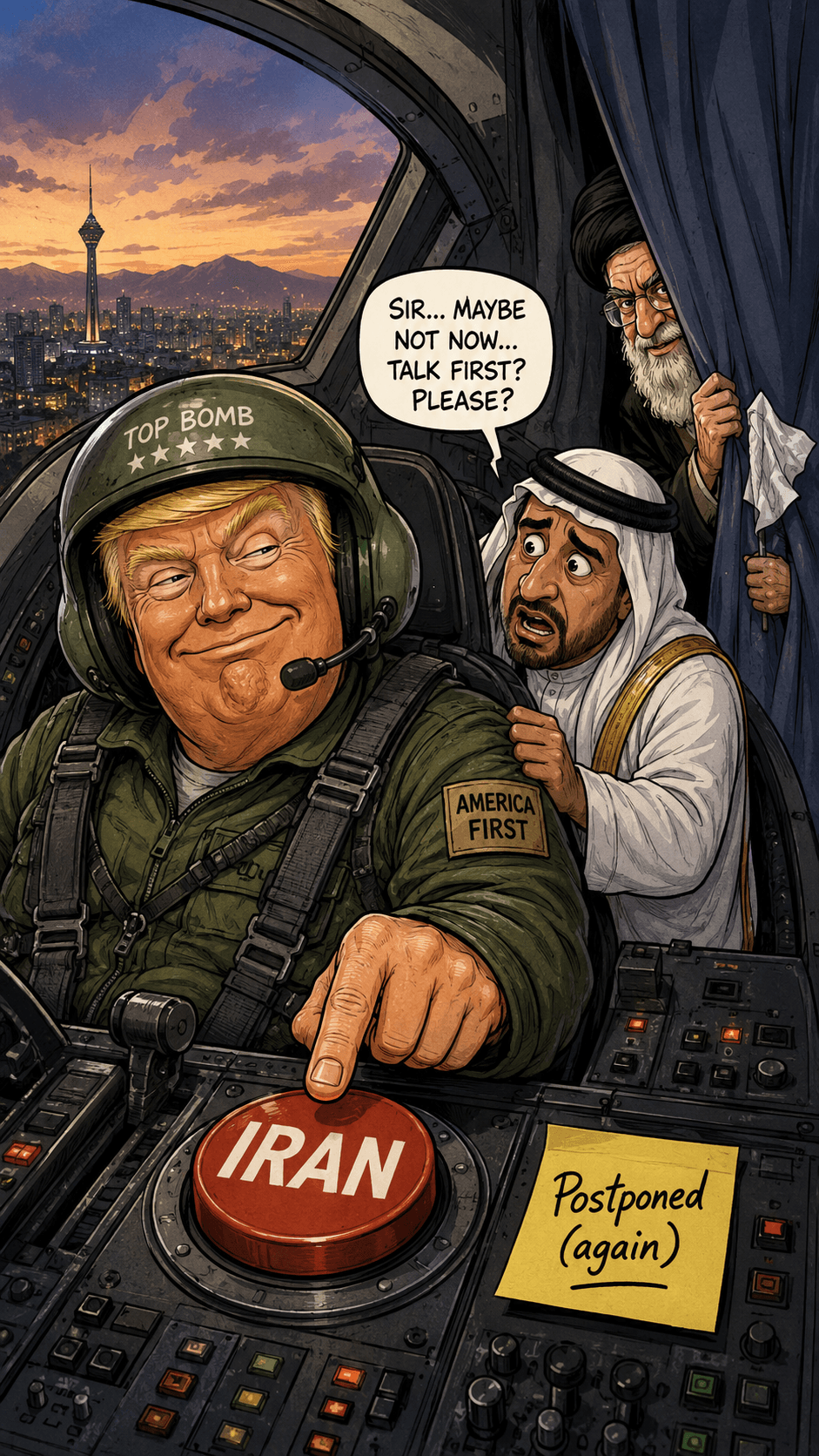
The most powerful military force in human history — 11 aircraft carrier strike groups, 800 overseas bases, a defence budget larger than the next ten countries combined — paused a war because its smaller allies said "please."
That is not a joke. That is the situation in the Middle East right now.
President Trump, who had reportedly authorised a strike package against Iranian military infrastructure, pulled back at the eleventh hour after Gulf states — led by Saudi Arabia and the UAE — privately urged restraint. The message from Riyadh and Abu Dhabi was clear: a direct American attack on Iran would set the entire neighbourhood on fire, and they would be the ones breathing the smoke.
So Trump blinked. And called it diplomacy.
How We Got Here
The US-Iran conflict, now entering its third month, began with the kind of escalation that Washington hawks had been dreaming about for decades. Iranian aggression in the Strait of Hormuz — drone attacks on commercial shipping, threats to close the waterway entirely — gave the Trump administration a pretext that was difficult to argue against.
Oil crossed $100 a barrel. Tanker traffic through the Strait ground to a near-standstill. The global economy, still fragile from years of inflation and trade wars, held its breath.
Washington launched what it called Operation Project Freedom — a naval buildup in the region accompanied by crippling sanctions and a blockade of Iranian ports. Tehran responded with defiance, as it always does publicly, while its diplomats quietly explored off-ramps through Pakistani and Omani intermediaries.
For weeks, the two sides have been locked in the geopolitical equivalent of a staring contest — neither willing to blink first, both aware that full-scale war would be catastrophic.
Then Trump blinked. Voluntarily, he insists.
The Gulf's Invisible Veto
What this episode reveals is something that rarely gets discussed openly in Western foreign policy circles: the Gulf states have acquired enormous leverage over American decision-making.
It is easy to see why. Saudi Arabia and the UAE are not simply American allies — they are customers, investors, and energy suppliers rolled into one. Saudi Aramco moves global oil prices. The UAE hosts critical American military infrastructure. Both countries have sovereign wealth funds with tentacles deep inside Western financial markets.
When Riyadh and Abu Dhabi call Washington, Washington picks up.
Their concern about a US strike on Iran is not sentimental. It is strategic and self-interested. A retaliatory Iranian missile barrage would not land in Washington. It would land in Riyadh, Dubai, and Doha. Iranian proxy forces across Yemen, Iraq, Lebanon, and Syria would activate simultaneously. The Gulf states would be fighting a multi-front war on their own soil while American aircraft carriers watched from a safe distance.
They want Iran weakened. They do not want to be collateral damage in the process.
Iran's Calculated Defiance
On the other side of the Strait, Tehran is doing what it has always done best: projecting strength while manoeuvring for survival.
Iran's leaders know they cannot win a conventional war against the United States. They have known this for forty years. What they have mastered is the art of asymmetric pressure — making any military confrontation so expensive, so messy, and so geographically destabilising that Washington perpetually hesitates.
The strategy is working again. Reports now suggest that American and Iranian negotiators are quietly closing in on a one-page memorandum — a framework to end hostilities and begin talks on Tehran's nuclear programme. A one-page deal. For a war that sent oil to $100 a barrel and brought French aircraft carriers to the Red Sea.
Iran's supreme leadership, publicly projecting defiance and rejecting what they call American pressure, is almost certainly aware of every word of those negotiations. The white flag is hidden. But it is there.
What This Tells Us About Power
The real lesson of this episode is not about Iran or Trump or even the Gulf states. It is about the nature of power in the modern world.
Raw military superiority no longer translates directly into political outcomes. The United States can destroy Iran's military infrastructure in 72 hours. It cannot control what happens in the 73rd hour, or the week after, or the decade that follows. It learned this in Iraq. It learned this in Afghanistan. It is relearning it now in the Persian Gulf.
And so the most powerful nation on earth sits in the cockpit, finger hovering over the button, waiting for permission from a sheikh in a white thobe.
The sticky note on the dashboard says: Postponed (again).