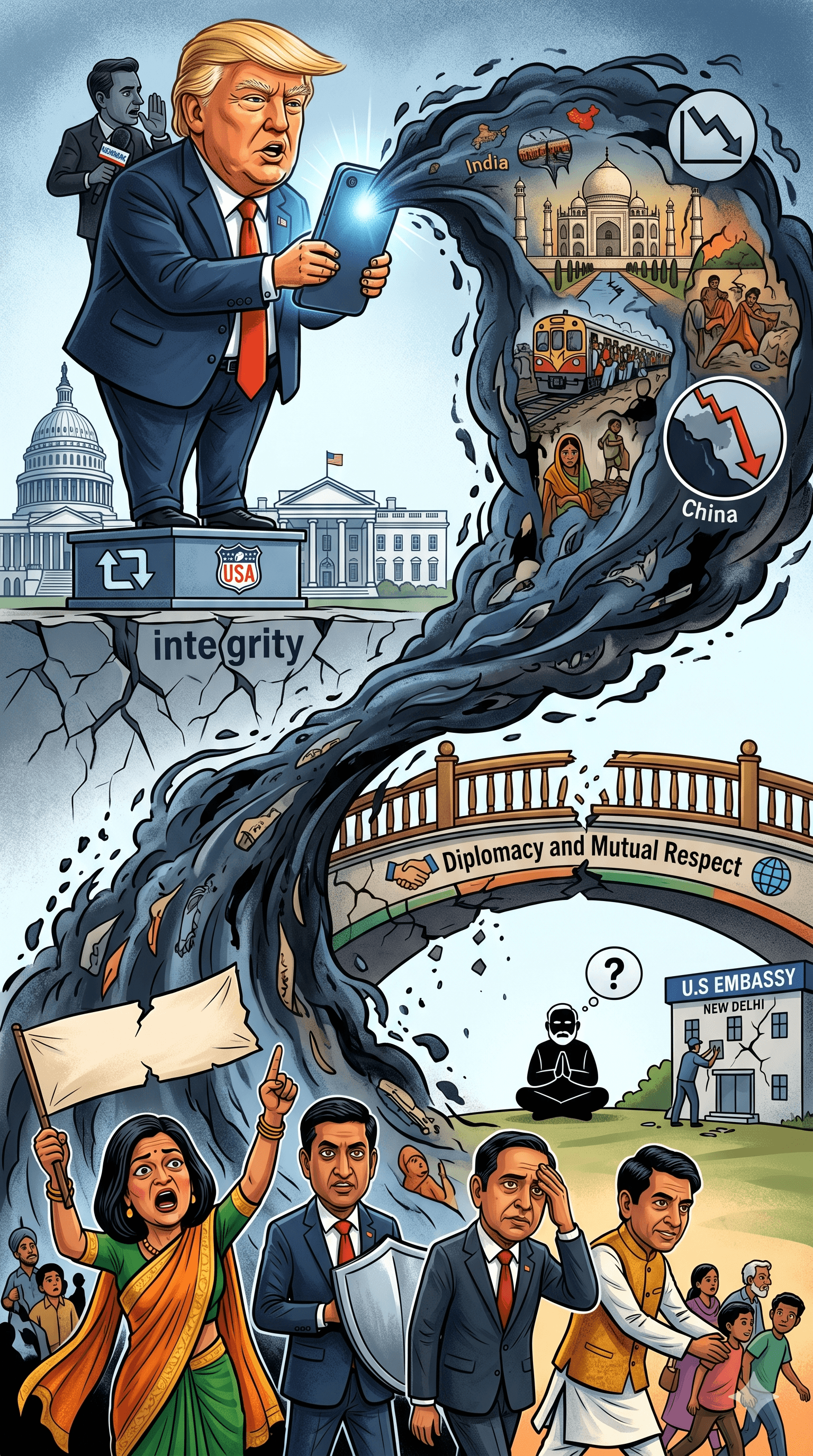
WASHINGTON, D.C. — In a week already marked by heightened diplomatic tensions and legal battles over constitutional rights, a social media post by President Donald Trump has ignited a firestorm of criticism from Indian-American lawmakers and New Delhi officials. On Thursday, April 23, 2026, the President reshared a controversial commentary that described India and China as “hellholes” and attacked the legal framework of birthright citizenship in the United States.
The backlash was swift and severe, led by prominent members of the "Samosa Caucus" in Congress, who characterized the President’s actions as a betrayal of American values and a direct insult to one of Washington’s most critical strategic partners.
The Repost That Sparked a Diplomatic Row
The controversy began when President Trump used his Truth Social platform to amplify a transcript and video from Michael Savage, a veteran conservative radio host and author of The Savage Nation. In the clip, Savage delivered a scathing critique of birthright citizenship, a policy currently under intense scrutiny following an executive order signed by Trump in January 2025.
Savage’s remarks, which the President shared without additional commentary, targeted immigrants from Asia in derogatory terms. “A baby here becomes an instant citizen, and then they bring the entire family in from China or India or some other hellhole on the planet,” Savage claimed in the footage. He went further, describing Indian and Chinese immigrants as “gangsters with laptops” and alleging that “English is not spoken here anymore,” while questioning the loyalty of the modern immigrant class.
The repost appeared just as the U.S. Supreme Court began hearing arguments regarding the 14th Amendment and the President’s attempts to curb automatic citizenship for children born on U.S. soil to non-citizen parents.
Indian-American Lawmakers React with Fury
Representative Ami Bera (D-CA), the longest-serving Indian-American in Congress, issued a blistering statement that echoed across the political landscape. Bera, a physician and the son of Indian immigrants, labeled the President’s choice to amplify such rhetoric as “offensive, ignorant, and beneath the dignity of the office he holds.”
“As the son of immigrants from India, I take great pride in both my heritage and in the country that gave my family the opportunity to build a better life,” Bera stated. “The comments shared by President Trump reflect a fundamental misunderstanding of who we are as a nation. America has always been strengthened by generations of immigrants who work hard and contribute to our country. They do not weaken America—they strengthen it.”
Congressman Raja Krishnamoorthi (D-IL) joined the condemnation, describing the post as a “racist rant” that undermines the very foundation of the U.S.-India partnership. “Donald Trump’s decision to amplify a racist rant attacking India and immigrants is disgraceful,” Krishnamoorthi posted on X (formerly Twitter). “His rhetoric doesn’t just insult millions of Indian Americans and one of our most important global partners—it undermines the values that have made America a nation of opportunity and innovation.”
Other members of the Indian-American legislative community, including Representatives Ro Khanna, Pramila Jayapal, and Shri Thanedar, also weighed in, with many calling for an immediate apology and the deletion of the post.
New Delhi Hits Back: ‘Uninformed and In Poor Taste’
The fallout was not limited to the halls of the U.S. Capitol. In New Delhi, the Ministry of External Affairs (MEA) broke its usual diplomatic reserve to address the President’s social media activity.
During a weekly press briefing on Friday, April 24, MEA Spokesperson Randhir Jaiswal stated that India had "seen the reports" and characterized the remarks as "obviously uninformed, inappropriate, and in poor taste." Jaiswal emphasized that such comments "certainly do not reflect the reality of the India-US relationship, which has long been based on mutual respect and shared interests."
The timing of the incident is particularly sensitive for the Modi government. India and the United States are currently engaged in high-stakes negotiations to finalize a major bilateral trade agreement. A team of 12 Indian officials is presently in Washington, and observers suggest that the "hellhole" rhetoric could complicate the final execution of the deal, especially following recent U.S. Supreme Court rulings that dismantled previous tariff structures.
Damage Control at the U.S. Embassy
Recognizing the potential for a long-term rift, the U.S. Embassy in New Delhi moved quickly to mitigate the damage. In a statement issued on Thursday evening, an embassy spokesperson attempted to separate the President’s social media reposts from his official stance on India.
The spokesperson quoted President Trump as previously saying, “India is a great country with a very good friend of mine at the top,” referring to Prime Minister Narendra Modi. The embassy sought to highlight Trump’s past praise for Modi during a 40-minute phone call earlier this month regarding the ongoing Iran war, where Trump described the Indian leader as "doing great."
However, critics in India’s opposition parties, including Congress chief Mallikarjun Kharge and leader Supriya Shrinate, used the incident to attack Prime Minister Modi’s "friendship" with Trump, calling the Prime Minister "weak" for not more forcefully demanding a retraction.
A Perfect Storm: Legal and Geopolitical Context
The "hellhole" controversy did not occur in a vacuum. President Trump’s approval ratings have reportedly hovered in the mid-30s amid public dissatisfaction with the economy and the administration's handling of the Iran conflict. With midterm elections approaching, analysts suggest the President is leaning into hardline anti-immigration rhetoric to solidify his base.
Central to this strategy is the challenge to birthright citizenship. In early 2025, Trump signed an executive order to stop automatically granting citizenship to those born in the U.S. under specific scenarios. The legal battle has now reached the Supreme Court, where Chief Justice John Roberts and Justice Elena Kagan have expressed skepticism over the administration’s legal reasoning. Michael Savage’s comments, amplified by Trump, were a direct reaction to these court proceedings, framing the legal debate as a struggle over national identity and "public opinion."
Outlook: Strained Ties and Domestic Division
The immediate impact of the "hellhole" repost is a palpable cooling of the personal rapport between the White House and the Prime Minister’s Office in New Delhi. While the strategic necessity of the U.S.-India partnership—particularly concerning regional security in Asia—remains intact, the rhetoric has provided significant ammunition to political opponents in both nations.
As the Supreme Court prepares to issue its ruling on birthright citizenship by early summer, and as trade talks continue in Washington, the "hellhole" remark serves as a stark reminder of the volatility inherent in modern digital diplomacy. For Indian Americans, the incident has reignited fears of rising xenophobia, with the Hindu American Foundation (HAF) urging the President to delete the post to prevent further stoking of hatred.
Whether this row will lead to a permanent shift in policy or remain a temporary diplomatic hurdle depends on the administration's next steps and the outcome of the looming midterm elections.